

By YAN Fusheng
By bridging computational design with in planta directed evolution, scientists at the Institute of Genetics and Developmental Biology have harnessed the power of generative artificial intelligence to design customized, programmable immunity for plants—giving crops a diversified arsenal to fight back against rapidly evolving pathogens.

AI-driven design of synthetic binders targeting pathogen proteins. A 3D model of a synthetic binder (blue) docking with a pathogen-derived protein (red). To create these Synthetic Plant Immune Receptors (SPIRs), scientists utilized AI-driven tools including AlphaFold 3 and BindCraft to engineer highly specific structural matches for rapidly evolving pathogens. (Illustration generated using AI)
In modern agricultural systems, where vast monocultures of genetically uniform plants stretch across the landscape, the threat of catastrophic disease outbreaks is higher than ever. To defend these crops, farmers and breeders have traditionally relied on the plant’s natural arsenal: intracellular immune receptors known as nucleotide-binding leucine-rich repeat (NLR) proteins. These biological lookouts act like microscopic castle guards, detecting specific foreign invaders through recognizing the proteins they secrete—molecules known as effectors. Once an effector is detected, the NLR receptor triggers a localized, hypersensitive “suicide” response in the infected plant cell, sacrificing a few cells to halt the spread of the infection.
Yet, this natural defense system has a critical vulnerability: speed. Pathogens evolve rapidly, and these processes commonly produce structural changes that prevent recognition by natural NLR receptors. When a crop’s resistance is broken, scientists must search for new resistance genes in wild plant varieties and spend years—sometimes decades—crossing them into commercial crop lines. Stacking multiple resistance genes together is an excellent way to prevent pathogens from easily overcoming host defenses, but the natural genetic reservoir is highly limited, and discovering new, functional immune receptors has become an increasingly difficult and time-consuming bottleneck.
Reprogramming the Guards with Generative AI
A recent study published in Science has fundamentally redefined this dynamic. Led by Dr. GAO Caixia at the Institute of Genetics and Developmental Biology, Chinese Academy of Sciences in Beijing, a collaborative research team has successfully developed Synthetic Plant Immune Receptors—or “SPIRs”—that recognize proteins from diverse plant pathogens.
To build these customizable biological guards, the researchers focused on a specific subfamily of non-canonical NLRs. Unlike typical NLRs, which recognize pathogens through massive, complex structures that are incredibly difficult to engineer, these specialized receptors contain compact, integrated decoy (ID) domains. These ID domains act as built-in molecular sensors, working through a coordinated “sensor and helper” system. When the pathogen’s effector binds to the decoy domain, the partner helper NLR is activated, unleashing the plant’s immune cascade. A prime, well-characterized example of this mechanism in nature is the Pik-1/Pik-2 receptor pair found in rice, which defends against the devastating rice blast fungus (Magnaporthe oryzae).
Using the rice Pikm-1/Pikm-2 receptor pair as their engineering scaffold, Dr. GAO’s team realized they could chemically slice out the natural decoy domain and replace it with a de novo—completely synthetic—binder engineered on a computer. The team established a sophisticated digital pipeline using AlphaFold 3 to predict the three-dimensional structures of target pathogen proteins. Then, utilizing the protein-design tool BindCraft, they generated tens of thousands of potential synthetic binding modules tailored to fit those targets. These candidate binders were subsequently filtered through HelixFold 3, a “digital stress-tester,” to select only the most stable, high-affinity structures. They then integrated these candidate proteins into the rice immune receptor Pikm-1 by replacing its native ID domain, generating SPIRs with customized recognition specificities.
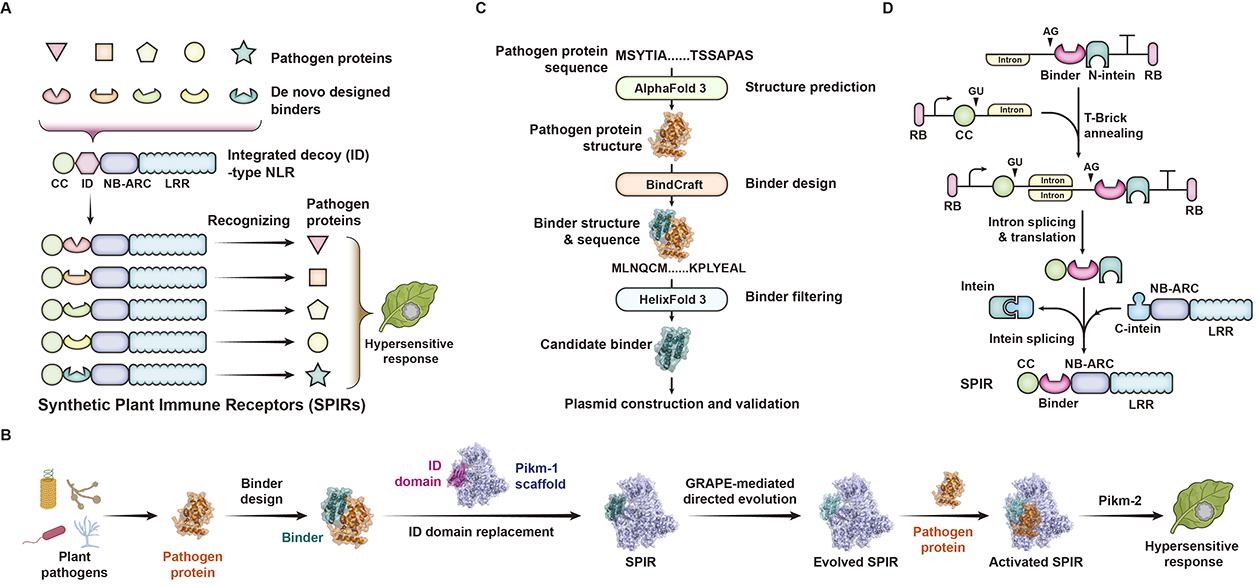
Blueprint for programmable plant immunity. (A) Schematic of the engineering of SPIRs, which are created by replacing the integrated decoy (ID) domain of an NLR with de novo designed binders that recognize specific pathogen-derived proteins. (B) Overview of the SPIR design and optimization process. Synthetic binders computationally designed to target pathogen proteins are grafted into the Pikm-1 scaffold as ID domains and optimized by GRAPE to enhance the immune response and minimize autoactivity. (C) Pipeline for de novo binder design. (D) Schematic of the modular SPIR assembly process in planta. (Credit: Zhu et al., 2026)
Surviving the Crucible: AI Meets Directed Evolution
Using this pipeline, the researchers generated 391 SPIRs designed to combat a wide spectrum of viral, bacterial, fungal, and oomycete pathogens. With 71 of these synthetic receptors (18.2%) successfully recognizing their targets and initiating an immune response, the study confirms that AI-assisted de novo protein design is a viable strategy for engineering functional plant immunity.
While some worked beautifully, a staggering 58.1% of the synthetic receptors were “autoactive”—meaning they triggered immediate cell death and tissue necrosis even when no pathogen protein was present. Another 23.8% were completely inactive, failing to recognize their targets altogether. This indicates AI-based design alone was not sufficient to cope with the messy, complex environment of a living cell.
To overcome this biological hurdle, the researchers turned to geminivirus replicon–assisted in planta directed evolution (GRAPE), a high-throughput platform they had established previously, and used it to optimize the newly designed SPIRs.
The core genius of GRAPE lies in its coupling of synthetic receptor function with viral replicon replication. The researchers loaded the diversified binder library into geminivirus replicons and delivered them into the leaves of Nicotiana benthamiana (a relative of the tobacco plant) via the package of Agrobacterium tumefaciens, a bacterium that can transfer DNA into plant cells. If a synthetic receptor variant was activated, it triggered localized cell death. This cellular suicide immediately shut down the replication of the geminivirus replicon housing that specific variant. By tracking which genetic variants were selectively depleted from the viral replicon pool using next-generation sequencing (NGS), the researchers could identify the precise amino acid combinations that maximized pathogen protein detection while completely eliminating autoimmune false alarms.
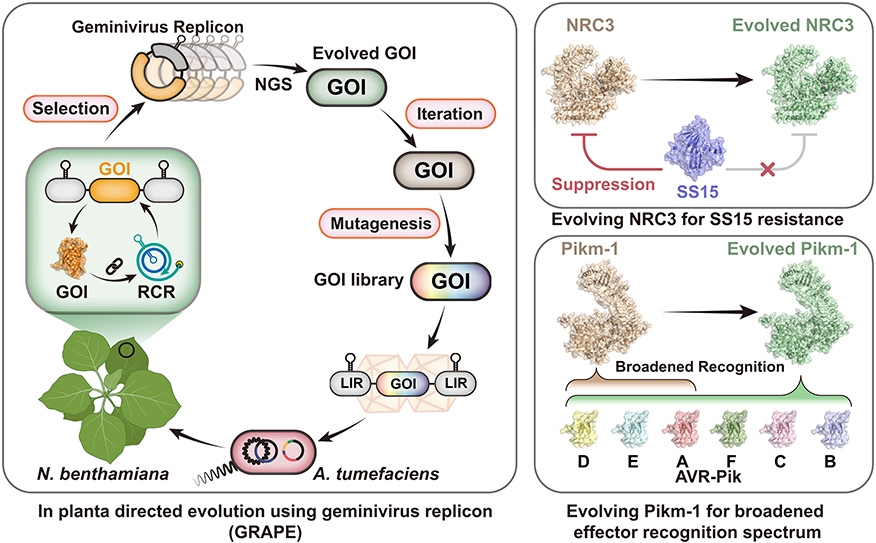
GRAPE: A high-throughput system for in planta directed evolution. This platform facilitates the rapid cellular evolution of the genes of interest (GOIs) by linking their function to the rolling circle replication (RCR) of engineered geminivirus replicons. For instance, using GRAPE, the team evolved NRC3 to overcome SS15 suppression and Pikm-1 to broaden its recognition spectrum of pathogenic AVR-Pik effectors in their formerly published work. (Credit: Zhu et al., 2025)
Broad Applicability and Future Considerations
The results of this dual AI-evolution platform are nothing short of remarkable. The researchers successfully designed and validated functional SPIRs against a diverse rogue’s gallery of 14 plant viruses, two bacteria, a destructive fungus, and a devastating oomycete pathogen. These engineered receptors proved to be highly target-specific and mutually orthogonal—meaning they only reacted to their exact target pathogen with virtually no dangerous cross-reactivity.
Furthermore, because crops in the field are rarely threatened by just one disease at a time, the team proved that multiple, distinct SPIR constructs can be stacked together. When expressed as full-length constructs, these stacked synthetic immune systems functioned simultaneously, providing multiplexed, broad-spectrum defense.
These achievements are further reinforced by the platform’s robust biological safety profile. The engineered geminivirus replicons used in the GRAPE directed evolution system are restricted exclusively to the screening and optimization phases, with their movement capabilities completely abolished. Since the final application in transgenic crops relies solely on the optimized genes—completely devoid of any viral components—the risk of viral vector escape is entirely eliminated. While the system is fundamentally safe and successfully weeds out autoactive receptors, the novel nature of the technology warrants standard long-term observation. Because these synthetic decoy domains utilize artificial binders rather than natural host proteins, ongoing field trials will continuously monitor the crops to ensure these receptors do not mutate or trigger unforeseen off-target autoimmune reactions.
Nonetheless, the SPIR platform represents a great leap forward. By decoupling agricultural disease resistance from the slow constraints of natural evolutionary breeding, scientists may have initiated a programmable, digital era of crop protection—one that can design, optimize, and deploy biological shields against emerging agricultural pandemics in a matter of weeks rather than decades.
Reference
Zhu, H., Jiang, D., Zhang, Q., Zhang, K., Zhao, K. T., Qiu, J. L., & Gao, C. (2026). Programmable design of synthetic plant immune receptors for pathogen protein recognition. Science, eaee1792. doi: 10.1126/science.aee1792
Zhu, H., Qin, X., Wei, L., Jiang, D., Zhang, Q., Wang, W., . . . Gao, C. (2025). Engineered geminivirus replicons enable rapid in planta directed evolution. Science, 390(6774), eady2167. doi: 10.1126/science.ady2167