

Recently, taking advantage of the large volume of data collected by the detector, the BESIII International Collaboration successfully measured the decay constant for the charmed meson D+ — with the best precision to date.
As an unstable particle, the charmed meson D+ can decay via many different pathways, each with a different possibility. In the process of the decay, its constituent heavy charm quark can transform itself into other particles, thereby diverting the subsequent decay cascade into a different pathway or a different decay network.
The numerous decay pathways of D+ meson, a direct consequence of the quantum rules described by the Standard Model (SM), provide a rich dataset for investigating the weak interaction, which governs the decay process.
Among these, the rarest “channel” has attracted the attention of particle physicists. In this case, the constituents of D+ meson, the charm quark and the anti-down quark, annihilate directly to produce a positive muon μ+ and a muon neutrino νμ. Since both produced particles are leptons, this type of decay is called “leptonic decay”. Therefore, the probability of this annihilation is directly proportional to the square of a fundamental parameter described in the SM — the Cabibbo-Kobayashi-Maskawa (CKM) matrix element.
Furthermore, the leptonic decay of D+ provides a clean background for precise comparison between theoretical predictions and experimental measurements. It is a sensitive probe to test chromodynamic calculations and the unitarity of CKM quark mixing matrix.
Using a total of 6.0×10⁷ D+ decay events collected by the BESIII detector, the BESIII Collaboration precisely measured the branching fraction of the D+ leptonic decays, and reported their results in Physical Review Letters on August 4 (DOI: 10.1103/gb8v-4rnh).

The BESIII detector (Credit: IHEP)
The D+ decay constant is determined to be (213.5 ± 2.1stat ± 1.1syst ± 0.8input ± 0.7EM) MeV, after correlating their measurement with the Fermi theory of weak interaction. The new measurement is 2.3 times more precise than the previously best measurement. Alternatively, using the value of the decay constant derived from a precise lattice quantum chromodynamics calculation, the precise value of the c→d CKM matrix element is extracted to be 0.2265 ± 0.0023stat ± 0.0011syst ± 0.0009input ± 0.0007EM. With an accuracy of approximately 1%, this result unveils a new era in testing the unitarity of the CKM matrix in the SM.
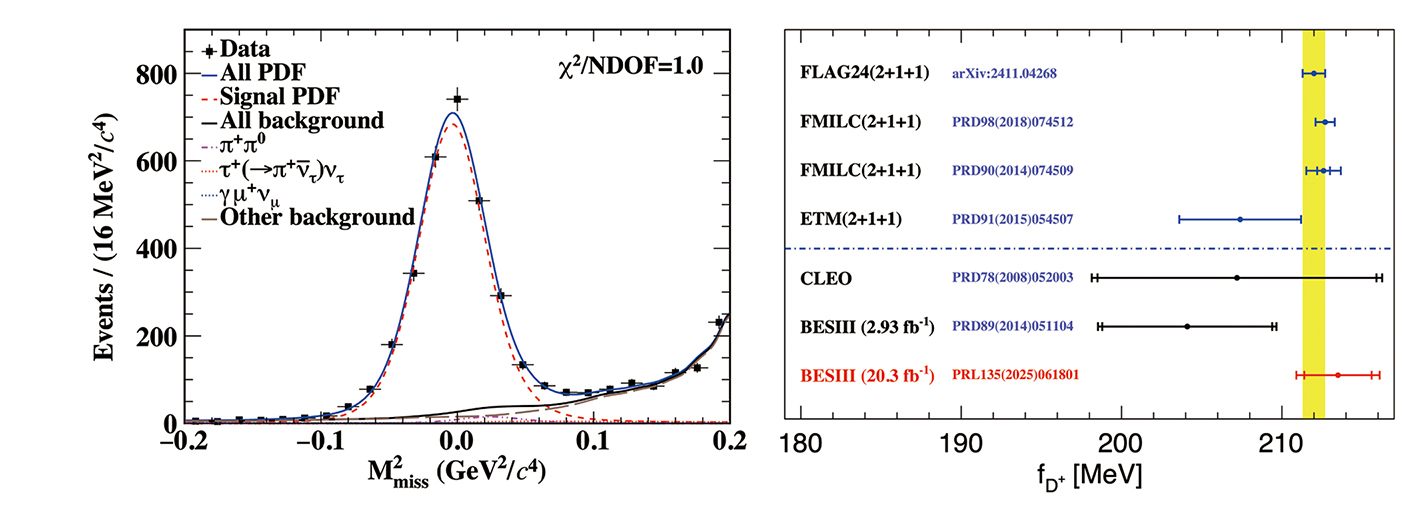
Left: Signals of the leptonic decay D+→μ+νμ. Right: The comparison between the experimental measurements and theoretical calculations of the decay constant fD+ for the leptonic decay. (Credit: BESIII Collaboration)
Reference
M. Ablikim et al. (2025) Precision Measurement of the Branching Fraction of D+→ μ+νμ. Physical Review Letters 135, 061801. (DOI: https://doi.org/10.1103/gb8v-4rnh)