

By SONG Jianlan
It is well-agreed that the life of our planet first emerged from the ocean, thriving from single-celled phytoplankton and algae, to multicellular species of more and more complicated structures. Then some tetrapods adventured to move onto the land, with a clade of them evolving and further diverging into amphibians—the ancestors of reptiles (including non-avian dinosaurs), birds and mammals.
It remains somewhat obscure to amateurs, however, that some terrestrial reptiles ventured back to the sea after dominating the land. Actually, due to the scarcity of fossil evidence, some of them—like stem archosaurs, the ancestor of pterosaurs, crocodiles, dinosaurs and birds—are primarily thought to be mostly terrestrial, leaving their secondary aquatic adventures rare and poorly understood, even by paleontologists. Against this context, a recent discovery by Chinese scientists unveils a surprising episode in the Triassic: Some reptilian clades even attempted to go back to the sea for at least TWICE.
Led by Dr. WANG Wei from the Institute of Vertebrate Paleontology and Paleoanthropology (IVPP) of the Chinese Academy of Sciences, a team of paleontologists recently reported in Science Advances a rare skeleton of tanysaurian, an early lineage under the above-mentioned stem archosaurs. Unearthed from the Triassic strata of southwestern China with well-preserved soft tissues, this specimen represents the earliest stem-archosaur known to have evolved unequivocally aquatic specializations, and can give some new insights into the ecological recovery and even species explosion after the most disastrous mass extinction known in geological history, namely the end-Permian mass extinction.
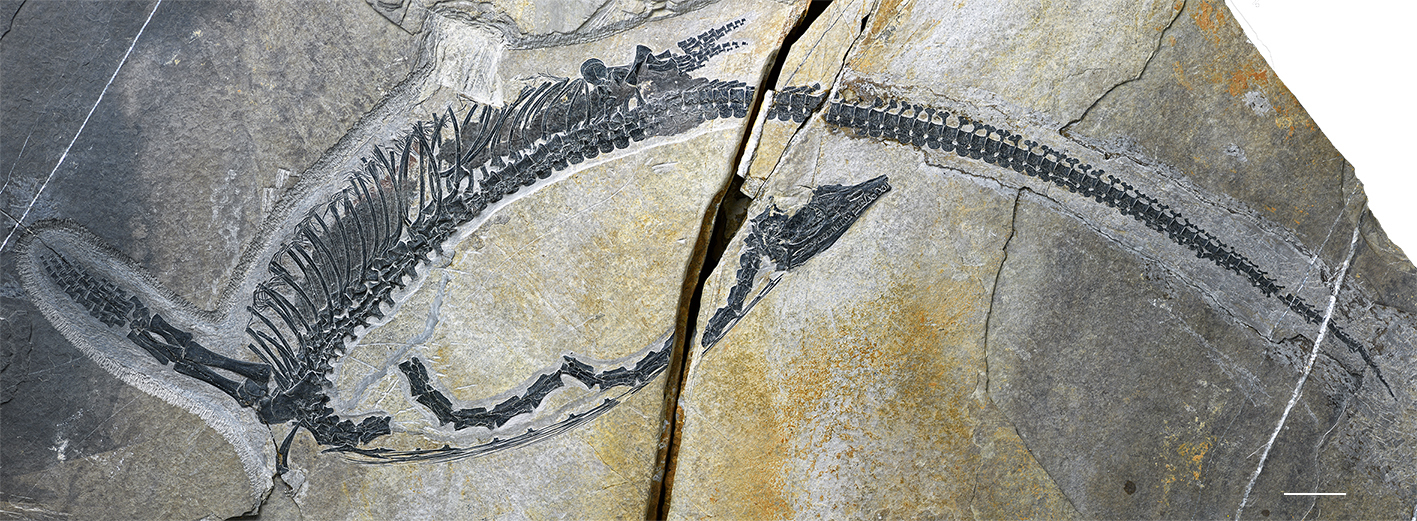
The specimen named IVPP V18579 represents an individual of Austronaga minuta, a taxon under Tanysauria. (Credit: IVPP)
Extensive Aquatic Adaptations in Austronaga minuta
After careful analyses of its anatomy and morphology in combination with UV photography and SEM-EDS of the soft tissues for chemical identification, the team identified unequivocal aquatic specializations in the body plan of Austronaga minuta. Unlike other taxa, its nose is located posteriorly rather than at the rostral tip, suggesting a possible adaptation for water-surface respiration; similar to those of piscivorous reptiles, its jaws have conical teeth with prominent fangs—and the remains of fish scales detected in its stomach confirmed that it could have actively preyed on small fishes. Its scapula and coracoid are expanded and plate-like, resembling other marine reptiles and quite distinct from its terrestrial relatives. Its pelvic girdle is substantially reduced, even at the cost of losing an articulation in the sacral vertebrae to allow its hindlimbs more flexibility for propelling in water. All such structures suggest highly adapted specialization to aquatic environments. To earn such advantages in water it traded off the necessary strength to support its weight for land locomotion—in contrast, even its semi-aquatic relatives maintained more reinforced pelvic girdles for weight bearing efforts.
More evident are the specialized aquatic adaptations in its limbs. Previous studies independently suggest that limb proportions indicate the degree of aquatic adaptation. A hindlimb shorter than the forelimb robustly indicates an advanced stage of aquatic adaptation, because in aquatic environments, the support for the hindlimbs is redundant, and extended forelimbs would anteriorly shift the center of mass to optimize submerged balance. Based on past data and their own measurements, the team made comparative analyses of limb proportions across extinct and extant secondarily aquatic reptiles and mammals. The results demonstrate that Austronaga exhibits more pronounced marine adaptations than most secondarily aquatic non-avian amniotes, exceptionally with outstanding limb proportions. The ratio between the lengths of the humerus and femur in Austronaga is as large as 2.19, showing much longer forelimbs than hindlimbs. It is the highest among all marine tetrapods sampled by the team.
More strikingly, both its fingers and toes are elongated and flattened, merging to form paddles—an obviously specialized aquatic adaptation. Such specializations are absent in semiaquatic Triassic archosauriforms. Moreover, Austronaga displays some characteristics similar to other highly aquatic reptiles, like plesiosaurs and ichthyosaurs, forming sharp contrast to its more terrestrial relatives. Aside from its large autopodial proportions in both forelimb and hindlimb as mentioned above, exceptional is also the fact that it completely lost its claws, additionally developing hyperphalangy, a feature convergent with other highly aquatic amniotes that develop hydrodynamic flippers.
Based on the preserved limb posture and flattened joint surfaces, the researchers inferred that Austronaga at least partially used its forelimbs to generate thrusts for aquatic propulsion.
Conservative Gastrointestinal System
The fossil even contains excellently preserved soft tissues—This scarcely occurred in geological history as it took demanding pre-conditions to happen. From the relic, the researchers reconstructed stomach, liver, and intestines, as the oldest known in reptiles.
Distinct from its highly specialized limbs, the reconstructed gastrointestinal system turns out to be more conservative than its body plan and limbs, exhibiting minimal aquatic specialization. For example, its large stomach remained single-chambered, more conservative in contrast with the two-chambered structure in birds and crocodiles, and reflects a morphologically plesiomorphic condition. Its short intestine system indicates a rapid digestion, in consistence with the piscivorous water monitor lizard. This reflects a much lower selective pressure on the gastrointestinal morphology compared to the highly specialized body plan associated with its aquatic lifestyle, the authors interpret.
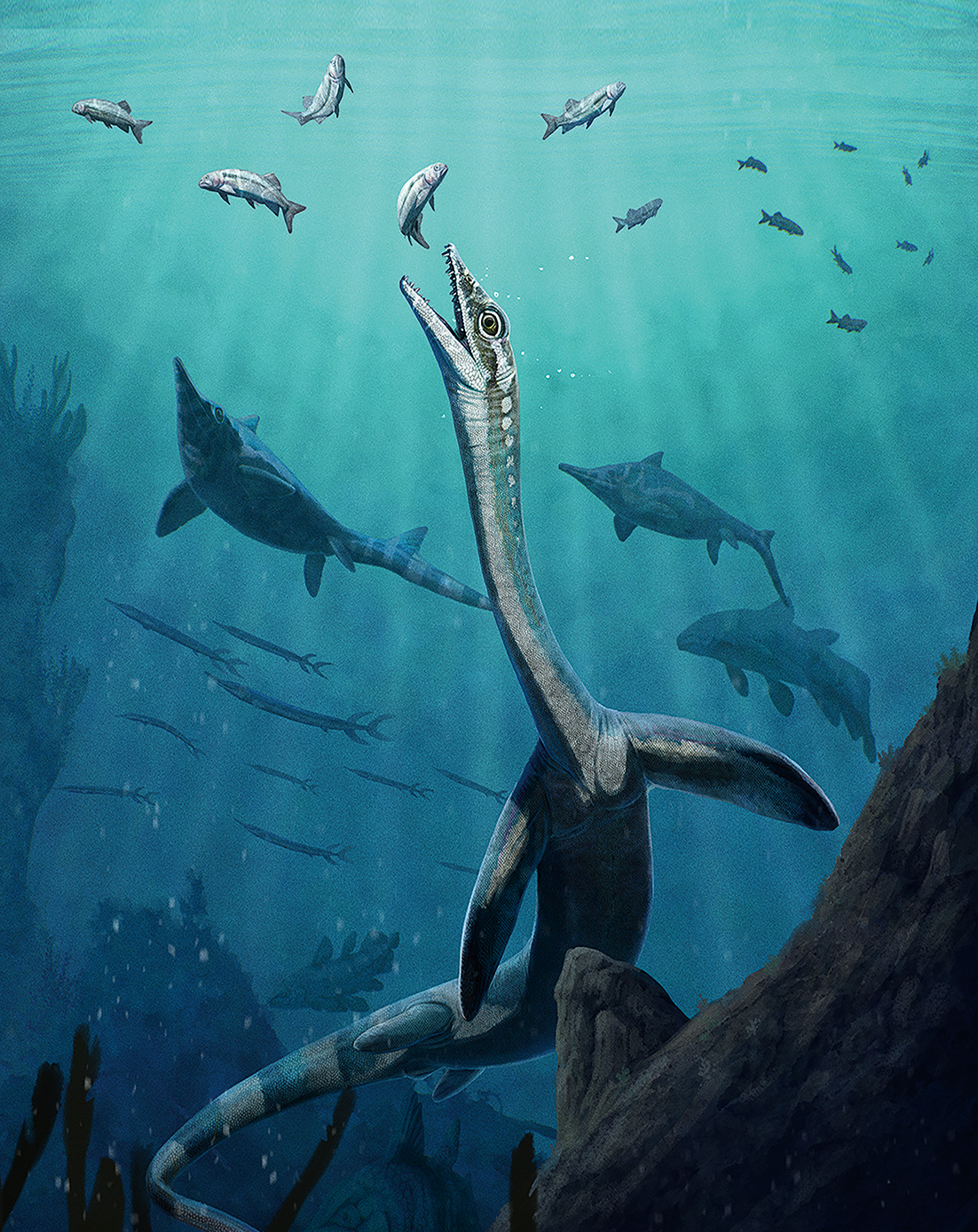
Ecological reconstruction of Austronaga minuta, a stem archosaur. (Credit: IVPP)
Repeated Attempts by Tanysaurians
To accurately locate the phylogenetic position of Austronaga among different tanysaurian lineages, the team sampled and scored its key anatomic characteristics and constructed a matrix of dataset. Strict and careful analysis of the matrix converged to stably resolve it within a branch including Pectodens and Dinocephalosaurus, as shown below.
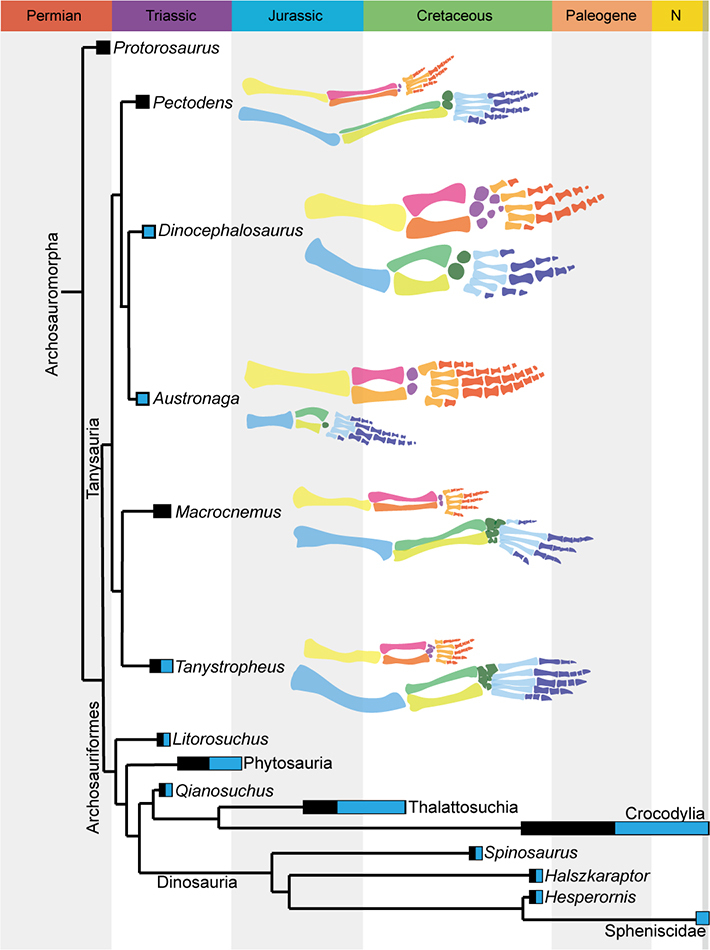
Austronaga and its sister-group Dinocephalosaurus are situated with other tanysaurian taxa in the family tree of archosauromorphs, with the detailed limb morphology of certain tanysaurs given (forelimb on the top and hindlimb at the bottom) near the corresponding taxa. Terrestrial lineages are labelled in black, aquatic in blue, semiaquatic in half blue and half black; and homologous bony elements are shown in the same colors. (Credit: IVPP)
Examining the morphology of different lineages of the family, the researchers came to even more surprising a conclusion: Tanysaurs might have attempted to go back to the sea for at least TWICE!
The team found that Dinocephalosaurus, the closest relative to Austronaga, is also aquatic but displays less specialized modifications in its appendicular skeleton. However, Pectodens in the same family exhibits more terrestrial characteristics. A lineage of their sister family, Tanystropheidae, also include both terrestrial and aquatic forms: some members (e.g. Macrocnemus) are predominantly terrestrial, and some (e.g. Tanystropheus) are at least semiaquatic. This, the researchers refer, indicates that tanysaurians have at least attempted twice returning to the ocean.
“Therefore, compared to major marine reptilian lineages (e.g., sauropterygians, ichthyosaurs, and thalattosaurs), these tanysaurs represent the only group so far with known terrestrial early-diverging members and deeply nested aquatic taxa. This clade thus provides a unique opportunity to document the land-to-sea transition in reptile evolution during the Triassic,” say the authors.
Recolonization of Mesozoic Ocean
“The discovery of Austronaga reshapes our understanding of early archosauromorph ecology,” the authors conclude. The specimen demonstrates that this clade of stem archosaurs recolonized the marine habitats earlier and more extensively than paleontologists previously thought. Embarking on their adventure back to the sea at the beginning of the Mesozoic, this major reptilian clade held a safe lead over their Triassic counterparts like Thalattosauria; and this lineage might have taken various strategies to survive the adverse living environment resulting from the mass extinction by the end of the Permian.
Therefore, the discovery of Austronaga has revealed an episode about how reptiles struggled to survive the difficult time after the end-Permian extinction. In the wake of the disastrous extinction, the oceanic ecosystem might have recovered more quickly than the fragile terrestrial ones, due to the buffer provided by the huge water body. Food was relatively abundant compared with the terrestrial ecosystems, with phytoplankton, algae and small fishes thriving. Hence heading back to the sea could have been a good choice for them; and the selective pressure there might have been lower than on land—They might have felt more relaxed home, relieved from the great nostalgia.
Reference
Wei Wang et al. (2026) Highly aquatic marine stem archosaur with soft tissue preservation. Sci. Adv. 12, eaeb7528. DOI:10.1126/sciadv.aeb7528