

The 2026 Tan Kah Kee Award in Mathematics and Physics goes to the research on “Discovering Chemical Imprints of the First Supermassive Stars and Relics of Early Mergers of the Milky Way” led by Prof. ZHAO Gang, Member of the Chinese Academy of Sciences (CAS) and Professor at the National Astronomical Observatories, CAS (NAOC).
ZHAO has proposed a new formula for non-local thermodynamic equilibrium (NLTE) analysis of stellar spectra to elucidate the influence of different physical processes on spectral formation. This new NLTE analysis, along with the subsequent development of a high-precision method for measuring stellar chemical abundances, has enabled the identification of nucleosynthetic signatures unique to the extreme environments of the early universe. These advancements provide decisive observational and analytical tools for discovering chemical imprints from the first-generation supermassive stars and relics of early mergers of the Milky Way.
The research has unveiled critical scenarios of early chemical evolution, and the formation of structures on different scales in the universe.
Chemical Evolution as a Cosmological Clock
For astronomers, a star’s metallic content serves as a powerful diagnostic tool, revealing both its age and the evolutionary history of its host galaxy. The early universe was devoid of metals; the first stars consisted solely of primordial hydrogen and helium. All elements heavier than helium—collectively termed “metals” in astronomy—were forged through stellar nucleosynthesis and subsequently dispersed into the interstellar medium upon stellar death. Consequently, younger stars inherit higher metallicity, making these chemical signatures a reliable gauge for tracking stellar generations. This early chemical enrichment is not only the foundation for understanding galactic evolution but also the key to deciphering the formation of cosmic structures across various scales.
While metal-poor stars are invaluable “cosmic fossils”, they are rare, faint and extremely difficult to detect and analyze. Traditional methods for measuring chemical abundances rely on the assumption of local thermodynamic equilibrium (LTE), which often yields inaccurate results—particularly for metal-poor stars where deviations from LTE are most pronounced. To address this, ZHAO proposed a novel NLTE formula to accurately model how diverse physical processes shape spectral profiles. In this new framework, he and his collaborators simultaneously synthesized 16 magnesium spectral lines, achieving a perfect fit with observations and demonstrating the model’s reliability.
The team applied this new NLTE model to 51 F and G dwarfs and subgiants, obtaining internally consistent stellar abundances of 17 critical elements from the light lithium to the heavy europium. Published in The Astrophysical Journal in 2016, this work analyzed a kinematically diverse sample spanning a wide metallicity range ([Fe/H] from −2.62 to +0.24). As the first extensive spectroscopic analysis based on homogeneous NLTE models, this work has provided highly accurate stellar abundances and established rigorous observational constraints for models of Galactic chemical evolution and stellar nucleosynthesis theory.
The NLTE formula is universal, and has been widely adopted by researchers in the related field. The precise measurements have since been adopted by the latest theoretical models and were featured in the Handbook of Nuclear Physics by renowned nuclear physicists Prof. Isao Tanihata et al., where they were lauded as “the best data” for constraining physical mechanisms of europium enrichment. Furthermore, this new NLTE analysis is described as “extremely difficult” and of “importance for resolving major abundance discrepancies.” Specifically, it successfully resolved long-standing discrepancies in scandium and potassium abundances between meteorites and the solar photosphere.
Together with his collaborators, ZHAO integrated mature atomic models of 17 elements accumulated over 20 years and has established a high-precision NLTE analysis framework that underpins a new era of research into the early cosmic history.
The “Holy Grail” in Galactic Archaeology
The new NLTE analysis has enabled ZHAO’s team to precisely determine stellar abundances, particularly for metal-poor stars whose chemical abundance deviates significantly from the LTE assumption. This has paved the way for the team’s discovery of the chemical imprint from the first-generation supermassive stars—a breakthrough in Galactic archaeology.
The question “when and how did the first stars and galaxies form” remains one of the most challenging scientific problems, as highlighted by the journal Science. These primordial stars, the first celestial objects to form after the Big Bang, hold key clues to the physical processes of the early universe and the origin of chemical elements. Before the formation of the first galaxies, these stars dictated the universe’s chemical evolution.
Theoretical models predict that these primordial stars were supermassive. Due to their low metallicity, they experienced negligible mass loss through stellar winds, allowing them to reach masses of 140 to 260 times that of the Sun. However, they are short-lived. In the cores of such massive stars, temperatures soared above a billion degrees, producing high-energy photons that collided to create electron-positron pairs. This “pair-production” process led to a sudden drop in radiation pressure, causing the star to succumb to its own gravity. The resulting cataclysm, known as a Pair-Instability Supernova (PISN), completely obliterated the star. Unlike Core-Collapse Supernovae (CCSNe), which leave behind a compact remnant, such as a neutron star or black hole, a PISN results in total disruption, ejecting all material, including synthesized heavy elements, into space. This enriched the primordial interstellar medium, leaving a unique chemical signature in the second-generation stars that formed from the enrichment nebula.
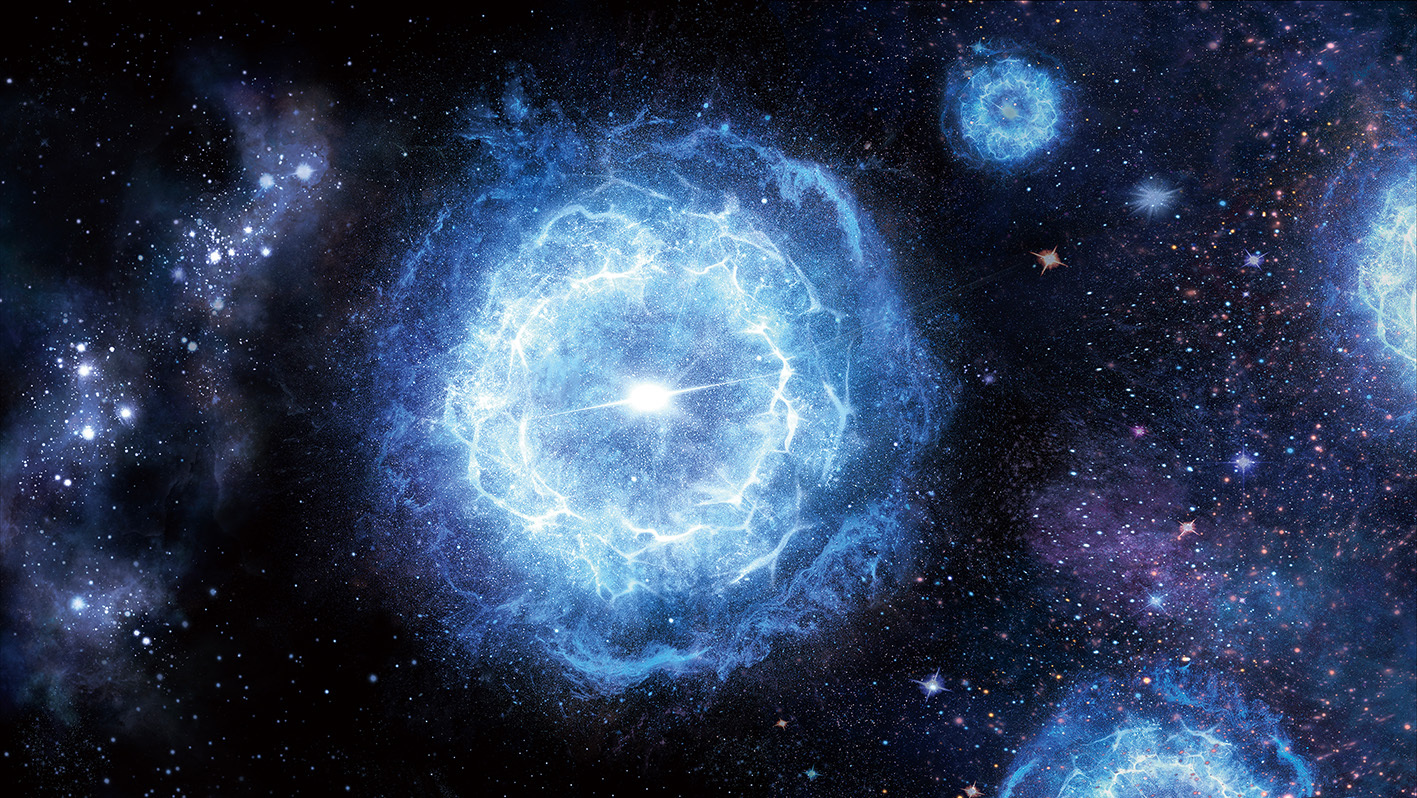
Artist’s impression of pair-instability supernovae (PISNe). (Image: NAOC)
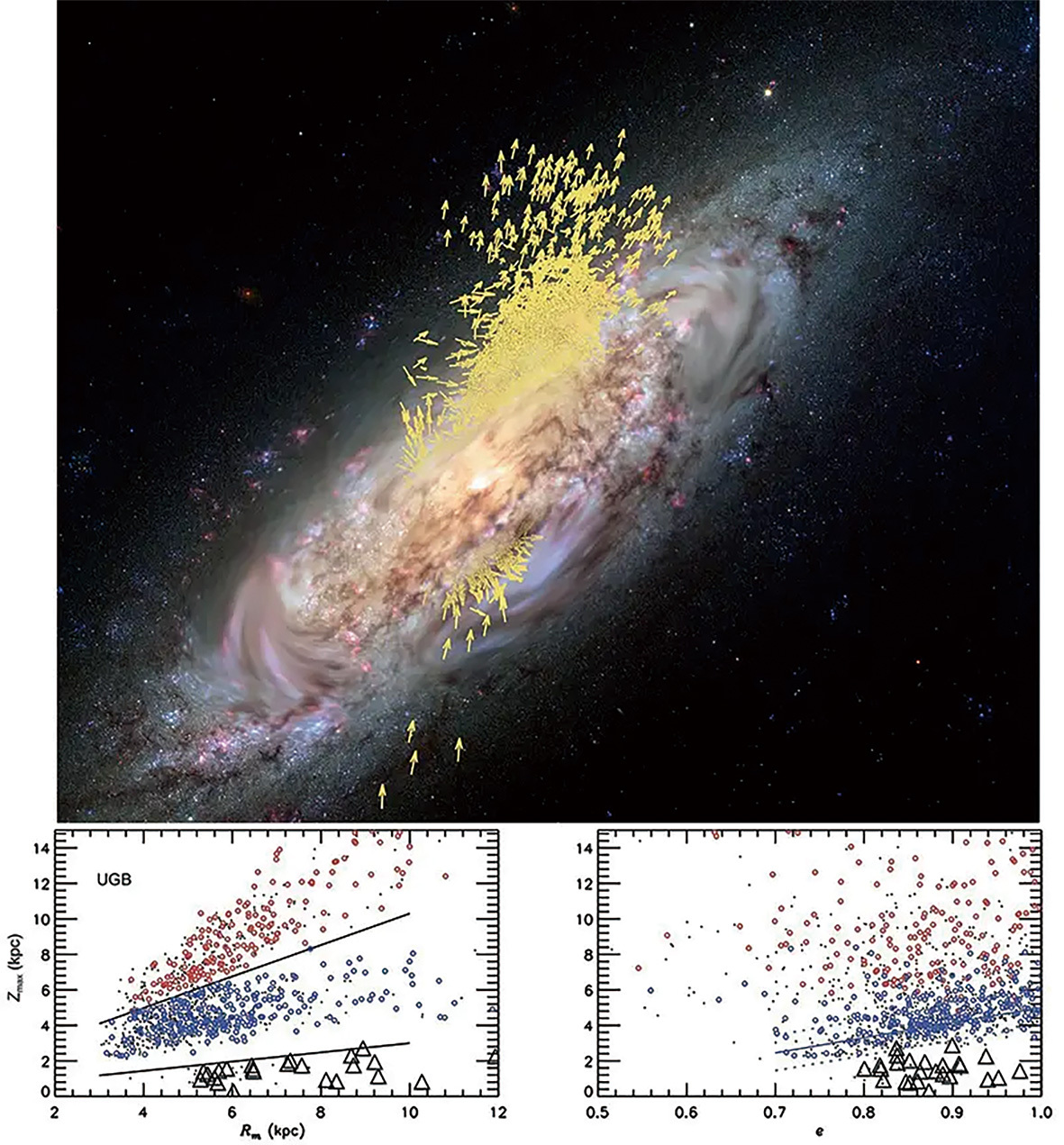
The team detected for the first time in orbital space the kinematics remnants from the early formation of the Milky Way. (Image: NAOC)
Proposed by theorists 55 years ago, the identification of PISNe has become a “holy grail” pursued by major observations worldwide. However, despite decades of targeted observations of the Milky Way’s most metal-poor stars, clear evidence of a PISN remnant has remained elusive. Instead, the metal-poor stars detected so far typically exhibit the chemical imprints of CCSNe, whose progenitors are predicted to be significantly less massive—typically less than 100 solar masses.
First Identification of PISN Imprints
Things changed with the operation of the Large sky Area Multi-Object fiber Spectroscopic Telescope (LAMOST), a major national astronomical scientific facility of China. Among the vast spectra obtained by LAMOST, ZHAO’s team identified a peculiar metal-poor star in the Galactic halo, LAMOST J1010+2358, which exhibits a highly unusual chemical abundance pattern. In contrast to typical halo stars, its sodium-to-iron ratio is more than two orders of magnitude lower than solar value. Moreover, the star displays a striking odd-even effect—a phenomenon where elements with odd atomic numbers (e.g., sodium and cobalt) are significantly depleted compared to their even-numbered neighbors (e.g., magnesium and nickel). This signature perfectly aligns with the most distinctive feature of PISN nucleosynthesis. Combined with the unusual deficiencies in α-elements (e.g. magnesium) and sodium, the chemical pattern provides a compelling match to the primordial PISN predicted by theoretical models.
The team excluded alternative scenarios, such as CCSNe or Type Ia Supernovae (SN Ia), as neither can produce such a “weird” abundance pattern—particularly the extremely low sodium, chromium and manganese contents. The numerical simulation indicated that the chemical pattern of LAMOST J1010+2358 aligns remarkably well with nucleosynthetic yields of a 260-solar-mass, zero-metallicity progenitor ending its life as a PISN. Thus, they concluded that LAMOST J1010+2358 is a direct descendant of an ancient PISN. The progenitor’s 260-solar-mass reaches the upper mass limit of PISN model. By providing the first clear observational evidence for the chemical imprint of a PISN, this discovery confirms the existence of very massive first-generation stars in the early universe and ushers in a new frontier in studying the Milky Way’s Initial Mass Function (IMF).
LAMOST J1010+2358 exhibits extremely low abundances of sodium, magnesium, manganese and cobalt, with heavy elements, such as strontium and barium being undetectable with current techniques, making it the star with the most primitive chemical composition discovered to date. This unique chemical signature represents a major observational breakthrough in revealing the extreme astrophysical environments of element nucleosynthesis and the early chemical enrichment of galaxies, providing insights for the establishment of the initial mass function at the high-mass end of the Milky Way.
Published in Nature (June 2023), this work has been hailed as a landmark achievement. Prof. Timothy Beers of the University of Notre Dame noted that this finding offers invaluable insights into the primordial stages of star formation—the era that forged nearly all elements in the periodic table. Experts agree that “even a single detection of a pure PISN descendant can be crucial to our understanding of the mass distribution of the first stars.”
Exploring the Milky Way’s Early Mergers
Based on the precise measurement of chemical abundances of a vast number of stars, ZHAO initiated a multi-dimensional exploration of the Milky Way’s merger remnants and conducted the study for chemically peculiar stars formed in diverse astrophysical environments, using the spectroscopic survey data from LAMOST.
The systematic inquiries into the early formation and evolution of the Milky Way led to a series of important discoveries. Notably, ZHAO’s team achieved the first detection in orbital space of the kinematics remnants from the early formation of the Milky Way. Furthermore, they discovered a peculiar star characterized by low α elements and extremely overabundant r-process elements. Combining theoretical models of galactic chemical evolution and binary neutron star merger, they revealed that the star is a chemical relic from a dwarf galaxy that merged with the Milky Way in its early stage.
Published in Nature Astronomy, this study provided observational evidence of dwarf galaxies accreted by the Milky Way in orbital and chemical spaces, respectively. Prof. Amina Helmi, a pioneer in Galactic archaeology and awardee of the Spinoza Prize (the highest scientific award in the Netherlands) noted: “Other potentially promising chemical labels for the identification of stars born in accreted dwarf galaxies appear to be r-process element abundances”
By precisely measuring the lithium abundances in a large sample of stars, the team achieved several fundamental breakthroughs. They discovered the most lithium-rich star known to date and revealed that lithium-rich stars are mainly red clump stars that have experienced helium flashes. Furthermore, the team proposed a new mechanism for lithium production via helium flashes, revising the established theory of lithium production and evolution. These research results, unveiling key physical processes in the early formation and evolution of the Milky Way, were presented in three papers that successively published in Nature Astronomy.
Prof. Sarah Martell of the University of New South Wales noted: “This provides an intriguing and testable prediction for RC stars as a population and may provide new insights into the internal rearrangement that happens as a result of the helium flash.” Prof. David L. Lambert of the McDonald Observatory remarked: “These suspicions were wonderfully raised to a near certainty.”
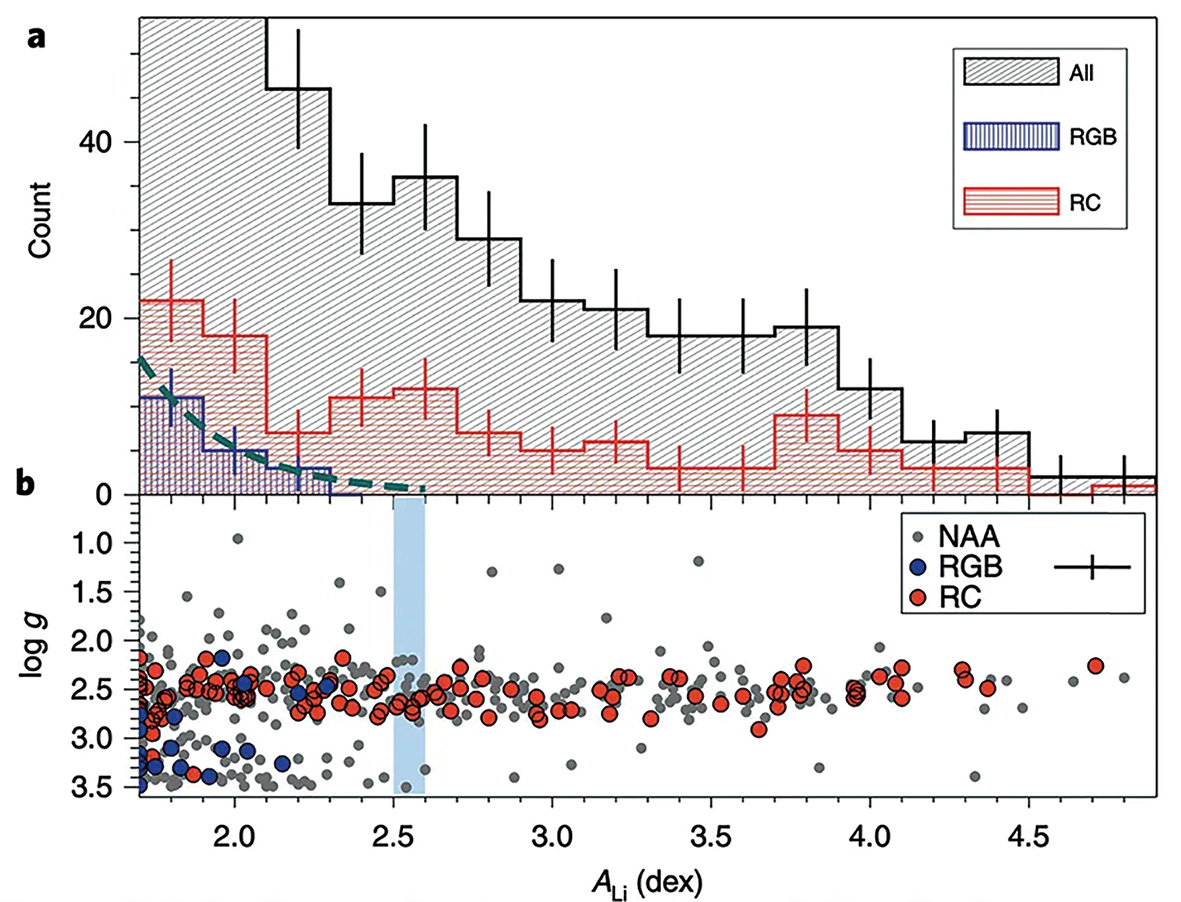
The team revealed that lithium-rich stars are mainly red clump stars that have undergone helium flashes. (Image by NAOC)
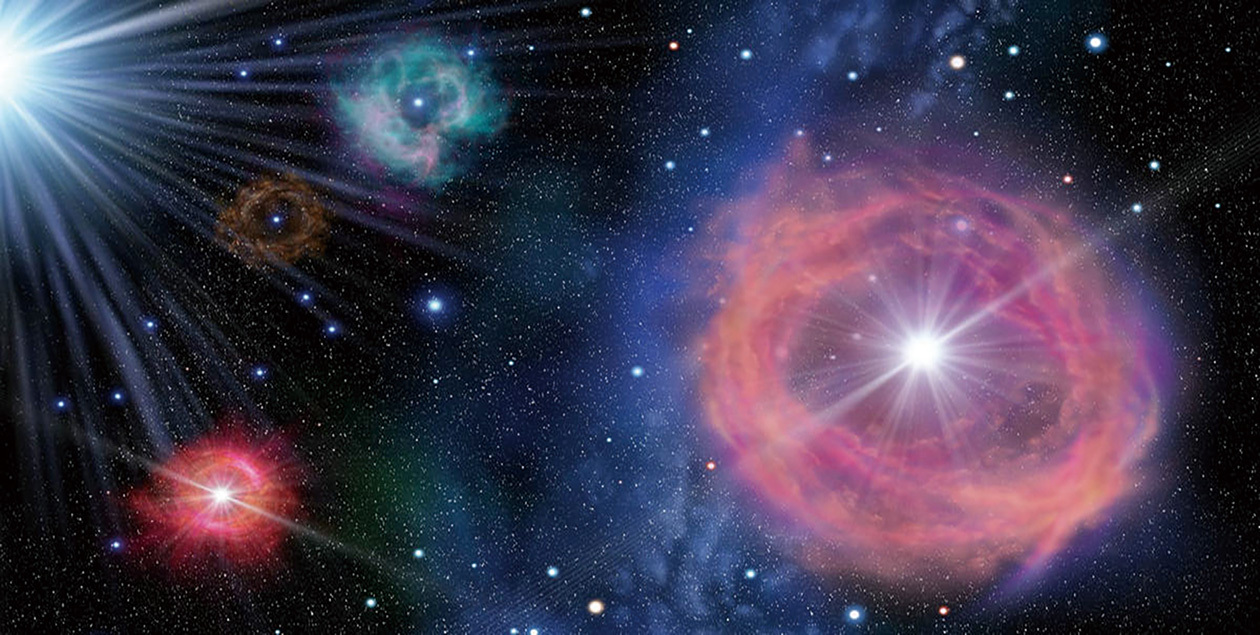
Illustration of clump stars undergoing helium flashes. (Image by NAOC)
The discoveries made by Prof. ZHAO and his team—ranging from the chemical imprints of the first-generation massive stars to the remnants from the early mergers of the Milky Way—are of decisive significance to Galactic archaeology and galaxy formation, and represent a major breakthrough in the study of the early history of our universe.
Reference
Kumar, Yerra Bharat*; Reddy, Bacham E.; Campbell, Simon W.; Maben, Sunayana; Zhao, Gang*; Ting, Yuan-Sen. (2020) Discovery of ubiquitous lithium production in low-mass stars, Nature Astronomy, 4, 1059–1063. https://doi.org/10.1038/s41550-020-1139-7
Xing, Qian-Fan*; Zhao, Gang*; Aoki, Wako; Honda, Satoshi; Li, Hai-Ning; Ishigaki, Miho N.; Matsuno, Tadafumi. (2019) Evidence for the accretion origin of halo stars with an extreme r-process enhancement, Nature Astronomy, 3, 631. https://doi.org/10.1038/s41550-019-0764-5
Xing, Qian-Fan; Zhao, Gang*; Liu, Zheng-Wei; Heger, Alexander; Han, Zhan-Wen; Aoki, Wako; Chen, Yu-Qin; Ishigaki, Miho N.; Li, Hai-Ning; Zhao, Jing-Kun. (2023) A metal-poor star with abundances from a pair-instability supernova, Nature, 618, 7966, 712. https://doi.org/10.1038/s41586-023-06028-1
Yan, Hong-Liang; Zhou, Yu-Tao; Zhang, Xianfei; Li, Yaguang; Gao, Qi; Shi, Jian-Rong*; Zhao, Gang*; Aoki, Wako; Matsuno, Tadafumi; Li, Yan; Xu, Xiao-Dong; Li, Haining; Wu, Ya-Qian; Jin, Meng-Qi; Mosser, Benoit; Bi, Shao-Lan; Fu, Jian-Ning; Pan, Kaike; Suda, Takuma; Liu, Yu-Juan Zhao, Jing-Kun; Liang, Xi-Long. (2021) Most lithium-rich low-mass evolved stars revealed as red clump stars by asteroseismology and spectroscopy, Nature Astronomy, 5, 86–93. https://doi.org/10.1038/s41550-020-01217-8
Yan, Hong-Liang; Shi, Jian-Rong*; Zhou, Yu-Tao; Chen, Yong-Shou; Li, Er-Tao; Zhang, Suyalatu; Bi, Shao-Lan; Wu, Ya-Qian; Li, Zhi-Hong; Guo, Bing; Liu, Wei-Ping; Gao, Qi; Zhang, Jun-Bo; Zhou, Ze-Ming; Li, Hai-Ning; Zhao, Gang*. (2018) The nature of the lithium enrichment in the most Li-rich giant star, Nature Astronomy, 2, 790. https://doi.org/10.1038/s41550-018-0544-7
Zhao, Gang*; Chen, Yuqin. (2021) Low-α metal-rich stars with sausage kinematics in the LAMOST survey: Are they from the Gaia-Sausage-Enceladus galaxy? Science China · Physics, Mechanics & Astronomy, 64, 3, 239562. https://doi.org/10.1007/s11433-020-1645-5
Zhao, G.*, Mashonkina, L.*, Yan, H. L. (2016) Alexeeva, S., Kobayashi, C., Pakhomov, Yu., Shi, J. R., Sitnova, T., Tan, K. F., Zhang, H. W., Zhang, J. B., Zhou, Z. M., Bolte, M., Chen, Y. Q., Li, X., Liu, F., Zhai, M., Systematic Non-LTE Study of the -2.6≤[Fe/H]≤0.2 F and G dwarfs in the Solar Neighborhood. II. Abundance Patterns from Li to Eu, The Astrophysical Journal, 833, 225. doi:10.3847/1538-4357/833/2/225