

The Tan Kah Kee Science Award in Chemistry for 2026 goes to the research “Single-Atom Catalysis” (SAC) led by Prof. ZHANG Tao from the Dalian Institute of Chemical Physics (DICP) of the Chinese Academy of Sciences (CAS). ZHANG, a CAS Member, first proposed the concept of SAC, ushering the era of atomic precision catalysis. His team elaborated the characteristics and underlying mechanism of SAC, and verified its universality and extensive application in catalyzed reactions. The Award honors a milestone in the history of catalysis: the creation of the world’s first practical catalyst with atomically dispersed active sites and the establishment of a new concept that has ignited a paradigm shift in catalytic science.
The Challenge: The Limits of Nanoparticles
Catalysts are the invisible workhorses of modern chemical industry, participating in over 80% of chemical processes. They function by utilizing “active sites” to accelerate the conversion of reactants into products; consequently, the quantity and microstructure of these sites determine a catalyst’s activity and selectivity. This is particularly critical for catalysts relying on precious metals—such as platinum (Pt), palladium (Pd), or gold (Au)—which are favored for their superior performance but are constrained by their scarcity and high cost.
Therefore, engineering catalysts that maximize the number of active sites while achieving precise control at the atomic level at the same time has long been a major pursuit and challenge in the field of catalytic science.
However, given the formidable difficulty in achieving atomic-level precision, traditional design strategy is focused on a single, geometric imperative: maximizing surface area to ensure maximal active site exposure to reactants. The strategy that chemists first landed on was to shatter bulk metal into ever-smaller fragments, dispersing catalytic material as nanoparticles across a solid support. While this improves efficiency, a fundamental limitation remains: Even in nanoparticles, a significant portion of the precious metal atoms are trapped within the inactive interior, inaccessible to reactants. More surface exposure means more reactive sites and better efficiency with less precious metal wasted in an inactive interior.
Unfortunately, this strategy hit a wall. Under the high temperatures of industrial operation, “restless” nanoparticles tend to migrate, collide, and merge—a process known as sintering—growing larger through aggregation and losing the very surface area that made them useful in the first place. As a result, atoms trapped inside these nanoparticles are virtually wasted, contributing little to the reaction. Activity drops; catalysts die young.
The theoretical ideal was clear but considered nearly impossible to achieve: dispersing the metal until every single atom sits directly on the supports to ensure 100% atomic utilization. The challenge was thermodynamic; individual metal atoms are energetically unstable and naturally tend to cluster back into nanoparticles.
Taking Catalysis to the Atomic Limit
ZHANG’s team—working with collaborators Prof. LI Jun at Tsinghua University and Prof. Jimmy Liu at the University of Missouri-St. Louis—turned this “impossible” idea into reality. Using carefully controlled wet chemistry, they produced a catalyst composed of iron oxide nanocrystallites decorated with individual, isolated Pt atoms (denoted as Pt1/FeOx). Each bright spot in the imaging data was a single Pt atom. Alone. Stable. And active.
Based on these findings, ZHANG initiated the concept of “Single-Atom Catalysis”, marking the birth of a new field. Notably, it is one of the very few original concepts in the century-long history of catalytic science to be proposed by Chinese scientists.
By utilizing advanced characterization techniques—including aberration-corrected scanning transmission electron microscopy (AC-STEM) and X-ray absorption spectroscopy—the team, for the first time, proved that the platinum existed as single atoms on the support. These atoms were not only stable but also highly active. In testing for CO oxidation, a critical reaction for exhaust purification, the single-atom catalyst exhibited exceptional activity and stability, defying traditional wisdom that platinum could not catalyze this reaction at low temperatures due to strong CO adsorption. The results were unambiguous: The single-atom catalysts with the highest noble-metal efficiency outperformed conventional platinum catalysts by a factor of three, while maintaining their structure under reaction conditions.
Published in Nature Chemistry (doi: 10.1038/nchem.1095) in 2011, this work has been cited over 6,000 times to date, making it the most cited research paper since the journal’s inception. The Chemical & Engineering News (C&EN) noted that the work could “lead to low-cost industrial catalysts and address questions in fundamental catalytic science.”
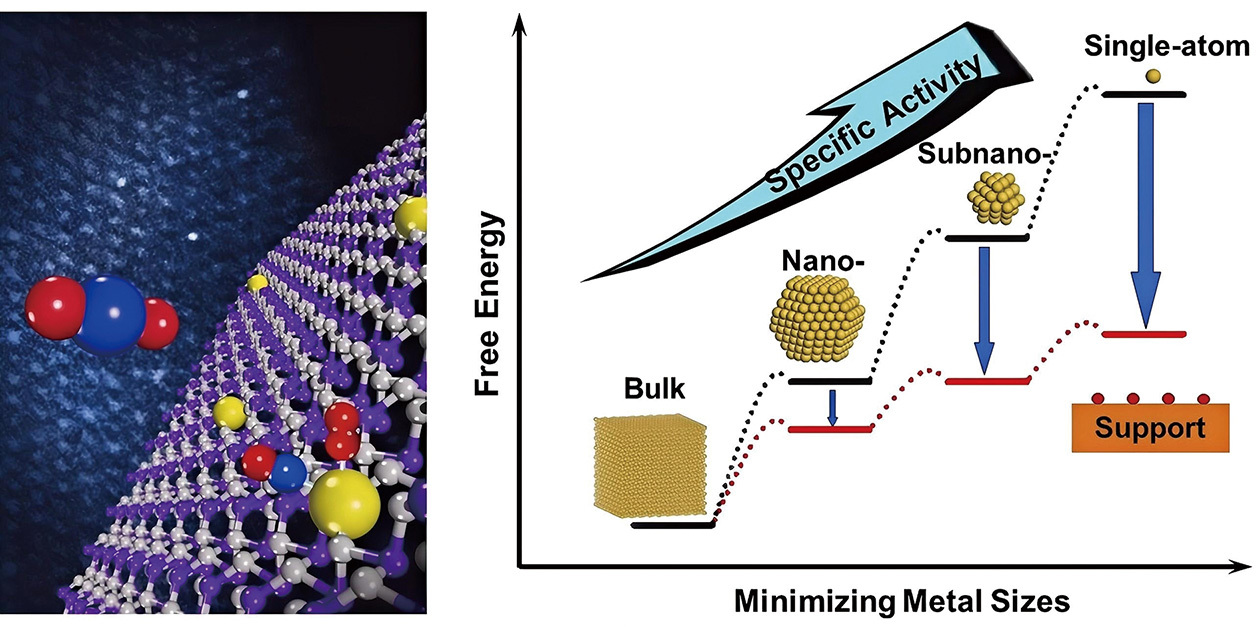
Left: An illustration of single platinum atoms (yellow spheres) on iron oxide (purple and gray) mediating the conversion of CO to CO2 with extremely high atom efficiency and stability. Right: The dispersion of single-atom on supports shows many unique characteristics that enable the improvement of both catalytic stability and activity. (Credit: DICP)
ZHANG’s team was also the first to propose that the coordination environment is the most characteristic descriptor of single-atom catalysts. They quantitatively identified metal-nitrogen species with diverse coordination environments in Fe-N-C single-atom catalysts; established a linear correlation between the metal-oxygen/nitrogen coordination number, the electron density of the single-atom center, and the resulting catalytic activity; revealed the influence of inner- and outer-sphere coordination atoms on the electronic properties and reactivity of the single-atom center; and elucidated the dynamic evolution of single-atom coordination under operating conditions. The related studies have been highlighted multiple times by C&EN and other scientific media. These discoveries provide guidance for tuning the coordination and performance of single-atom catalysts, spearheading new research directions in the field.
A New Paradigm in Chemistry
This innovation of SAC represented a massive conceptual leap. It shifted the understanding of active sites in heterogeneous catalysis from the micro- and nanoscale to the precise level of individual atoms.
ZHANG’s team continued to expand the boundaries of this field. They discovered that the “coordination environment” of the single atom is the key descriptor of catalytic performance, allowing for the precise tuning of activity and selectivity. They successfully applied SAC to complex reactions beyond simple oxidation, including nitroarene hydrogenation and hydroformylation, achieving performance levels that traditional catalysts could not match.
By combining the uniform, isolated active sites typical of homogeneous catalysis with the stability and ease of separation found in heterogeneous catalysis, SAC may have the potential to bridge the gap between these two major branches of catalytic chemistry.
The establishment of SAC landed “like a stone in still water,” creating ripples that have spread globally. The impact of this research extends far beyond the laboratory, evidenced by the fact that more than 1,000 research institutions around the world have followed up on these findings. In terms of economic and environmental efficiency, because SAC maximizes atom utilization, it offers a pathway to drastically reduce the usage of expensive noble metals like platinum and gold.
ZHANG Tao’s work has deepened the fundamental understanding of chemical reactions and opened a new frontier in catalytic science, heralding a future where catalysts are not only more efficient but also atomically precise.
Reference
Qiao, B., Wang, A., Yang, X., et al. (2011) Single-atom catalysis of CO oxidation using Pt1/FeOx. Nature Chemistry, 3(8), 634–641. doi:10.1038/nchem.1095