

The 2026 Tan Kah Kee Science Award in Life Sciences goes to “Genome Design of Hybrid Potato”, a game-changing agricultural innovation achieved by a research team led by Prof. HUANG Sanwen from the Agricultural Genomics Institute at Shenzhen (AGIS), Chinese Academy of Agricultural Sciences (CAAS). The outstanding work has transformed a clonally propagated crop into a sexually reproduced one for the first time in history.
For centuries, the humble potato has survived harsh climates and quietly sustained empires, feeding billions of people. Today, it remains a vital staple for roughly 1.3 billion people worldwide. Yet, beneath its unassuming, starchy exterior lies a genetic labyrinth so convoluted that it has frustrated plant breeders for generations.
Unlike cereal crops that are grown from true seeds, the modern commercial potato is a propagated asexually through tubers, and is an autotetraploid whose genetic makeup follows four complete sets of “instruction manuals”, instead of the usual two. Farmers need to plant about 3 tons of seed tubers per hectare of farm—a practice that demands massive storage and transportation logistics with high costs. Compared with other major crops, the genetic gains in potatoes have been small and traditional potato breeding is a slow, non-accumulative slog that can take 10 to 15 years to yield a new variety. To break these bottlenecks, visionary plant genomicist Prof. HUANG Sanwen realized that it required a complete reinvention for potatoes to unlock the crop’s huge potential in the global food and nutrition security.
Spearheading the ambitious “Upotato Plan” (meaning “Superior Potato Plan”), HUANG embarked on an extraordinarily complex biological undertaking: to transform the potato from a cumbersome, tuber-propagated tetraploid into a nimble, seed-propagated diploid crop. This paradigm-shifting endeavor required nothing short of genomic alchemy, and his contributions have since utterly transformed our understanding of crop evolution.
Decoding the Enigma
You cannot rewrite a blueprint that you cannot even read. The potato’s highly heterozygous nature has made its genome a notoriously difficult puzzle to assemble and analyze. In 2011, HUANG played a leading role in the international effort to sequence and analyze the potato genome, publishing the landmark results in Nature as a cover article (Xu et al., 2011). This foundational mapping provided the first real glimpse into the genetic architecture of the tuber, revealing a palaeopolyploid origin and tracing the expansion of gene families responsible for tuber development.
Building on this foundation, HUANG’s team analyzed 128 genomes, including those from cultivated potato varieties and their wild relatives, to uncover the evolutionary origins of the tuber itself (Zhang et al., 2025). They revealed that the modern potato lineage is the product of an ancient hybridization between the wild relative Etuberosum and Tomato lineages 8 to 9 million years ago—a vital move that has driven underground tuberization and triggered the explosive species radiation of wild potatoes.
However, mapping the genome and its evolutionary history was merely the prologue. To transition the potato into a seed-propagated diploid, HUANG’s team had to confront two formidable biological barriers that had evolved over millions of years: self-incompatibility and profound inbreeding depression.
Overcoming Self-Incompatibility
In nature, most diploid potatoes possess a biological failsafe to prevent self-fertilization, ensuring genetic diversity but making the creation of pure inbred lines—the cornerstone of modern hybrid breeding—impossible. This self-incompatibility is largely governed by S-RNase genes expressed in the plant’s style.
Through meticulous genomic design, HUANG and his colleagues identified and utilized natural mutations, or employed CRISPR-Cas9 genome editing to knock out the S-RNase gene entirely, dismantling the plant’s ability to reject its own pollen (Ye et al., 2018). As expected, the recalcitrant potato could self-pollinate. The first barrier was shattered, but the second was a veritable genetic minefield.
An Evolutionary Lens and a Paradox
When a clonally propagated plant is suddenly forced to inbreed, the results are often catastrophic. Millions of years of asexual reproduction allows the accumulation of a vast reservoir of “deleterious mutations” (harmful genetic defects), hidden behind the mask of heterozygosity. When inbred, these recessive flaws are exposed, leading to stunted growth, sterility, and death—a phenomenon known as inbreeding depression.
To unravel the genetic basis of this severe inbreeding depression, HUANG’s team conducted extensive genetic analyses of diploid potato inbred populations and constructed high-resolution, haplotype-resolved genomes. They uncovered a daunting genetic reality: Deleterious recessive alleles are largely lineage-specific, that is, each potato line has its own deleterious mutations (Zhang et al., 2019). Severe deleterious alleles are distributed in a widespread, mosaic pattern across the two haplotypes in a heterozygous state (Zhou et al., 2020). This mosaic architecture fundamentally explains why traditional phenotypic selection fails—it is nearly impossible to intuitively break the tight, repulsion-phase linkages between these hidden deleterious mutations and essential beneficial alleles without precise genomic intervention.
To purge these hidden genomic landmines, HUANG’s team pioneered an ingenious tool: the “Evolutionary Lens.” By constructing a deep whole-genome phylogeny of 92 species across the nightshade family (Solanaceae) and its sister clades, they tracked the evolutionary constraints of the genome over millions of years (Wu et al., 2023). This allowed them to map a genome-wide atlas of deleterious variants, pinpointing exactly where the genetic “broken windows” lay.
Armed with this atlas, the researchers introduced a profoundly counterintuitive breeding philosophy. Traditional breeders instinctually select the most vigorous, robust plants for propagation. However, HUANG’s genomic analysis revealed a paradox: Highly vigorous diploid clones actually harbor a massive burden of hidden, heterozygous deleterious mutations. If these robust plants are used as founders, their hidden genetic burden inevitably dooms their inbred descendants. Instead, they proposed “selecting weak seedlings over strong ones”. By choosing less vigorous plants that possessed a higher homozygous deleterious burden but a lower total genetic burden, they could effectively flush the hidden mutations out of the gene pool, successfully developing highly homozygous inbred lines.
Hybrid Revolution: From Tubers to True Seeds
Building on these evolutionary insights, HUANG’s team established a comprehensive hybrid breeding system for the potato (Zhang et al., 2021). They first screened founder materials with low deleterious mutation burdens. Through precise genome design, they identified and purged large-effect deleterious mutations and broke their repulsion-phase linkages, effectively eliminating Hill-Robertson interference. Finally, by matching crosses based on genomic complementarity, they pioneered the world’s first highly homozygous inbred lines and unlocked the potato’s hybrid vigor (heterosis).
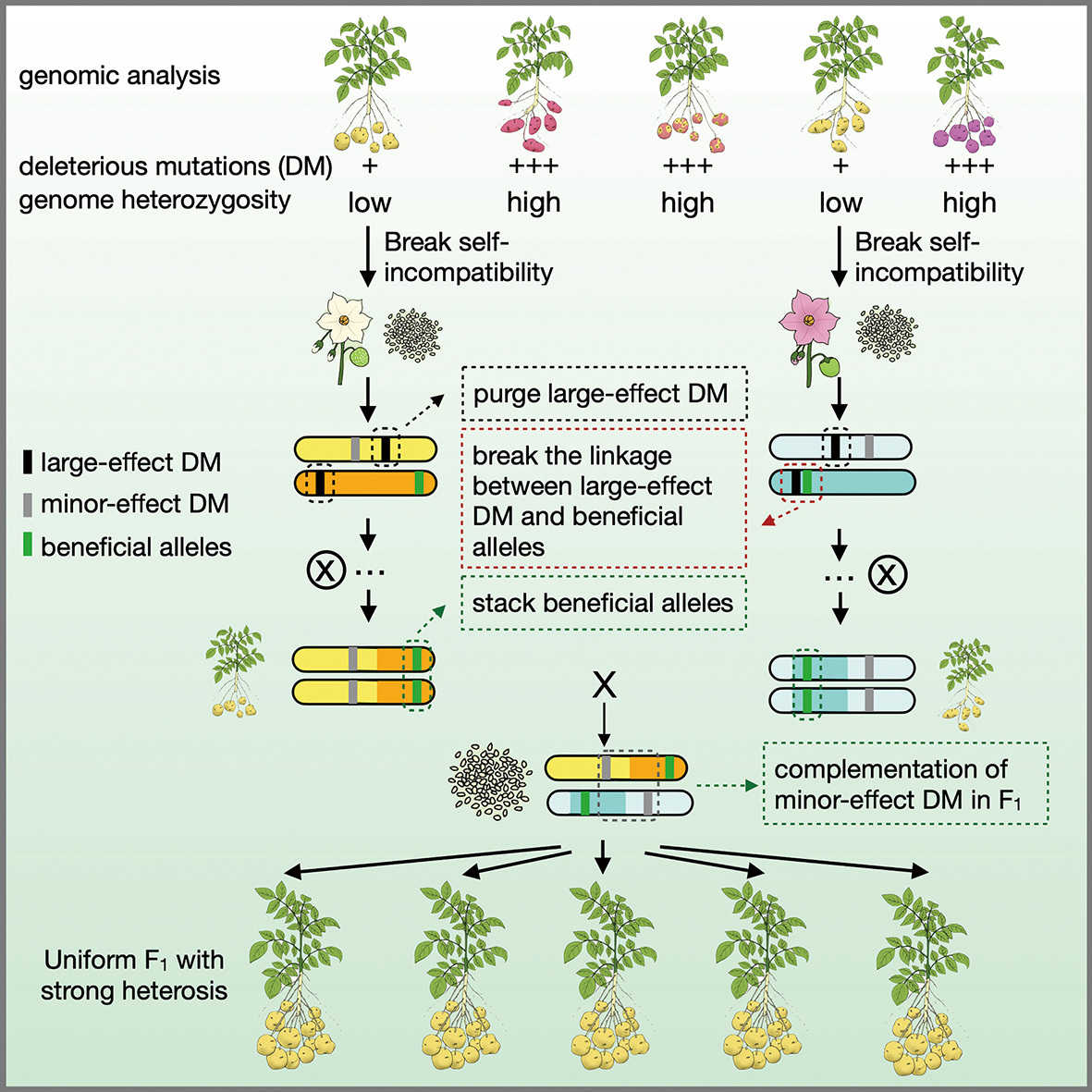
Genome design for hybrid potato breeding that removes deleterious (black) alleles and enriches beneficial (green) ones. (Reprinted with permission from Elsevier, Zhang et al., 2021)
The effort yielded prototype varieties like “Upotato 1” (Youshu-1 in Chinese) and “Upotato 2” (Youshu-2)—which have undergone successful trial plantings across five provinces, delivering high dry matter content, rich carotenoid profiles, and exceptional uniformity.
The logistical implications of this scientific breakthrough are staggering. A traditional potato farm requires approximately 3 tons of perishable, disease-prone seed tubers to plant a single hectare of land. Under HUANG’s new hybrid seed system, that requirement is reduced dramatically to a mere 30 grams of true botanical seeds. By replacing bulky tubers with true seeds, this innovation effectively solves the perennial problems of seed-borne viral accumulation and the massive logistical burdens of storage and transportation. Furthermore, the breeding cycle to develop new varieties, once a 10-to-15-year marathon, has been compressed into a rapid 3-to-5-year sprint.
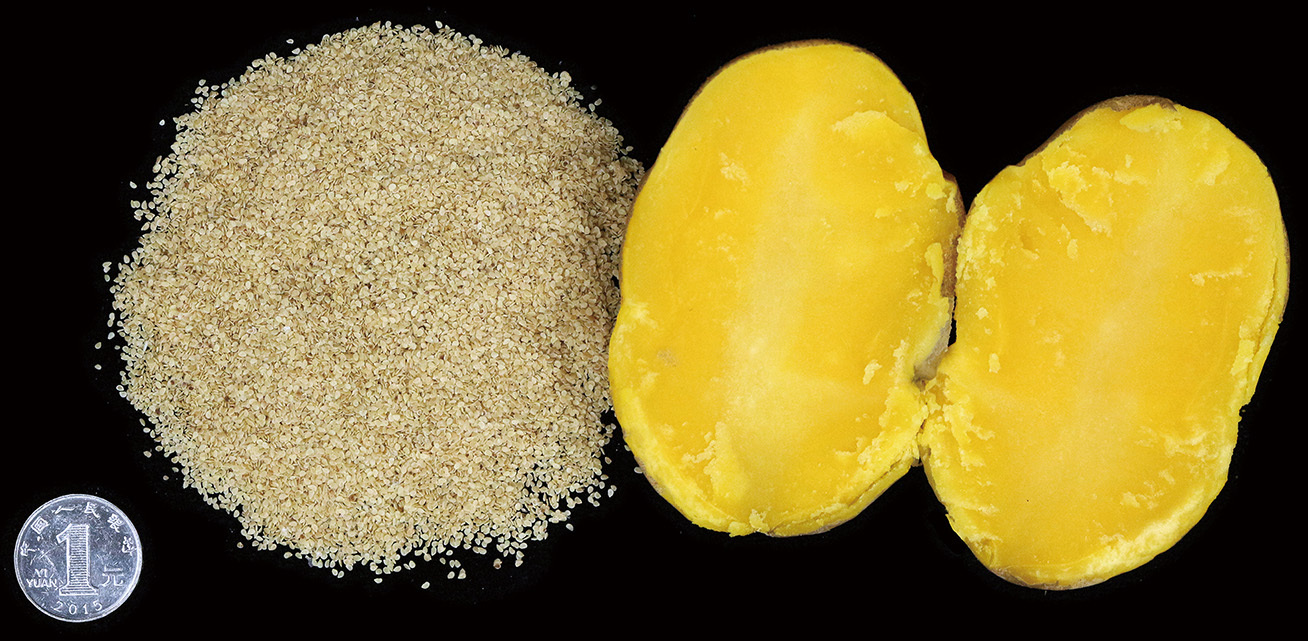
Upotato 1: seeds and tubers. (Photo: HUANG’s group)
Domestically, the strategic potential is immense. These hybrid potatoes are perfectly suited for over 100 million mu (about 6.7 million hectares) of winter fallow fields in southern China. Cultivating this vast, untapped area will significantly reduce China’s reliance on foreign food imports, bolstering national food security. Recognizing this impact, the technology was named a “2021 Major New Technology for Agriculture and Rural Areas in China”.
Furthermore, HUANG’s team mapped a pan-genome to completely resolve two haplotypes and designed an “ideal haplotype” blueprint with minimal deleterious mutations, providing a precise genomic guide for the continuous, iterative improvement of elite inbred lines (Cheng et al., 2025).
A Blueprint for the Future
What HUANG’s team has achieved is not merely improving the breeding of the potato, but fundamentally reinventing it. Plant geneticist Nils Stein at the Leibniz Institute of Plant Genetics and Crop Plant Research (IPK) in Germany called it the “reinvention of the potato,” and agronomist YUAN Longping (late “Father of hybrid rice,” Academician of the Chinese Academy of Engineering) praised it as a “disruptive innovation that will bring about a green revolution in potatoes.”
Furthermore, HUANG’s paradigm of genome-designed hybrid breeding extends far beyond the potato field. Of the 100 most widely planted crops globally, 45 are propagated asexually—including cassava, sweet potato, bananas, and sugarcane—feeding a quarter of the world’s population. Due to their highly heterozygous genomes and unpredictable breeding results, however, breeding of them has lagged far behind that of sexually propagating crops like corn, rice and wheat. By establishing the “Global Hybrid Potato Alliance” together with international partners including the International Potato Centre located in Lima, Peru, HUANG’s team has already trained more than 20 potato scientists from 12 developing countries, ensuring that this genomic revolution addresses the urgent food security challenges for the Global South.
Through the meticulous unraveling of ancient evolutionary codes, HUANG and his team have transformed a complex, burdensome tuber into a streamlined, resilient crop of the future. It is a milestone in agricultural genetics: A spectacular achievement that not only validates the theoretical and practical feasibility of seed-based potato propagation, but fundamentally establishes a powerful, translatable paradigm for the genetic improvement of other vegetatively propagated crops globally.
Reference
Cheng, L., Wang, N., Bao, Z., Zhou, Q., Guarracino, A., Yang, Y., . . . Huang, S. (2025). Leveraging a phased pangenome for haplotype design of hybrid potato. Nature, 640(8058), 408–417. doi: 10.1038/s41586-024-08476-9
Wu, Y., Li, D., Hu, Y., Li, H., Ramstein, G. P., Zhou, S., . . . Huang, S. (2023). Phylogenomic discovery of deleterious mutations facilitates hybrid potato breeding. Cell, 186(11), 2313–2328.e15. doi: 10.1016/j.cell.2023.04.008
Xu, X., Pan, S., Cheng, S., Zhang, B., Mu, D., Ni, P., . . . Visser, R. G. (2011). Genome sequence and analysis of the tuber crop potato. Nature, 475(7355), 189–195. doi: 10.1038/nature10158
Ye, M., Peng, Z., Tang, D., Yang, Z., Li, D., Xu, Y., . . . Huang, S. (2018). Generation of self-compatible diploid potato by knockout of S-RNase. Nature Plants, 4(9), 651–654. doi: 10.1038/s41477-018-0218-6
Zhang, C., Wang, P., Tang, D., Yang, Z., Lu, F., Qi, J., . . . Huang, S. (2019). The genetic basis of inbreeding depression in potato. Nature Genetics, 51(3), 374–378. doi: 10.1038/s41588-018-0319-1
Zhang, C., Yang, Z., Tang, D., Zhu, Y., Wang, P., Li, D., . . . Huang, S. (2021). Genome design of hybrid potato. Cell, 184(15), 3873–3883.e12. doi:10.1016/j.cell.2021.06.006
Zhang, Z., Zhang, P., Ding, Y., Wang, Z., Ma, Z., Gagnon, E., . . . Huang, S. (2025). Ancient hybridization underlies tuberization and radiation of the potato lineage. Cell, 188(19), 5249–5265.e15. doi: 10.1016/j.cell.2025.06.034
Zhou, Q., Tang, D., Huang, W., Yang, Z., Zhang, Y., Hamilton, J. P., . . . Huang, S. (2020). Haplotype-resolved genome analyses of a heterozygous diploid potato. Nature Genetics, 52(10), 1018–1023. doi: 10.1038/s41588-020-0699-x