

“The Evolution of the Jehol Biota and Its Geological Background,” led by Prof. Dr. ZHOU Zhonghe, Member of the Chinese Academy of Sciences (CAS) and a researcher with the Institute of Vertebrate Paleontology and Paleoanthropology (IVPP), CAS, has won the 2026 Tan Kah Kee Award in Earth Sciences.
With decades of efforts, ZHOU’s team have greatly enriched humans’ understanding of the evolutionary process from dinosaurs to birds, and based on the discoveries and analyses of plenty of new species, the team further revealed the process and mechanism of the diversity evolution of the Jehol Biota. Moreover, integrating their work with studies of stratigraphy and tectonics by adopting an Earth system science approach, they proposed the hypothesis of the consistent diachronous development of tectonics, volcanism, continental basins and strata in the Early Cretaceous of East Asia, as well as the hypothesis that the evolutionary radiation of the Jehol Biota is controlled by the tectonic activity occurring at the depth of the Earth system. ZHOU and his team have significantly promoted the development of fundamental theories in this field, with far-reaching influence in the global circle of paleontology, and even in the international community of solid Earth sciences.
The Jehol Biota
The Jehol Biota, discovered in the lacustrine sediments of Liaoning and Hebei provinces as well as Inner Mongolia in northeastern China, is a fossil treasure trove renowned for feathered dinosaurs, well-preserved early birds, mammals, pterosaurs, insects, early angiosperms and other groups. It has been in the focus of research for nearly a century since its discovery. Starting from the 1990s, a large number of precious fossils from there have provided crucial evidence for the research on the origin and evolution of various biological groups. Among them, well-known to paleontology enthusiasts are the large number of fossil dinosaurs, including feathered ones, and early birds, offering a wonderful window into the transition from dinosaurs to birds.
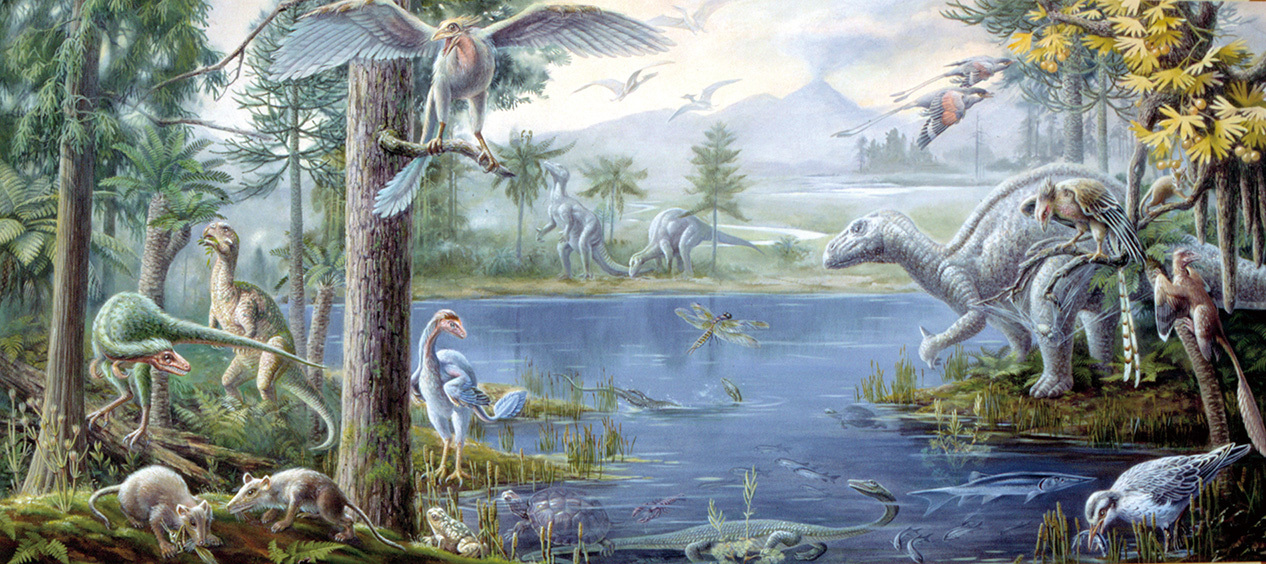
Ecological reconstruction of the Jehol Biota. Rather than a mere “refugium for relics,” it is a cradle and center of diversification for many Cretaceous groups. (Credit: IVPP)
Concerning the evolution of dinosaurs and birds, the team highlighted the preservation of soft tissues and their significance in the research on biological evolution, and integrated traditional paleontology with modern biology to explore the developmental plasticity and sexual selection in biological evolution. Through interdisciplinary research on feather melanosomes and other materials, they reconstructed the feather color of early dinosaurs and birds, unraveled the evolution of ancient feather proteins, and that of the digestive, respiratory and reproductive systems of birds. Based on evidence accumulated over the past decades, the team elucidated the mode and tempo of the transition from dinosaurs to birds.
Thanks to their work, the dinosaur-bird transition has been evaluated as among the best documented ever in the history of paleontology. They advanced to propose that early birds already possessed key characteristics similar to modern birds, such as crop, lung and feather protein structure, and put forward the hypothesis that developmental plasticity and sexual selection played a role in driving the evolution of early birds.
ZHOU and his colleagues’ studies on early birds and the Early Cretaceous Jehol Biota have been commented on or reported by many important academic journals, such as Science, Proceedings of the National Academy of Sciences (PNAS), and Nature Ecology & Evolution, and have been highly praised by many renowned scholars. The research results have been extensively included in authoritative textbooks published in Europe and America.
The Jehol Biota as an Ecosystem
As a Konservat-Lagerstätte of fossils, the Jehol Biota is the most important object for studies of the origin of birds and their flight, the origin and evolution of auditory ossicles in the mammalian middle ear, and the co-evolution of insects and plants on Earth. Its duration, its biodiversity composition, the environmental background of its formation, the evolutionary mechanisms of its key biological groups (such as birds, dinosaurs and pterosaurs), and the relationship between its own evolution and the destruction of the North China Craton have long been major foci of academic research.
Building on their long-term comprehensive research on the key biological groups of the Jehol Biota and their stratigraphic ages in northeast and north China, ZHOU and his team started to examine the whole biota from a more holistic and systematic view.
On the basis of long-term geochronological and biostratigraphic studies of the fossil-bearing deposits of the biota, ZHOU and his team gave a preliminary temporal framework in a review published in Geological Journal (DOI: 10.1002/gj.1045) in 2006, stating that the Jehol Biota had lasted for at least 11 million years during the late Early Cretaceous (spanning from 131 to 120 million years ago). He has since established the chronological sequence of fossil-bearing strata for the Jehol Biota, and revealed that the Biota had undergone three major phases of evolution, each defined by distinctive biodiversity signatures. Particularly, the second phase saw the most significant biological radiation. He noted that a high percentage of the major vertebrate groups in the Biota were arboreal and herbivorous, suggesting an adaptation to the diverse forest environment. In addition to strong phylogenetic and morphological differentiation and high taxonomic diversity, he noted, the Jehol Biota is also characterized by significant dietary differentiation and biological interactions, with competition and co-evolution between various animal groups imbedded in tectonic activities and palaeoclimatic changes both at a global and local scale.
With in-depth analysis of the diversity composition and ecological background of the Jehol Biota, ZHOU further concluded that the differentiation of feeding habits and behaviors of the vertebrates as well as the prosperous forest environment had promoted the prosperity of the Jehol Biota.
Departing from the traditional view interpreting Jehol Biota as a mere “refugium for relics,” ZHOU reinterpreted it primarily as a cradle and center of diversification for many Cretaceous groups. Its evolutionary radiation was shaped by a combination of regional/global geological and climatic changes, and intrinsic biological factors like adaptation, dietary differentiation, and interspecific interactions. It provides an exceptional window into Early Cretaceous terrestrial ecosystems and the origins of modern ecosystems.
The Jehol Biota as Imbedded in the Earth System
After decades of research on the individual biological groups at different evolutionary stages of the Jehol Biota, ZHOU moved on to explore the relationship between the biota as a whole ecosystem and its hosting geological environments. On the one hand, his team continued research on early birds and their dinosaur ancestors, making important discoveries one after another; on the other, from a view of Earth system science, they carried out a great deal of interdisciplinary exploratory research across different spheres of the Earth system.
Resulting from their decade-long efforts, the team made important progress in a series of research issues, including the biodiversity restoration of the Jehol Biota, its formation, development and the underlying mechanism, and the relationship between its evolution and the concurrent geological environments—the subduction of the paleo-Pacific Plate, the destruction of the North China craton (NCC), and the impact of the Yanshan Movement, a tectonic movement widely influencing the whole China from the Jurassic to the Cretaceous Period.
Particularly, he and colleagues focused on the impact from the NCC Destruction, a tectonic event concurrent with the evolution of the biota.
In a paper titled “Spatiotemporal evolution of the Jehol Biota: Responses to the North China craton destruction in the Early Cretaceous” published in PNAS (https://doi.org/10.1073/pnas.2107859118) in 2021, ZHOU and his team investigated the spatiotemporal evolution of the Early Cretaceous Jehol Biota and its relationship with the local tectonic processes.
The authors analyzed that spatiotemporally, the biota at first was limited within an area centering on nowadays Hebei Province of China. The biota then significantly diversified and radiated, expanding its distribution eastward, westward and southward, spreading across northeast China and beyond into regions like Mongolia, Korea, Japan, and Transbaikalia (Russia).
Further, they unveiled the connection between the Biota’s evolution and the NCC Destruction, a series of tectonic activities triggered by the subduction, trench retreat and slab rollback of the paleo-Pacific plate. During the Early Cretaceous, NCC Destruction caused widespread lithospheric extension, magmatism and the formation of rift basins in eastern China. The team found that the prosperity of the Biota (about 125 million years ago) temporarily coincided with the initial and the peak stages of the NCC Destruction. Moreover, biological groups of the biota were mainly distributed in the eastern and northern edges of the NCC, where the most serious destruction manifested.
The team discovered that the Early Cretaceous rift basins migrated eastward in the northern margin of the NCC and the Great Xing’an Range, and analyzed that the migration could have resulted from the eastward retreat of the subducting paleo-Pacific plate. On the other hand, the distribution and prosperity center of the Jehol Biota also shifted eastward. The team hence proposed a tectonic-biotic coupling mechanism: As the spatial-temporal correlation between the tectonic activity and the biota’s evolution suggests, the eastward retreat of the subducting paleo-Pacific plate could have controlled the sequential, eastward migration of tectonic and volcanic activity; and this, in turn, triggered the diachronous development of sedimentary basins and paleoenvironments, which directly governed the spatiotemporal evolution and migration of the Jehol Biota.
The study presents a clear example of how surface geological processes like basin formation and paleogeography—as responses to the changes occurring at the depth of the Earth—control the evolution and distribution of a terrestrial biota. Also, this study highlights the need to look at paleontology from the perspective of Earth system, integrating processes of multiple spheres, and considering the inter-spheric reactions.
Far-reaching Implications in Disciplinary Development
The innovative work by ZHOU and his colleagues on the diachroneity of continental strata solved the long-standing discrepancy between biostratigraphic and chronostratigraphic correlations. Integrating traditional paleontology and stratigraphy with geochemistry, tectonics, petrology, deep Earth dynamics and other disciplines, they proposed the deep and surface mechanisms driving the evolution of the Jehol Biota. Their work has also promoted the interdisciplinary integration of paleontology with other geological disciplines across different spheres, and life sciences.
ZHOU was recently selected into the list of the world’s top 0.05% scientists of lifetime influence released by ScholarGPS, ranking first in the research field of “the Early Cretaceous.”
ZHOU has successively served as Vice President and President of the International Palaeontological Association, respectively. He was elected as a Foreign Associate of the US National Academy of Sciences in 2010, elected as a Fellow of the World Academy of Sciences for the Advancement of Science in Developing Countries and a Corresponding Member of the Brazilian Academy of Sciences in 2015, and elected as an Honorary Member of the American Ornithological Society and a Member of the International Ornithologists’ Union Committee in 2019 and 2022 respectively.
Reference
Zhou, Z.* (2006) Evolutionary radiation of the Jehol Biota: chronological and ecological perspectives. Geological Journal, 41: 377393. https://doi.org/10.1002/gj.1045
Zhou, Z.*, Meng, Q., Zhu, R., & M. Wang. (2021) Spatiotemporal evolution of the Jehol Biota: Responses to the North China craton destruction in the Early Cretaceous, Proceedings of National Academy of Sciences, 118 (34) e2107859118. https://doi.org/10.1073/pnas.2107859118