

Dr. CAI Shuhui, researcher at the Institute of Geology and Geophysics (IGG), Chinese Academy of Sciences (CAS), has won the 2026 Tan Kah Kee Young Scientist Award in Earth Sciences, for her outstanding work on the samples returned by Chang’e-5 (CE-5) and Chang’e-6 (CE-6) missions. She led the development of an innovative methodology for studying extremely weak magnetic records in small and fragile extraterrestrial samples, and obtained critical constraints on the mid-stage evolution of the lunar magnetic field. Her research suggests that the lunar dynamo may have strengthened again around 2.8 billion years ago and persisted, albeit weakly, until at least about 2.0 billion years ago, revising current views of the Moon’s magnetic and thermal evolution.
The paleomagnetic field of the Moon, as well as its possible power sources, is essential for understanding the inner structure, thermal history and surface environment of this satellite.
The Elusive Lunar Magnetic Field
Orbital and in-situ observations show that the Moon does not possess a global dynamo magnetic field nowadays. Yet these observations also reveal widespread magnetization in the lunar crust, with the strongest surface magnetic anomalies reaching hundreds of nanoteslas. This contrast suggests that the Moon once experienced stronger magnetic fields, which later faded.
The mechanism that produced this magnetic field remained ambiguous. Was it generated by a lunar dynamo broadly analogous to the Earth’s? What energy source could have powered it? What was its geometry? How long did it persist? And, why did it disappear? Answers to these questions can help us understand the Moon’s interior, thermal evolution and surface environment, and can also inform broader questions in planetary science, including the evolution of Earth and other rocky bodies.
Any moving charged material can produce a magnetic field. Specifically, for the Moon, scientists have come up with some theories about the possible mechanisms that might have driven the ancient magnetic field there. A possible mechanism is a global dynamo: The rotation of the conductive metallic core could have generated a magnetic field for the Moon. Another possible driver could be the transient field generated by the impact events. Fierce impacts from extraterrestrial objects may remagnetize rapid-cooling rocks and let them record such impact-generated field.
Paleomagnetic studies of Apollo samples have provided a broad outline of lunar magnetic evolution. From about 4.2 to 3.5 billion years ago, the Moon may have possessed an active dynamo that generated a strong magnetic field, with intensities of up to several tens of microteslas. For comparison, Earth’s surface magnetic field is about 25 to 30 microteslas near the equator and about 60 to 70 microteslas near the poles. This magnetic field receded by an order of magnitude about 3.1 billion years ago, down to merely several microteslas, and possibly ceased at some time about 1 billion years ago.
This overall picture about the Moon’s magnetic evolution is incomplete. Spatially, before CE-6, no sample was obtained from the lunar far side. Temporally, before CE-5, the available paleomagnetic data retrieved from basalts were mainly older than about 3.0 billion years, with merely sporadic data from breccia reflecting the evolution thereafter. As a result, the middle- to late-stage evolution of the lunar magnetic field remained poorly known, leaving major uncertainties over the lifetime, geometry and driving power of the lunar dynamo.
A Great Opportunity from Chang’e Samples
China’s CE-5 mission collected the first batch of mid-latitude lunar basalt samples from the Oceanus Procellarum. Basalts are valuable for paleomagnetic research because, when they cool from lava, they can lock in a record of the magnetic field present at the time and place of cooling. Dating work by the group led by Prof. LI Xianhua and other researchers showed that the CE-5 basalts are about 2.0 billion years old, making them the youngest lunar basalts returned to Earth so far. These young samples therefore provide a rare window into the middle to late stages of the Moon’s magnetic evolution.
The CE-6 mission returned the first samples ever collected from the lunar far side. The basalt clasts studied by CAI and colleagues came from the southern Apollo crater within the South Pole-Aitken basin and were dated to about 2.8 billion years ago. They therefore fill an important gap both in time, between the older Apollo record and the younger CE-5 record, and in space, by providing the first direct paleomagnetic evidence from the lunar farside.
To meet the special requirements of lunar returned samples, which are scarce, tiny and magnetically weak, the team established a high-precision, low-loss workflow for magnetic measurements. This methodology provides technical support not only for CE-5 and CE-6 samples, but also for future samples returned by deep-space missions.
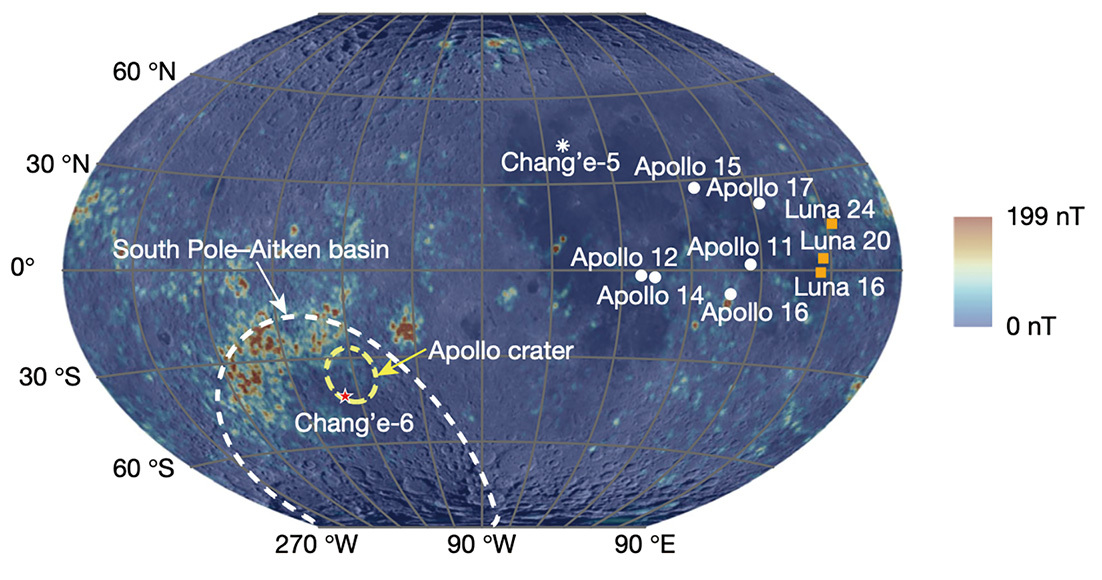
Magnetic anomalies on the lunar surface, together with the landing sites of different lunar exploration missions. (Image by IGG)
Recovering Lunar Paleointensities
Led by CAS Member Prof. ZHU Rixiang at IGG, Dr. CAI Shuhui’s team worked with colleagues from the National Astronomical Observatories, CAS (NAOC) to measure and analyze the paleomagnetism of four CE-6 basalt samples. Their results revealed an unexpected rebound in the strength of the lunar magnetic field around 2.8 billion years ago, offering new evidence for understanding the evolution and possible power sources of the lunar dynamo.
Previous model suggested that, after the sharp decline around 3.1 billion years ago, the lunar dynamo may have entered a prolonged low-energy state before its eventual demise. Several mechanisms had been proposed for such late-stage activity, including core crystallization and mechanical stirring related to the Moon’s precession. The CE-6 results challenged the idea that the post-3.1-billion-year lunar dynamo simply remained weak until it disappeared.
The team reported online in Nature on December 19, 2024 that the recovered CE-6 paleointensity varies from 5 to 21 microteslas, much stronger than the intensities for this age predicted by the previous hypothesis. Because lunar rocks may carry magnetic records from several possible sources, the team carefully separated different remanence components and evaluated possible contamination. They assessed effects from Earth’s magnetic field after sample return, local crustal magnetic anomalies near the CE-6 landing site in the southern Apollo crater within the South Pole-Aitken basin, and possible impact-related remagnetization. The team also examined the samples using computed tomography (CT), scanning electron microscopy (SEM), Raman spectroscopy and optical microscopy. These observations showed that the basalt clasts largely preserve primary volcanic textures and have limited shock modification, arguing against an impact origin for the stable remanence used to estimate paleointensity.
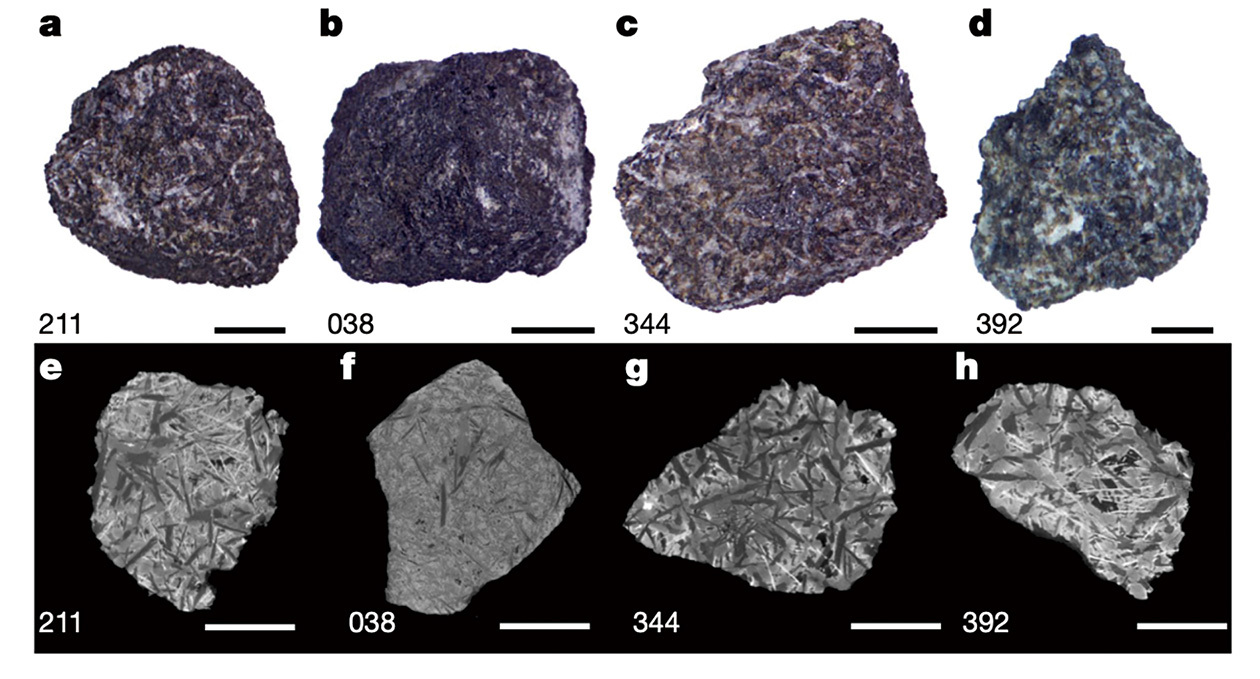
Stereomicroscope photos (a–d) and CT transects (e–h) of the basalt clasts investigated in the study. The well-preserved volcanic textures and limited shock modification argue against an impact origin for the recovered stable remanence. (Image by IGG)
A Dynamo Origin for the Recovered Field
After evaluating these possible non-dynamo sources, the team concluded that the moderate-to-strong paleointensities recovered from the CE-6 basalt clasts are most likely to reflect a global lunar dynamo field.
To find out what could have powered this magnetic field, the team explored simulation results of different types of dynamos as possible power sources for the paleointensities of CE-6 samples. They found that the measurements were most consistent with a basal-magma-ocean dynamo, although other mechanisms, such as precession supplemented by core crystallization, remain possible. The basal magma ocean is proposed to form from the emplacement of a radioactive heat-producing and metalliferous layer at the core-mantle boundary during the lunar mantle overturn.
These results imply that the lunar dynamo was probably still operating in a moderately strong state about 2.8 billion years ago. However, since both the basal magma ocean and precession models still involve major uncertainties, the exact power source of the 2.8-billion-year-old lunar dynamo remains open.
The team suggested that this reinforcement might imply a re-activation of the once declined dynamo, or some change in the magnetic field’s driving mechanism. Their further analyses revealed that during the period between about 3.5 to 2.8 billion years ago, the lunar dynamo might have experienced an unstable period, which led to visible fluctuations in the magnetic field.
Clues from CE-5
The CE-5 samples, dated to about 2.0 billion years ago, provide a window into the Moon’s subsequent magnetic evolution. Using several paleointensity methods, CAI’s team investigated nine CE-5 basalt clasts and obtained reliable estimates for reconstructing the state of the lunar dynamo at about 2.0 billion years ago.
On January 1, 2025—just less than two weeks after the aforementioned Nature paper, CAI’s group reported their discovery in Science Advances that the Moon still had a weak dynamo-generated magnetic field of approximately 2 to 4 microteslas about 2.0 billion years ago. This result implies that thermal convection may still have existed in the lunar deep interior at that time. Potential energy sources include core crystallization, precession-driven mechanical stirring and the sinking of ilmenite-rich mantle cumulates. Such long-lived interior dynamics may have contributed heat to the Moon’s relatively young volcanic eruptions.
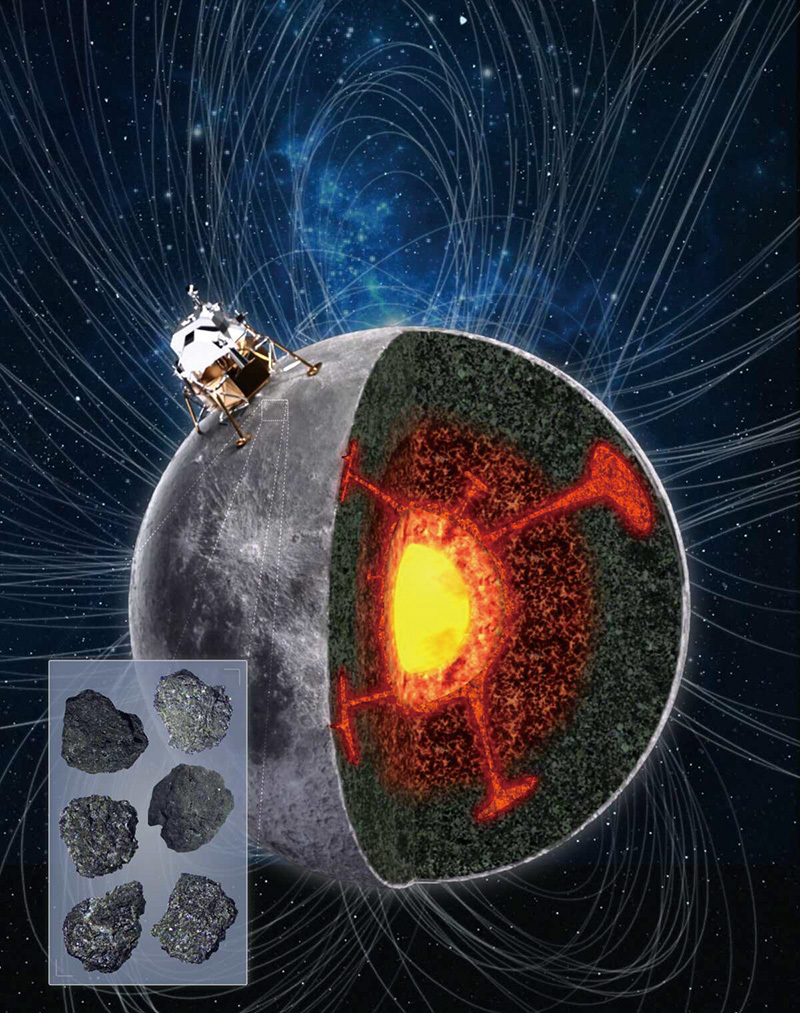
Samples brought back by CE-5 indicate that about 2 billion years ago, the Moon may still have had a weak magnetic field produced by a lunar dynamo. (Image by IGG)
This work further filled a temporal gap with important constraints in the midstage of the Moon’s magnetic evolution. Combining the results from both CE-5 and CE-6 samples, the team concluded that the lunar dynamo magnetic field might have kept operating at least until its midlife, with possible fluctuations in its strength.
The CE-5 paper was published together with a commentary by Prof. Benjamin P. Weiss, a planetary scientist at the Massachusetts Institute of Technology. In this commentary, titled “The Moon goddess’s magnetic midlife”, Prof. Weiss noted that the CE-5 basalts, because of their age, magnetic properties and mid-latitude landing site, provide valuable information for reconstructing the lunar paleomagnetic field. He also highlighted the research design that enabled CAI’s team to extract useful constraints from unoriented lunar soil fragments.
The Shape of the Ancient Lunar Magnetic Field
Most studies of the lunar magnetic field focused on its intensity rather than geometry. In the limited discussions of its shape, several models have been proposed. One commonly discussed model is that the ancient Moon may have had a field resembling a bar magnet aligned along the Moon’s spin axis [named a selenocentric axial dipole (SAD)]. However, because the Moon rotates much more slowly than the Earth, its ancient magnetic field may have been more complex than the Earth’s present field.
Constraining the geometry of the lunar magnetic field is difficult. The CE-5 samples are unoriented soil fragments, so their remanence directions cannot directly reveal the direction of the ancient local field. However, CAI’s team used an indirect approach. As Prof. Weiss commented, the CE-5 landing site is the highest-latitude site from which lunar samples have been returned, making it especially useful for testing whether the field strength changed with latitude as expected for a simple axial dipole.
In a SAD field, both inclination and intensity vary systematically with latitude: the field is more horizontal and weaker near the equator, and more vertical and stronger toward the poles. By comparing paleointensities from samples returned from different latitudes, including CE-5 and Apollo samples, CAI’s team tested whether the observed pattern was consistent with a SAD geometry.
The results suggest that, although the field was probably generated by a dynamo, its geometry may have differed from a simple Earth-like axial dipole during the Moon’s middle to late stage. Under most tested assumptions, the probability of a SAD geometry is low, often below 5%. The team emphasized that this inference remains tentative, because it relies on limited data and model assumptions, and called for more high-precision measurements from future lunar samples.
Dr. CAI’s research results, including evidence for a rebound of the lunar dynamo around 2.8 billion years ago and for weak dynamo activity at about 2.0 billion years ago, challenge existing views of lunar magnetic and thermal evolution. These results provide new constraints on planetary dynamos, the thermal evolution of rocky bodies, and the long-term development of the Earth-Moon system. They also raise new questions about how magnetic fields are generated, sustained and lost in small planetary bodies, and why the Moon remained internally active longer than once expected.
Reference
Cai, S., Qi, K., Yang, S. et al. (2025) A reinforced lunar dynamo recorded by Chang’e-6 farside basalt. Nature 643, 361–365. https://doi.org/10.1038/s41586-024-08526-2
Cai, S., Qin, H., Wang, H. et al. (2025) Persistent but weak magnetic field at the Moon’s midstage revealed by Chang’e-5 basalt. Sci. Adv. 11, eadp3333. https://doi.org/10.1126/sciadv.adp3333
Benjamin P. Weiss. (2025) The Moon goddess’s magnetic midlife. Science Advances 11, eadu7441. DOI: 10.1126/sciadv.adu7441