

The 2026 Tan Kah Kee Young Scientist Award in Earth Sciences is conferred upon Prof. GE Rongfeng of Nanjing University for his pioneering research on “The Origin and Tectonic Evolution of Earth’s Early Continents.” His work has uncovered the largest-known expanse of 3.7-billion-year-old continental crust in China, developed a novel method to decode the hidden chemical conditions of ancient magmas, and proposed a new blueprint for how Earth’s first landmasses were assembled, reshaping our understanding of when and how plate tectonics began.
Continents: The Foundation of Our Habitable Planet
The continents we live on are so fundamental to our existence that we rarely pause to consider their origin. Yet, for Earth scientists, the question of how and when the first continental crust formed is one of the most profound mysteries of our planet’s history. Continents are the very stage upon which the drama of life has unfolded. They host the vast majority of Earth’s mineral resources, regulate long-term climate through the carbon cycle, and provide the stable platforms upon which ecosystems and civilizations have flourished. Understanding how and when the first continents formed is thus inseparable from understanding how Earth became a habitable planet—and why it remains the only known world in the universe with such landmasses.
Yet the earliest chapters of Earth’s history are shrouded in mystery. Our planet formed about 4.6 billion years ago, but rocks older than 3.6 billion years are extraordinarily rare. Most have been destroyed by relentless tectonic recycling, intense metamorphism, or simply buried beyond reach. What little remains is often so altered that its original composition and mode of formation are difficult to decipher. For decades, scientists have debated whether the first continents were forged by subduction, the same process that builds mountains and drives earthquakes today, or by other mechanisms unique to a young, hot Earth, such as mantle plumes or impacts.
Prof. GE and his team have devoted years to solving this puzzle. Through painstaking fieldwork in the remote deserts of northwestern China, innovative analytical techniques, and sophisticated thermodynamic modeling, they have uncovered a series of discoveries that provide the clearest evidence yet for how Earth’s first continental crust was born, and the surprising role that water and oxidation played in the process.
Unearthing the Oldest Rocks in Western China
The story begins in the remote, uninhabited desert of the southeastern Tarim Craton in western China. Here, Prof. GE and his team conducted extensive geological mapping and discovered a suite of ancient tonalitic gneisses dating back to approximately 3.7 billion years ago, a time known as the Eoarchean era. Covering an area of about 16,000 square meters, this is the largest exposure of Eoarchean rocks ever found in China.
But size wasn’t the only remarkable feature. Through detailed geochemical analysis, the team identified these rocks as a rare type of granitoid known as “high-pressure TTG” (tonalite-trondhjemite-granodiorite). TTGs are the dominant building blocks of Earth's oldest surviving continental crust, and their composition holds vital clues about the conditions under which they formed.
The rocks from Tarim turned out to be the oldest high-pressure TTGs documented anywhere in the world. Thermodynamic modeling indicated that they were derived from the water-fluxed melting of enriched mafic rocks at relatively high pressures (1.8–1.9 GPa) and moderate temperatures (800–830°C), conditions consistent with those found in hot subduction zones, where one tectonic plate dives beneath another.
This discovery was a game-changer. It provided a pristine, well-preserved natural laboratory for investigating how the earliest continental nuclei were assembled, and it pointed toward a subduction-related origin for some of Earth’s most ancient crust.
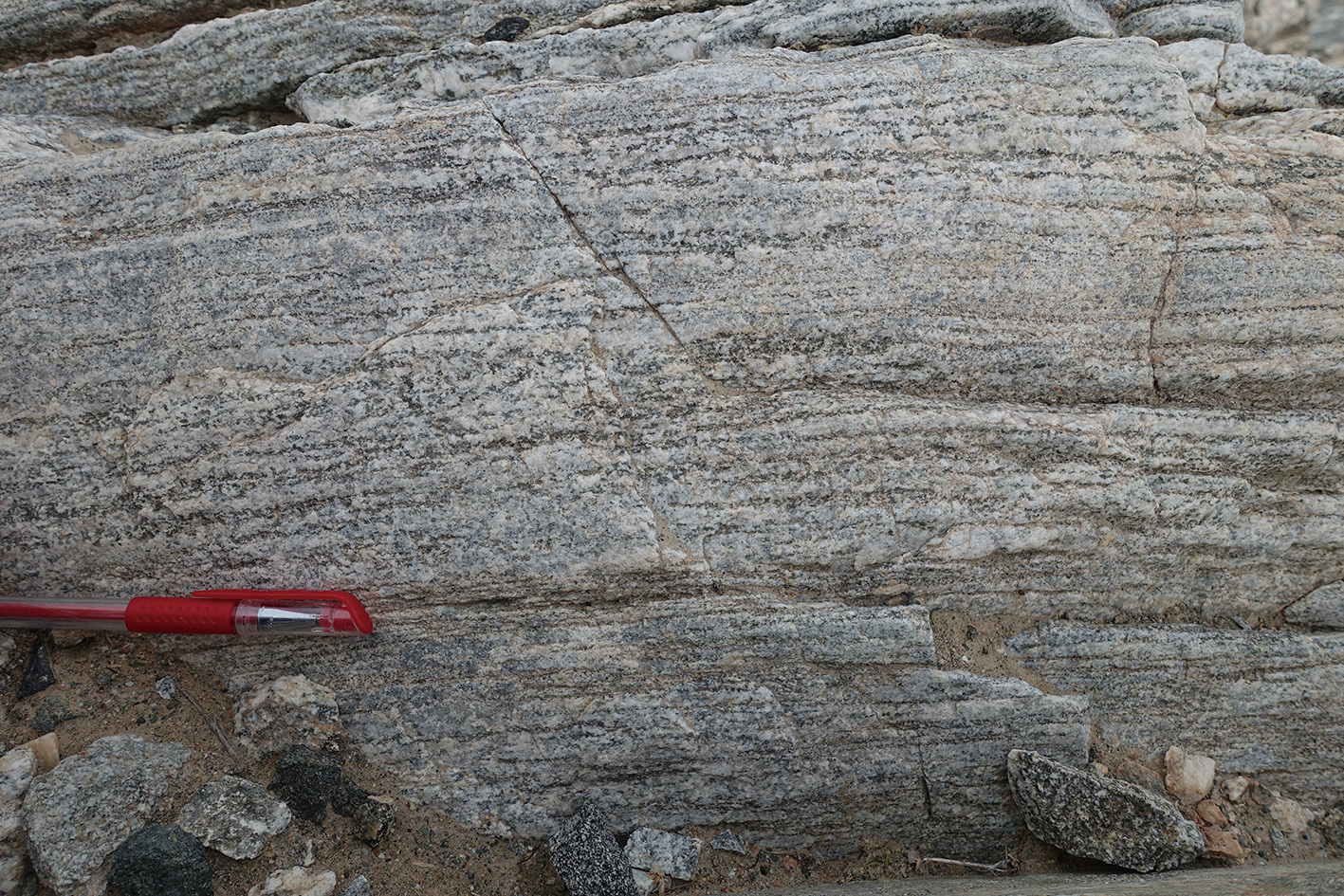
A field photo of the 3.7-billion-year-old rock discovered by Prof. GE in the Tarim Craton (Image: GE Rongfeng)
Deciphering the Secret Recipe of Earth’s First Crust
While the Tarim discovery was monumental, a critical piece of the puzzle was still missing. To truly understand the tectonic setting in which the early continental crust was baked, Prof. GE needed to determine the key “ingredients” and “cooking conditions” of the ancient magmas. Two of the most diagnostic properties were the magma’s oxidation state and its water content. In modern times, magmas formed above subduction zones are notably more oxidized and water-rich than those formed at mid-ocean ridges.
However, reading this chemical recipe from 3.7-billion-year-old rocks is extremely difficult. The minerals that record this information have been altered over time, and existing methods for estimating water content in granitic magmas were unreliable.
To tackle this, Prof. GE worked on the incredibly durable mineral zircon and developed an ingenious new tool. By combining two existing chemical sensors based on zircon compositions, his team found that they could not only calculate the oxidation state of the magma but also, for the first time, accurately back-calculate its water content—essentially decoding the “secret sauce” of the early crust. The method was rigorously tested on magmas with known water contents and proved to be accurate to within about 1 weight percent.
This innovative approach opened a vast new frontier. It provided a way to quantitatively probe the hidden volatile history of ancient granitic rocks worldwide, a feat previously thought impossible.
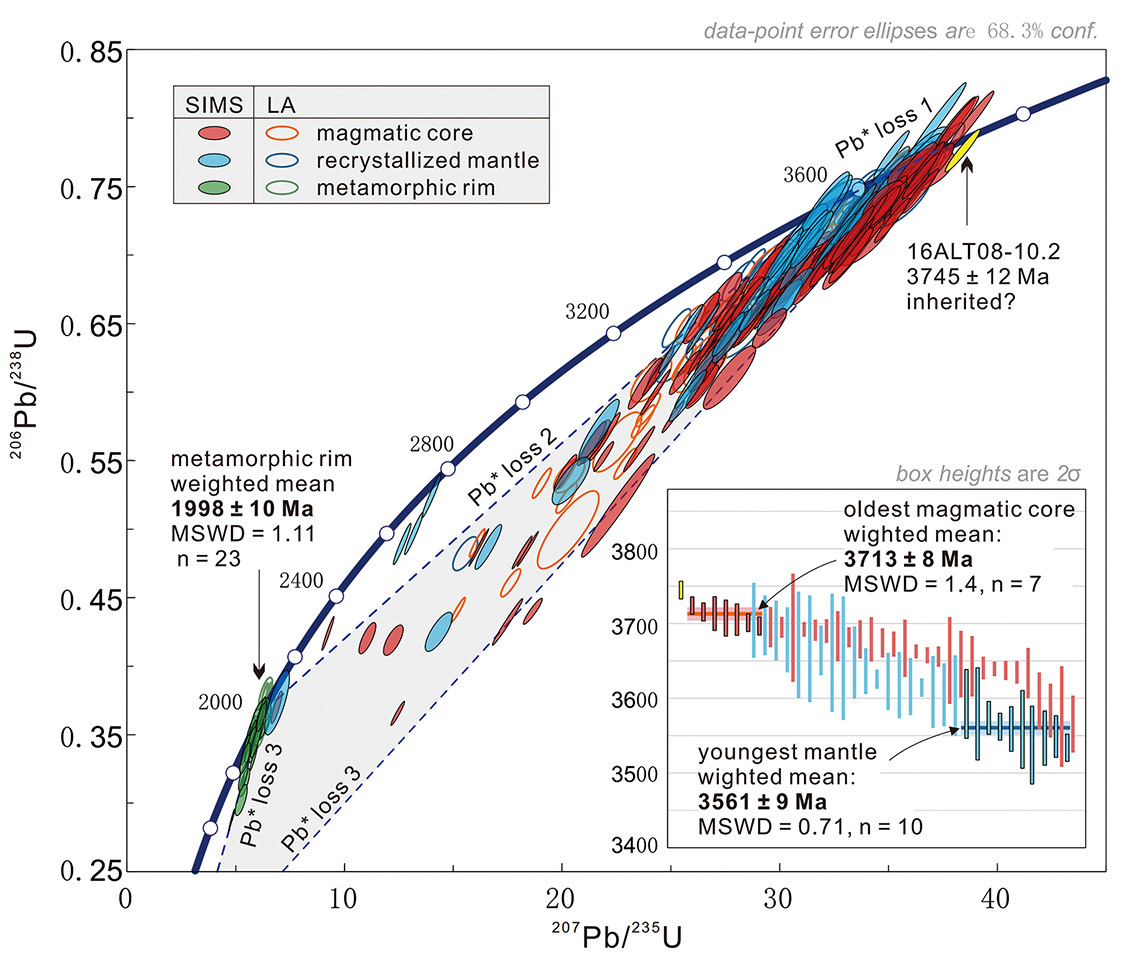
Zircon U-Pb dating results of the 3.7-billion-year-old rock (Image: GE Rongfeng)
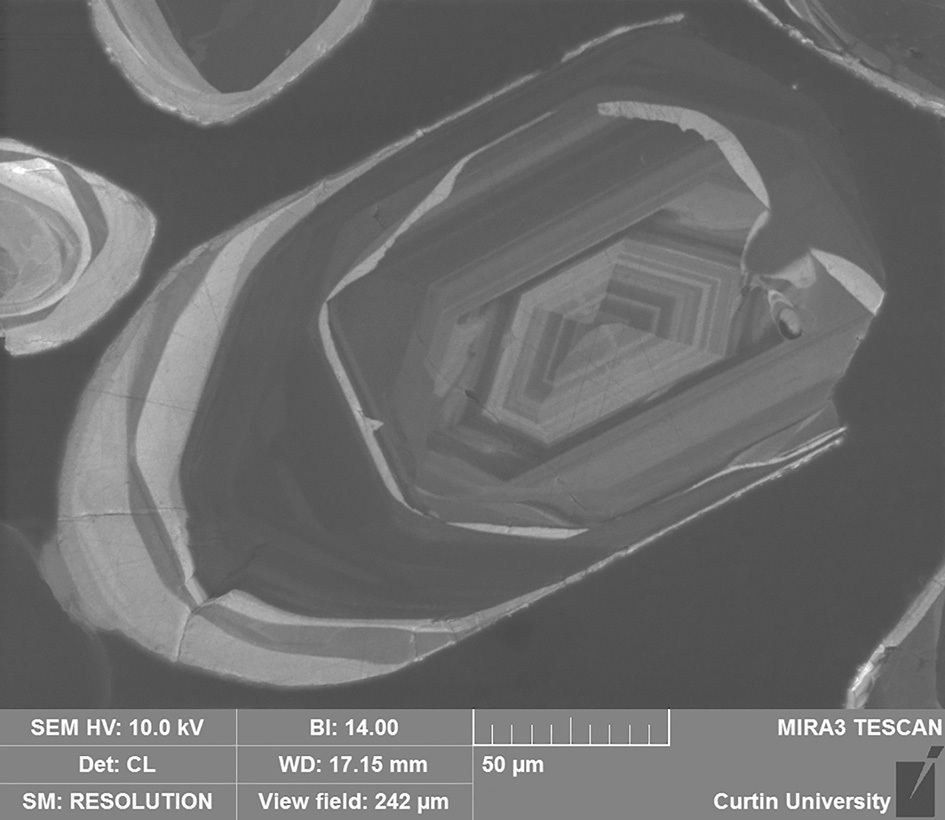
Cathodoluminescence image of a zircon grain from the 3.7-billion-year-old rock (Image: GE Rongfeng)
Uncovering the True Nature of Ancient Magmas
Armed with their new method, Prof. GE and his team applied it to a comprehensive collection of Archean (2.5–4.0 billion years old) granitic rocks from major cratons across the globe. The results were stunning.
They discovered that most Archean granitic magmas were significantly more oxidized, by about an order of magnitude, than the mantle-derived magmas from which they were ultimately derived.
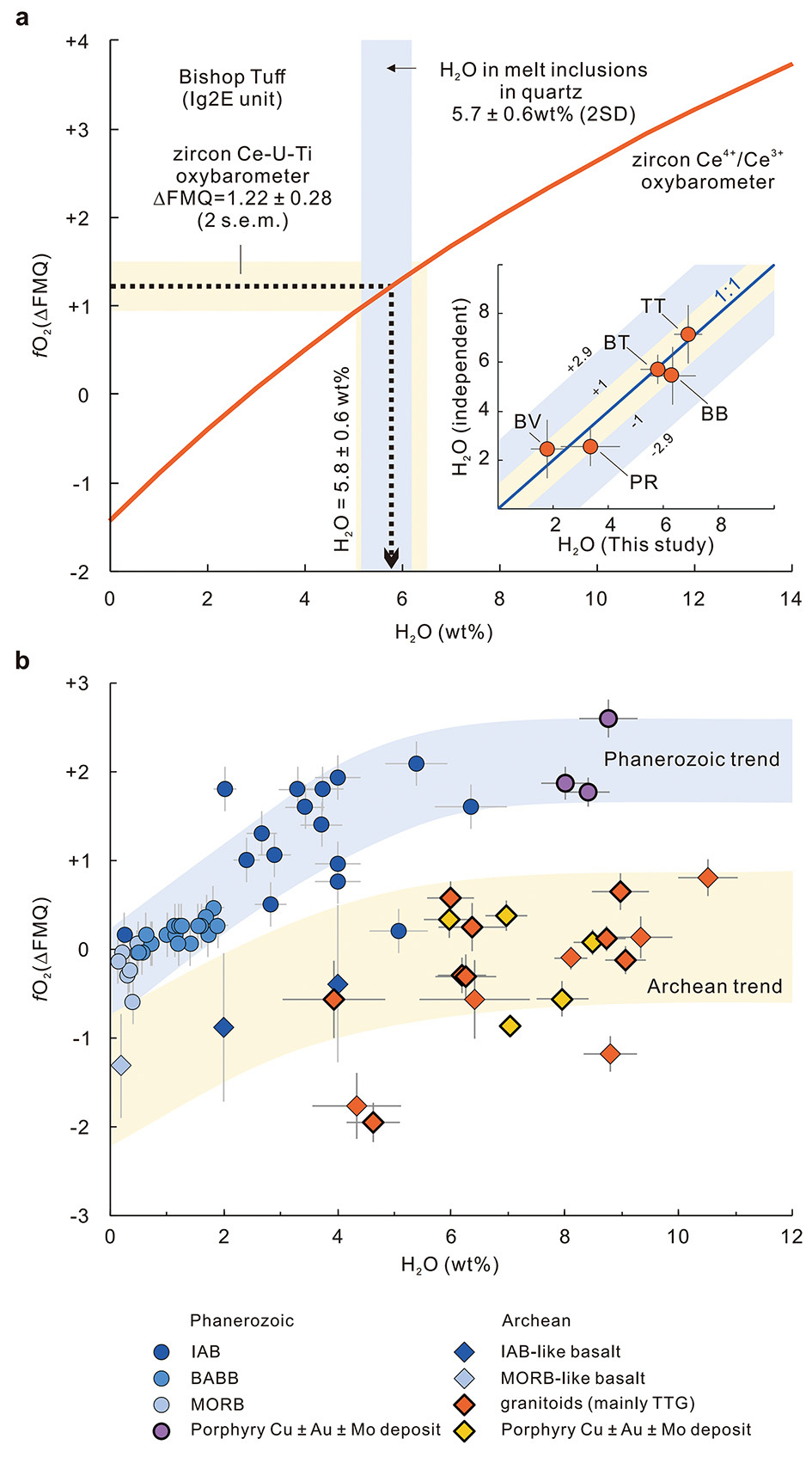
Magma oxygen fugacity and water content calculated using zircon compositions (Image: GE Rongfeng)
This finding directly challenges the long-standing view of early Earth. Before the onset of plate tectonics, many scientists believed that the young Earth’s mantle was considerably hotter than today, producing magmas that were more reduced and less water-rich through large-scale melting. Under such conditions, the first continental crust was thought to have formed through processes like mantle plumes or the foundering of dense volcanic plateaus, mechanisms that operate largely in isolation from surface water and lack the oxidizing agents that drive modern subduction zone magmas. In this older model, early continental crust should have been relatively “dry and reduced,” with little chemical imprint from the hydrosphere.
What Prof. GE’s data revealed, however, was the opposite. The ancient magmas were surprisingly wet, with water contents ranging from 4 to 11 weight percent, comparable to those found in modern subduction zone settings. Their water content and oxidation state correlated strongly with geochemical indicators of melting depth, a pattern that is uniquely consistent with the transport of surface water into the deep crust and mantle via the down-going slab of a subduction zone.
This connection between subduction and the formation of early continents is profound. Subduction is the only tectonic process that can efficiently deliver large volumes of water, along with oxidized components, from Earth’s surface into the deep mantle, triggering melting that produces the wet, oxidizing magmas characteristic of continental crust. By demonstrating that 3.7-billion-year-old magmas bore the same chemical fingerprints as modern arc magmas, Prof. GE’s work provides the first quantitative evidence that this engine was already running in the Eoarchean. Most importantly, the data revealed a dramatic jump in both the oxidation state and water content of granitic magmas between 4.0 and 3.6 billion years ago, marking the transition from a world without plate tectonics to one where subduction began actively building the first continents—pushing back the known start of this process by at least a billion years.
A New Blueprint for Continent Formation
Synthesizing these findings, Prof. GE proposed a new model for the origin of the early continental crust.
In this model, the first continental blocks were not formed in place but were assembled from fragments of ancient oceanic island arcs. During the Archean, Earth’s mantle was hotter, producing thicker, more buoyant oceanic plateaus and island arcs. These arcs were then piled together through collisions and accretion. As they thickened, water-rich fluids from subducted arc fragments triggered extensive melting of the overlying mafic rocks, producing the TTG magmas that would eventually coalesce into the first continents.
This new blueprint elegantly explains several long-standing observations: the source of water and large-ion lithophile elements in TTGs, the coexistence of high-pressure and medium-to-low-pressure TTGs, the rapid growth of continental crust during the Archean, and its subsequent decline. It underscores the critical and intertwined roles of surface water and subduction-accretion tectonics in making Earth a planet with continents—a feature that appears to be unique in our solar system.
A New Chapter in Earth’s Story
Prof. GE’s work, published in leading journals including Nature (2023), Science Advances (2018), and Earth-Science Reviews (2022), has been hailed as a landmark achievement. It has not only provided the first robust evidence that subduction was operating as early as 3.7 billion years ago but has also quantitatively linked the formation of the first continents to the deep-water cycle driven by subduction.
His research has profound implications beyond academic geology. The “zircon oxybarometer-hygrometer” he developed is now being used by over 20 research groups worldwide to study magmatic rocks from the Archean to the present day. It is becoming an essential tool for understanding magma genesis, tectonic settings, and even the potential for mineral resources, such as porphyry copper deposits, which are critical for modern technology.
By deciphering the code written in Earth’s oldest rocks, Prof. GE and his team have rewritten the opening chapters of our planet’s biography. They have shown that the story of the continents is not just a tale of rocks and heat, but one of water, oxidation, and the dynamic dance of plate tectonics—a process that began far earlier than we ever imagined, laying the foundation for the habitable world we know today.
Reference
Ge, R., Zhu, W., Wilde, S. A., & Wu, H. (2018). Remnants of Eoarchean continental crust derived from a subducted proto-arc. Science Advances, 4(2), eaao3159.
Ge, R., Wilde, S. A., Kemp, A. I. S., Jeon, H., Martin, L. A. J., Zhu, W., & Wu, H. (2020). Generation of Eoarchean continental crust from altered mafic rocks derived from a chondritic mantle: The∼3.72 Ga Aktash gneisses, Tarim Craton (NW China). Earth and Planetary Science Letters, 538, 116225.
Ge, R., Wilde, S. A., Zhu, W., & Zhou, T. (2022). Formation and evolution of Archean continental crust: A thermodynamic–geochemical per spective of granitoids from the Tarim Craton, NW China. Earth-Science Reviews, 234, 104219.
Ge, R., Wilde, S. A., Zhu, W., & Wang, X. (2023). Earth’s early continental crust formed from wet and oxidizing arc magmas. Nature, 623(7986), 334–339.