

The 2026 Tan Kah Kee Young Scientist Award in Information Technical Sciences recognizes the breakthrough work on integrated optical quantum chips led by Professor WANG Jianwei and Professor GONG Qihuang at Peking University. Their team has built chips that combine quantum light sources, optical circuits, and light detectors all on a millimeter-scale chip. This makes it possible to generate, control, and measure quantum states entirely on a single chip, providing a hardware platform that can be scaled up for quantum computing and networking.
Quantum information technology uses quantum superposition and entanglement to achieve exponentially faster computing, secure communication, and precise measurement. Among the main quantum hardware platforms—such as superconducting circuits, trapped ions, and neutral atoms—photonic (light-based) systems have unique natural advantages. Photons act as “flying qubits”: they keep their quantum properties at room temperature, are hardly affected by environmental noise, and can operate and transmit data at very high speeds (Wang et al., 2020).
For decades, laboratory quantum optics experiments relied on bulky optical parts like lenses, beam splitters, and external lasers. These tabletop setups, however, are sensitive to vibrations, hard to reproduce, and difficult to expand. Scaling them up to handle millions of quantum modes is practically impossible. Integrated optical quantum chips can solve this problem by using standard semiconductor manufacturing techniques to pack complete quantum optical circuits onto tiny silicon chips. Around the world, research groups from the University of Bristol, MIT, Xanadu, and PsiQuantum have pioneered photonic quantum prototypes. In China, many universities are also carrying out research on silicon and lithium niobate quantum photonics. The Peking University team launched a systematic effort to build large-scale integrated quantum chips, aiming to advance practical quantum computing and wide-area quantum communication networks. They have achieved a series of important milestones in both integrated optical quantum computing and large-scale quantum communication.
On-chip Quantum Optical Devices and Hardware
Quantum light sources are the starting point of all photonic quantum systems. WANG’s team developed three different types of integrated quantum light sources for different applications. These include entangled photon sources, which use optimized nonlinear waveguides and resonant cavities to produce photon pairs with high purity and identity—a basic requirement for high-quality quantum interference. They have also demonstrated ultra-low-noise coherent frequency comb sources to support large-scale quantum key distribution (QKD) networks with many chip-based nodes. In addition, they have realized squeezed light sources and arrays with consistent performance across entire wafers, and achieved monolithic integration of squeezers with high-fidelity quantum gates and projectors, opening the way for continuous-variable universal quantum computing. These on-chip quantum light sources eliminate the need for bulky external optical modules. They are compact, stable, and compatible with standard wafer fabrication.
To implement quantum logic gates and dynamic control of quantum states, the team developed on-chip technology for manipulating various quantum properties, including polarization, path, frequency, time, and orbital angular momentum. For reconfigurable quantum processors, they built fully programmable photonic mesh arrays that can perform any linear optical quantum operation, as well as fully reconfigurable recirculating linear optical lattices. Single-photon detection is essential for reading out quantum states. The team also integrated superconducting single-photon detectors directly onto silicon waveguides, achieving over 99% on-chip detection efficiency, which removes the photon loss caused by using external detectors.
With their mass-manufacturing process, thousands of optical components can be fabricated on a single chip (Wang et al., 2018). This enables precise generation, programmable control, and high-fidelity readout of multi-photon, high-dimensional quantum entanglement states, as well as both discrete-variable and continuous-variable quantum entanglement states.
Integrated-optical Quantum Computing
Optical quantum computing operates at room temperature, with high operating speed and excellent quantum coherence, making it a promising scalable platform. The team has developed fully programmable Boson sampling chips for specialized quantum computing tasks, such as solving combinatorial optimization and graph problems (Bao et al., 2023). They have also built discrete-variable and continuous-variable quantum chips for universal quantum computing. In discrete-variable systems, they experimentally demonstrated on-chip cluster states, graph states, and hypergraph states, constructed measurement-based universal photonic quantum computing prototypes, and realized a set of quantum logic gates and mainstream quantum algorithms. In continuous-variable systems, they achieved on-chip generation, manipulation, and measurement of multi-partite cluster states, bringing China to an international leading position in continuous-variable photonic quantum computing (Jia et al., 2025 & 2026).
The team has also worked on both digital and analog quantum simulation. They proposed a new mechanism for topologically protected quantum entanglement based on anomalous Floquet topological insulators, which shields quantum states from fabrication defects (Dai et al., 2022). They developed fully programmable topological photonic chips to simulate non-Hermitian topological phase transitions and quantum transport processes (Dai et al., 2024 & 2024; Ma et al., 2026). They combined AI with photonic quantum hardware to optimize quantum circuit parameters and learn unknown Hamiltonian operators (Wang et al., 2017). Their chip platform supports variational quantum simulation of molecular energy levels and dynamic evolution, offering new experimental tools for quantum chemistry and quantum material design.
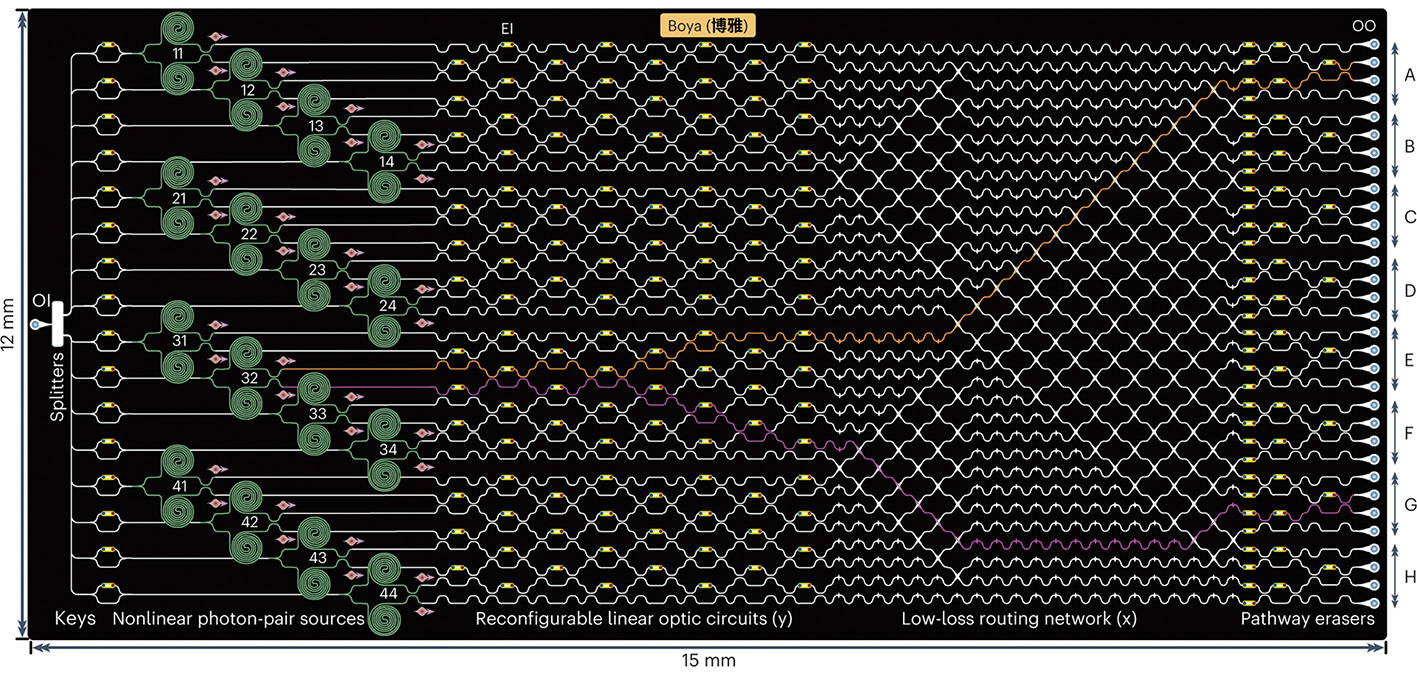
A large-scale-integrated optical quantum computing chip: the Boya Quantum chip. (Image adapted from Bao et al., 2023)
Integrated-optical Quantum Networking
The future quantum internet requires miniaturized quantum chips that act as terminal quantum nodes, enabling secure communication and distributed quantum computing. Quantum teleportation is the core method for transmitting quantum states over distance. They achieved high-fidelity quantum teleportation between two independent chips, overcoming phase instability and low transmission fidelity at the chip interface. They also developed vortex entanglement chips that support the manipulation of orbital angular momentum states (Huang et al., 2025), which could help build space-air-ground integrated quantum communication infrastructure.
Multi-chip entanglement networking is the key to overcoming the scale limits of single-chip quantum systems. By developing hybrid multiplexing and AI-assisted entanglement self-recovery technologies, they built the first multi-chip high-dimensional entanglement network (Zheng et al., 2023). This network achieves synchronized control and high-fidelity entanglement distribution across multiple independent quantum chips, providing critical technical support for distributed quantum computing. Their most transformative achievement is a large-scale multi-node QKD network built entirely with integrated photonic chips (Zheng et al., 2026). Equipped with microcomb quantum light chips, the network supports simultaneous communication among 20 chip nodes, with a maximum transmission distance of 370 km between any two nodes and a total coverage capacity of up to 3,700 km. This breaks the distance limits of traditional QKD protocols and accelerates the transition of quantum secure communication from laboratory demonstrations to large-scale real-world deployment.
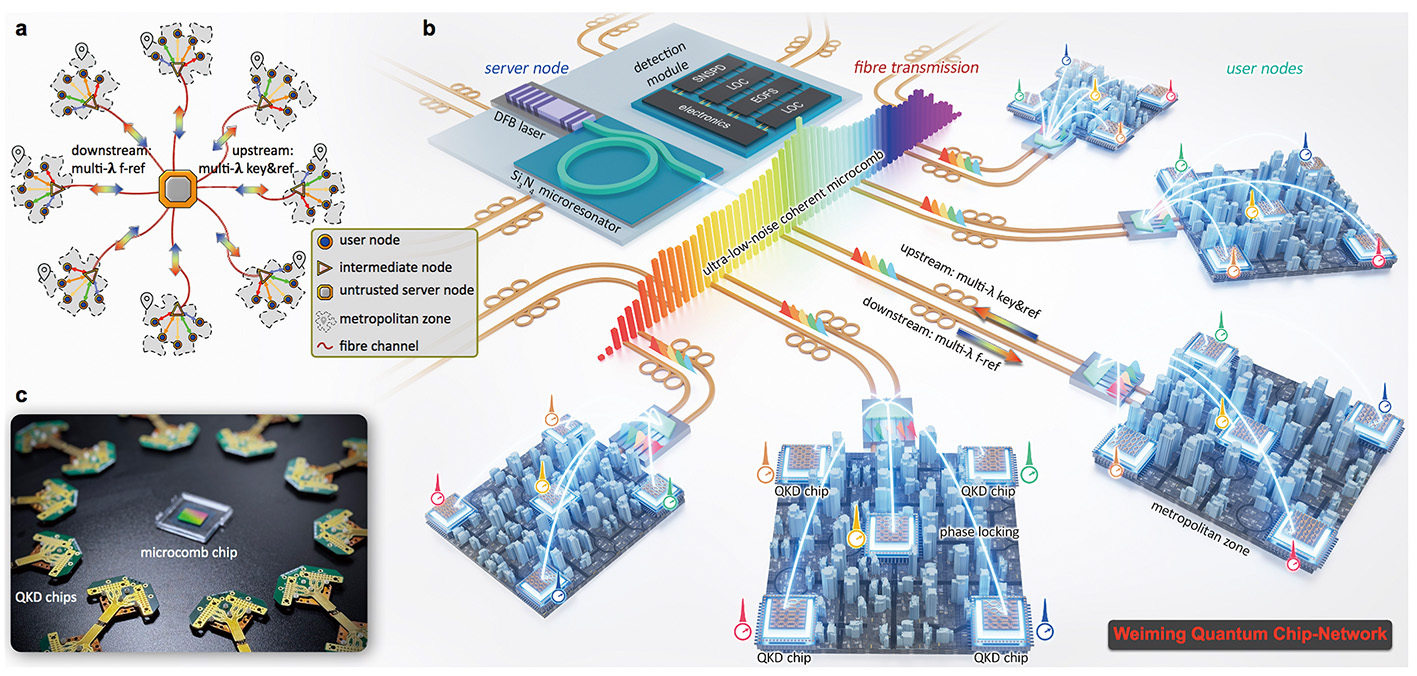
A large-scale quantum communication network comprising 20 client chips and a Hz-level microcomb source: the Weiming Quantum Chip–Network. (Image adapted from Zheng et al., 2026)
Reference
Bao, J., Fu, Z., Pramanik, T., et al. (2023) Very-large-scale integrated quantum graph photonics. Nature Photonics, 17(7), 573–581. doi:10.1038/s41566-023-01187-z
Dai, T., Ao, Y., Bao, J., et al. (2022) Topologically protected quantum entanglement emitters. Nature Photonics, 16(3), 248–257. doi:10.1038/s41566-021-00944-2
Dai, T., Ao, Y., Mao, J., et al. (2024) Non-Hermitian topological phase transitions controlled by nonlinearity. Nature Physics, 20(1), 101–108. doi:10.1038/s41567-023-02244-8
Dai, T., Ma, A., Mao, J., et al. (2024) A programmable topological photonic chip. Nature Materials, 23(7), 928–936. doi:10.1038/s41563-024-01904-1
Huang, J., Mao, J., Li, X., et al. (2025) Integrated optical entangled quantum vortex emitters. Nature Photonics, 19(5), 471–478. doi:10.1038/s41566-025-01620-5
Jia, X., You, C., Zhai, C., et al. (2026) Monolithic integration of continuous-variable cluster-state generation, manipulation and measurement. Nature Photonics, 20(4), 428–436. doi:10.1038/s41566-026-01868-5
Jia, X., Zhai, C., Zhu, X., et al. (2025) Continuous-variable multipartite entanglement in an integrated microcomb. Nature, 639(8054), 329–336. doi:10.1038/s41586-025-08602-1
Ma, A., Dai, T., Li, G., et al. (2026) Reconfigurable and programmable integrated topological photonics. Nature Reviews Physics, 8(6), 327–343. doi:10.1038/s42254-026-00936-7
Wang, J., Paesani, S., Ding, Y., et al. (2018) Multidimensional quantum entanglement with large-scale integrated optics. Science, 360(6386), 285–291. doi:10.1126/science.aar7053
Wang, J., Paesani, S., Santagati, R., et al. (2017) Experimental quantum Hamiltonian learning. Nature Physics, 13(6), 551–555. doi:10.1038/nphys4074
Wang, J., Sciarrino, F., Laing, A., & Thompson, M. G. (2020) Integrated photonic quantum technologies. Nature Photonics, 14(5), 273–284. doi:10.1038/s41566-019-0532-1
Zheng, Y., Wang, H., Jia, X., et al. (2026) Large-scale quantum communication networks with integrated photonics. Nature, 651(8104), 68–75. doi:10.1038/s41586-026-10152-z
Zheng, Y., Zhai, C., Liu, D., et al. (2023) Multichip multidimensional quantum networks with entanglement retrievability. Science, 381(6654), 221–226. doi:10.1126/science.adg9210