

The 2026 Tan Kah Kee Youth Science Award in Technological Sciences is conferred upon Prof. PAN Qingsong at the Institute of Metal Research, Chinese Academy of Sciences for his team’s outstanding research on “superior mechanical performance of ordered metallic materials”. Through an innovative design strategy of multi-scale spatially gradient ordering of structural elements, his team fundamentally overcame the century-long dilemma between structure and performance of metallic materials to simultaneously improve the strength as well as plasticity and fatigue performance of the materials. Their breakthrough has offered new insights and technologies for the development of high-performance structural materials.
Traditional strategies for developing metallic materials have long relied on two main approaches, i.e. forming alloys with impurity elements and microstructural homogenization, such as homogeneous grain size refinement. However, increasing strength normally compromises other properties, such as ductility and fatigue resistance—a fundamental challenge known as the inevitable intrinsic trade-off dilemma in mechanical properties.
To address this long-standing fundamental challenge in materials science, PAN and his collaborators proposed a new materials design concept through regulating stable structural units and spatially ordering them in a gradient, such as the low-energy dislocation pattern, and successfully fabricated a series of alloys containing an engineered gradient hierarchy of dislocation cells, achieving a synergistic “1+1>2” enhancement of strength, ductility, and fatigue resistance.
Gradient Cell-structured Metals with Exceptional Strength and Ductility
The fundamental plastic deformation and strain hardening in crystalline lattices—one of the most important and thorny problems in materials science for centuries—is essentially mediated by linear defect, i.e. full dislocations and their complex interaction with diverse structural defects, such as grain boundaries. Annealed soft coarse-grained metallic materials usually display the highest strain hardening and best tensile ductility, owing to their abundant intra-grain space for dislocation movement and storage. By contrast, the traditional strengthening methodologies, either by changing composition or incorporating various defects, such as grain boundaries, invariably confront a dilemma: While strongly resisting dislocation motion, they also greatly reduce their accumulation density, thereby remarkably deteriorate the strain hardening capacity and ductility inevitably, even at cryogenic temperatures.
To address this, PAN and his collaborators proposed a novel design strategy for metallic materials based on the spatial ordering of multiscale dislocation patterns. To this end, the team successfully developed a simple, yet efficient cyclic-torsion (CT) treatment without any surface tooling. Published in Science in 2021, by integrating this new technique, their work is the first to controllably introduce a novel sample-level gradient nanoscaled low-angle dislocation-cell structure (GDS) in one well-studied single-phase face-centered-cubic multicomponent alloy. In particular, the noticeably unchanged grain structure after CT treatment, including grain size and morphology, is in sharp contrast against those nanostructured metals with severely-refined grain size produced by conventional severe plastic deformation strategies.
The team discovered that this GDS alloy exhibits a yield strength 2 to 3 times higher without sacrificing ductility at ambient temperature, thereby breaking the conventional trade-off between strength and ductility at ambient temperature. Such an exceptional synergy of strength and ductility has not been possibly achieved in conventional metals with homogenous or heterogeneous nanograins, which inevitably suffer from structural coarsening during mechanical stimulus. Their observations point out that engineering gradient low-angle cell structures can help readily activate a brand-new deformation mechanism of two-dimensional parallel planar stacking fault nucleating from abundant low-angle dislocation cells, rather than traditional linear dislocations. These novel planar deformation faulting activities in crystalline lattices not only play an alternative, elementary carrier role of crystal plasticity, analogous to dislocation, but also simultaneously cause gradual structural refinement, which is significantly responsible for strengthening.
Inspired by this, the team further explored whether this GDS can effectively trigger stacking faults at low temperatures to break through the thorny dilemma of strain hardening. Unexpectedly, their experiments revealed an unprecedentedly high strain hardening capacity throughout the deformation stage at 77 Kelvin in a stable single-phase alloy with gradient dislocation cells, even beyond that of its coarse-grained counterpart. Their findings not only resolved the long-standing strength–ductility trade-off—a century-old challenge in structural materials—but also overturned the conventional wisdom that coarse-grained metals possess the highest strain-hardening capability, opening new frontiers in the creation of metals with ordered dislocations.
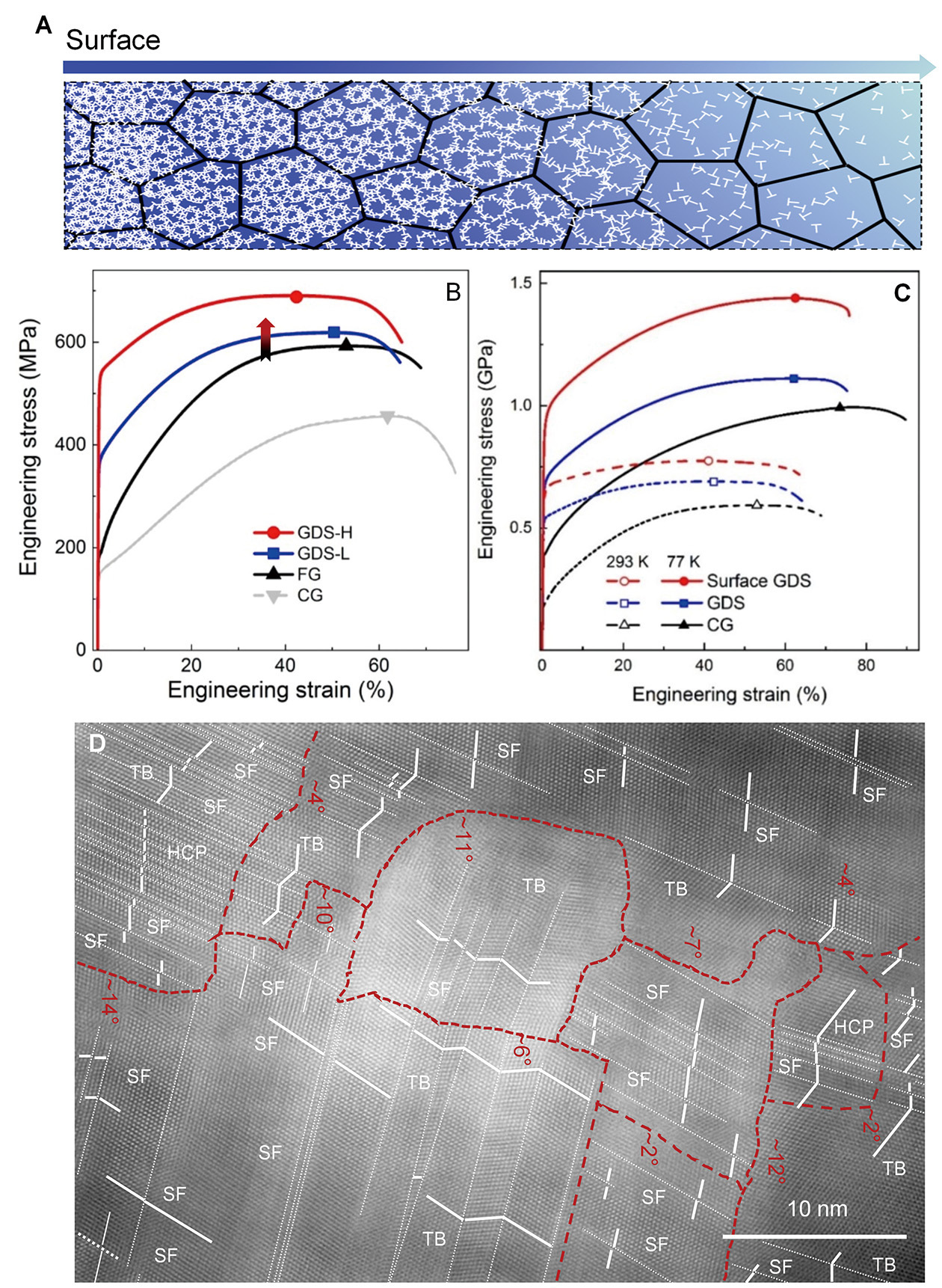
Gradient cell structured alloy with exceptional strength, ductility and strain hardening, enabled by atomic faulting (Image by IMR)
Their experimental observations pointed to an unusual strain-hardening mechanism that is readily triggered by the formation of extremely refined multi-orientational tiny SFed mosaics in gradient-dislocation-structure at cryogenic temperatures. This dynamic SFed-mosaics induced strain-hardening mechanism at cryogenic temperatures echoed their earlier results of SF-induced plasticity as well as the exceptional strength and ductility in the GDS alloy at room temperature. The dominance of atomic-scale planar deformation faulting in plastic deformation introduces a different approach for simultaneously strengthening and robust hardening metallic materials, which extends beyond the classical dislocation theory framework that has governed crystalline materials for nearly a century and offers promising properties and potential applications.
The representative findings were published in Science with two papers as First Release. Both papers were selected as Web of Science Hot Papers and have been cited over 600 times. A Perspective article in the same issue of Science remarked: “Mechanically introducing nanoscale dislocation cell structures creates a strong ductile alloy, inspires further research on other alloys to achieve superior properties”. Prof. HUANG Xiaoxu, a renowned metals expert, highlighted this work as “Exceptionally high strain hardening via two-dimensional atomic scale faulting” in the title of an article.
Superior Resistance to Fatigue in Gradient Cell-structured Steel
Ratchetting (or cyclic creep) is a severe form of fatigue deformation. It is characterized by continuously increasing unidirectional plastic deformation under asymmetrical cyclic loading with non-zero mean stresses, often leading to premature failure of structural materials in service. Enhancing ratchetting resistance is a formidable challenge in materials engineering, arising primarily due to the combined effects of cyclic softening and strain localization during prolonged asymmetrical cycling. Therefore, exploiting the gradient dislocation architecture to enhance ratchetting resistance under asymmetrical cyclic stresses is of great interest.
To this end, Dr. PAN and his collaborators introduced a gradient hierarchy of dislocation cells in a cost-effective austenitic 304 stainless steel, and have achieved a remarkable combination of high strength and superior ratchetting resistance caused by coherently-nanolayered martensitic transformations in cells during ratcheting loading. The average ratchetting rate in GDS 304 is two to four orders of magnitude lower than that of its coarse-grained counterparts. Their findings offer key insights into the ratcheting-resistant mechanisms and provide a widely applicable framework for designing high-strength, ratchetting-resistant materials for advanced engineering applications, such as nuclear power plants, and aerospace systems.
The representative findings were published in Science in 2025, and were later selected as Web of Science Hot Papers. Prof. KANG Guozheng, a renowned expert in metal fatigue at Southwest Jiaotong University, highlighted this work as having “contributed new insights and pathways for designing advanced metals with high resistance to ratchetting”.
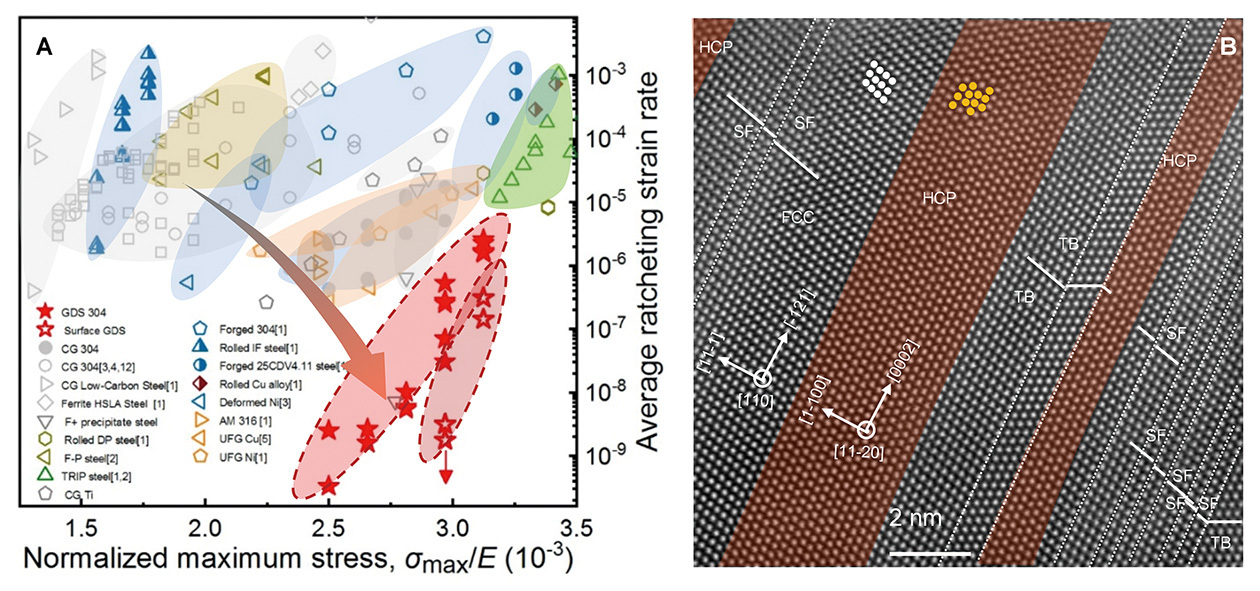
Superior ratchetting resistance of gradient cell structured steel austenitic stainless steel enabled by coherently-nanolayered martensitic transformations. (Image by IMR)
History-Independent Cyclic Stable Response in Stable Nanotwin Unit
Metals in service typically suffer from large, accumulative, irreversible damages in microstructure during fatigue. This will lead to history-dependent unstable (either hardening or softening) fatigue responses, an everlasting critical limitation for structural safety, which make fatigue life prediction under a realistic load spectrum extremely difficult.
Besides the low-angle dislocation cells discussed above, Dr. PAN in 2017 proposed another stable unit, i.e., stable nanotwin unit, to optimize the fatigue resistance of metallic materials, and developed electrodeposition techniques to fabricate bulk nanotwinned copper. Through both variable-strain-amplitude cyclic loading experiments and atomistic simulations from their collaborators, they took the lead in discovering that a type of single-slip correlated necklace dislocations are formed in the highly oriented nanotwinned structure under cyclic loading, and help maintain the stability of twin boundaries as long as the nanotwins are tilted within about 15° relative to the loading axis. This mechanism effectively suppresses fatigue damage accumulation, leading to a history-independent cyclically stable response and simultaneous enhancement of fatigue strength and lifetime in metals. This work resolved the long-standing issues of cyclic softening and strong history dependence in high-strength metals, challenging the traditional view that fatigue damage of metallic materials is inevitable (Nature, 2017).
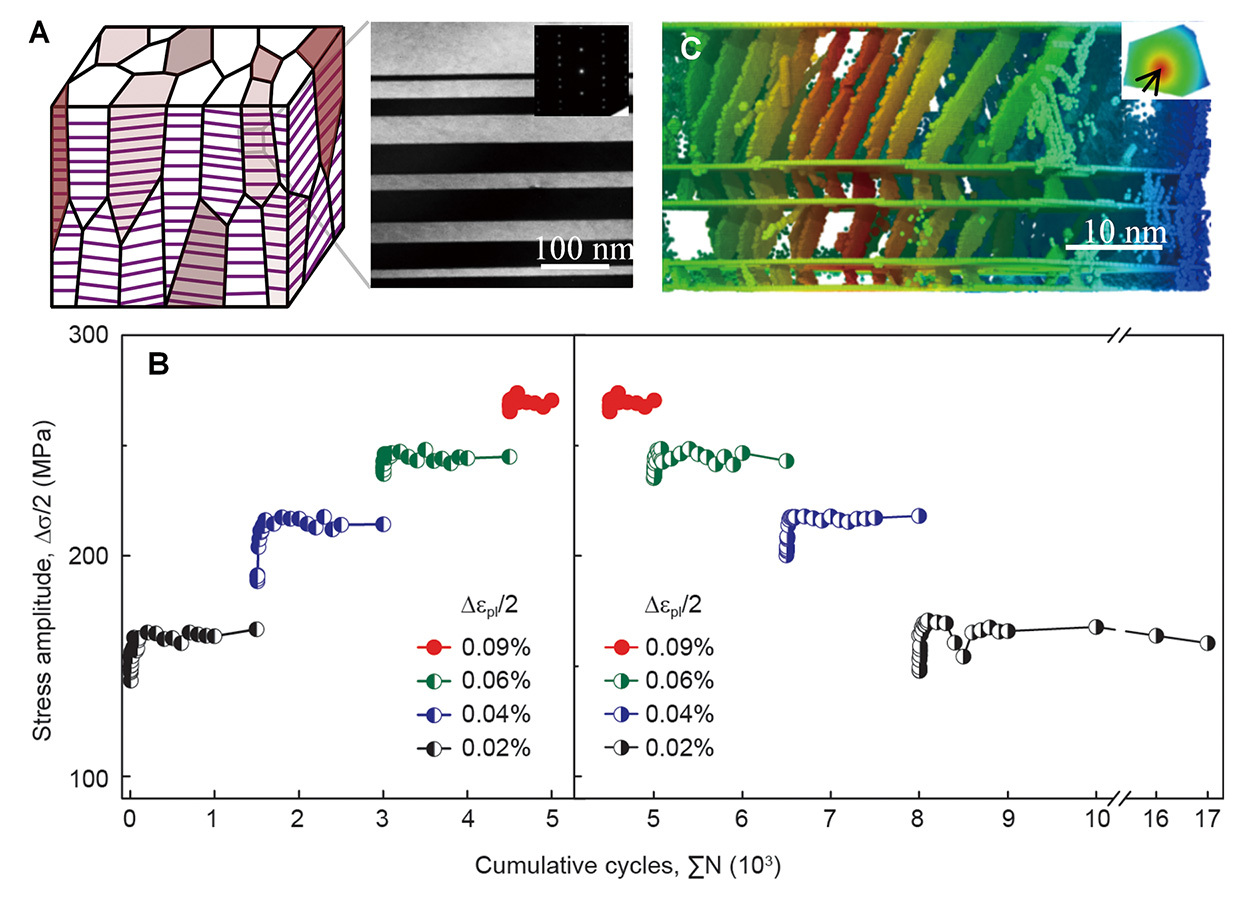
The team show, for the first time, a history-independent and stable fatigue response in a bulk polycrystalline Cu sample containing highly oriented nanoscale twins, arising from single-slip correlated necklace dislocations gliding back-and-forth in twin interior. (Image by IMR)
Prof. Robert O. Ritchie, Member of the U.S. National Academy of Engineering, commented that “nanoscale twins represent an optimal feature for structural metals”; and Prof. TIAN Yongjun, Member of the Chinese Academy of Sciences, highlighted its significance in a Perspective article and remarked that it has “paved a new route to more fatigue-resistant metals through tailor-designed microstructure”. The work was selected as one of the 30 candidate entries for the “Top 10 Scientific Advances in China” in 2017. In recognition of their academic contributions to the field of metal fatigue—a long-standing yet critically important area, Dr. PAN was also invited to author a Perspective article entitled “Fatigue in metals and alloys” in Nature Materials.
The discoveries made by Prof. PAN and his team, ranging from history-independent cyclic stable response in stable nanotwin unit to the creation of gradient dislocated metals with superior mechanical performance, are of decisive significance in breaking through the mechanical performance trade-offs of metals, and have laid a novel scientific foundation for the rational design of next-generation metallic materials with transformative properties.
Reference
Pan, Qingsong; Ding, Kunqing; Guo, Song; Lu, Ning; Tao, Nairong; Zhu, Ting; Lu, Lei; Superior resistance to cyclic creep in a gradient structured steel, Science, 2025, 388, 82–88. https://doi.org/10.1126/science.adt6666
Pan, Qingsong; Yang, Muxin; Feng, Rui; Chuang, Andrew Chihpin; An, Ke; Liaw, Peter K.; Wu, Xiaolei; Tao, Nairong; Lu, Lei; Atomic faulting induced exceptional cryogenic strain hardening in gradient-cell-structured alloy, Science, 2023, 382, 185–190. https://doi.org/10.1126/science.adj3974
Pan, Qingsong; Zhang, Liangxue; Feng, Rui; Lu, Qiuhong; An, Ke; Chuang, Andrew Chihpin; Poplawsky, Jonathan D.; Liaw, Peter K.; Lu, Lei; Gradient cell–structured high-entropy alloy with exceptional strength and ductility, Science, 2021, 374, 984–989. https://doi.org/10.1126/science.abj8114
Pan, Qingsong; Zhou, Haofei ; Lu, Qiuhong; Gao, Huajian; Lu, Lei; History-independent cyclic response of nanotwinned metals, Nature, 2017, 551, 214–217. https://doi.org/10.1038/nature24266
Pan, Qingsong; Lu, Lei;Fatigue in metals and alloys, Nature Materials, 2025, 25, 357–365. https://doi.org/10.1038/s41563-025-02308-5