

Earning the 2026 Tan Kah Kee Young Scientist Award in Technological Sciences, Prof. LI Tiefeng’s breakthrough research rewrites the rules of deep-sea engineering. Instead of fighting the crushing 110-megapascal pressures of the Mariana Trench with massive, rigid metal shells, his team at Zhejiang University took inspiration from a fragile creature that already thrives there: the Mariana snailfish. By mimicking snailfish’s partially open skull and delicate fins, LI’s team developed a self-powered, completely unarmored soft robot.
How the Soft Robot Survives and Swims
To survive the crushing depths of 10,900 meters, the team had to completely rethink traditional robotics. Instead of cramming microchips tightly onto rigid circuit boards—which grind together and fail catastrophically under extreme pressure—they created a “decentralized brain”. Inspired by the snailfish’s partially open skull, the engineers spread the electronic components out like isolated islands and encased them in soft silicone. This simple design shift dropped structural stress by over 80% (reducing shear stress from 60 megapascals down to 10 megapascals) and entirely eliminated the need for heavy titanium armor.
Rather than using bulky motors, the robot swims using artificial muscles made from dielectric elastomers—smart, rubbery materials sandwiched between carbon-grease electrodes. When an electrical voltage is applied, opposite charges accumulate and physically squeeze the material, causing it to thin out and expand. To generate large, powerful flapping movements, the team harnessed a mechanical quirk known as “snap-through instability”. As demonstrated in a foundational 2013 study published in the Journal of the Mechanics and Physics of Solids, LI and his colleagues discovered how to coax gigantic, unprecedented movements out of these materials by harnessing this phenomenon. It works just like blowing up a stiff party balloon: you must blow incredibly hard at first, but once you push past a critical pressure threshold, it suddenly gives way and inflates easily.
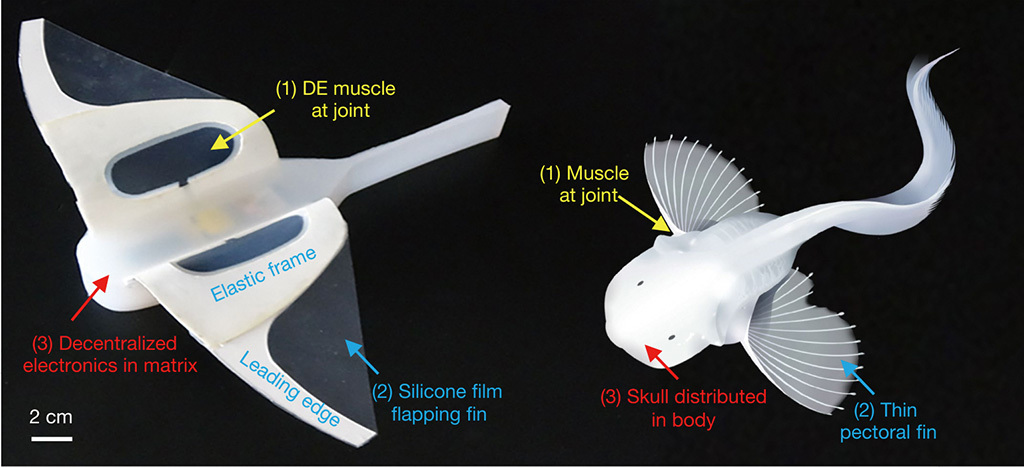
A soft robot built out of inspiration from a deep-sea snailfish with scattering bones within a soft body can brave at a depth of 10,900 m in the Mariana Trench. (Image by Li et al., 2021)
In standard robotics, this sudden non-linear jump in volume—known as electromechanical pull-in instability—is widely considered a fatal flaw that leads to excessive material thinning and catastrophic electric breakdown (short-circuiting). However, LI’s team viewed this terrifying instability not as a bug to be avoided, but as a powerful feature to be creatively harnessed. They solved the breakdown issue by mounting a dielectric elastomer membrane over a carefully tuned, sealed air chamber and pre-pressurizing it right to the exact verge of this snapping point. When they applied a small electrical voltage to this critically pre-stressed state, the membrane underwent an explosive, massive expansion. The air chamber acts as a thermodynamic safety net that bends the mechanical snap-through path, buffering the material right at the snapping point to prevent it from expanding too far. This safely allowed a staggering, record-breaking voltage-induced area expansion of 1692%, definitively proving that dielectric elastomers could perform colossal mechanical work safely.
Further, considering standard commercial polymers used in soft robotics (like VHB) effectively freeze into stiff plastic in the icy 2.7°C waters of the trench, the team engineered a highly specialized triblock copolymer (SBAS) skin that stays perfectly elastic and flexible all the way down to –17.2°C.
Real-World Triumphs and Trade-offs
The engineering paid off. In field tests, the robot successfully flapped its delicate wings for 45 continuous minutes at the bottom of the Mariana Trench (10,900m) and swam entirely freely at 3,224 meters in the South China Sea.
“Li and co-workers’ research now pushes the boundaries of what can be achieved: the replacement of rigid protective enclosures for electronic components by distributed electronics embedded in a soft material paves the way to a new generation of deep-sea explorers,” commented Prof. Cecilia Laschi and Prof. Marcello Calisti, two renowned scholars expert at robotics and intelligent systems in the same issue of Nature.
While these robots are significantly cheaper to build (cutting manufacturing costs by up to 90%) and much safer for navigating fragile coral reefs, this squishy design has drawbacks. It is currently much slower than traditional propeller-driven subs, achieving top speeds of roughly 0.45 body lengths per second, making it vulnerable to strong ocean currents. Furthermore, if these untethered robots get swept away, the permanently embedded lithium-ion batteries and decentralized electronics pose a potential concentrated electronic pollution hazard to pristine marine ecosystems.
Nevertheless, LI’s pioneering work serves as a triumphant testament to the power of biomimicry and rigorous fundamental physics, beautifully echoing the ancient Chinese philosophy of “yi rou ke gang” (“以柔克刚” in Chinese characters)—conquering the unyielding with yielding. It definitively proves that to conquer the most extreme and crushing environments on our planet, we do not always need to aggressively fight nature with brute force and thick titanium.
Reference
Laschi, C., & Calisti, M. (2021) Soft robot reaches the deepest part of the ocean. Nature, 591(7848), 35–36. doi:10.1038/d41586-021-00489-y
Li, G., Chen, X., Zhou, F., et al. (2021) Self-powered soft robot in the Mariana Trench. Nature, 591(7848), 66–71. doi:10.1038/s41586-020-03153-z
Li, T., Keplinger, C., Baumgartner, R., Bauer, S., Yang, W., & Suo, Z. (2013) Giant voltage-induced deformation in dielectric elastomers near the verge of snap-through instability. Journal of the Mechanics and Physics of Solids, 61(2), 611–628. doi: 10.1016/j.jmps.2012.09.006