

InBrief · 31 Dec 2025
Vitamin C Fights Primate Ovarian Aging
Vitamin C Fights Primate Ovarian Aging
Ovarian aging profoundly impacts female reproductive health, driven primarily by key factors like oxidative stress. Non-human primates (monkeys) serve as vital models because they, like humans, can not synthesize their own Vitamin C (VC). Researchers, including those from the Institute of Zoology, Chinese Academy of Sciences, and the China National Center for Bioinformation and Beijing Institute of Genomics, Chinese Academy of Sciences, investigated the use of oral VC supplementation to mitigate this biological decline.
In a significant 3.3-year longitudinal study conducted on aged cynomolgus macaques, oral VC was found to delay ovarian aging. The treatment diminished crucial aging markers, including follicular depletion and widespread oxidative stress. Molecular analysis using a single-cell transcriptomic clock revealed substantial rejuvenation: VC lowered the biological age of ovarian somatic cells by 5.66 years and oocytes by 1.35 years. This geroprotective effect is mediated, at least in part, by activating the NRF2 pathway—an intrinsic cellular antioxidant defense mechanism that subsequently alleviates inflammation and cellular senescence. Published in Cell Stem Cell (doi: 10.1016/j.stem.2025.09.008) on November 6, these findings support VC as a translatable nutritional strategy for combating reproductive aging.
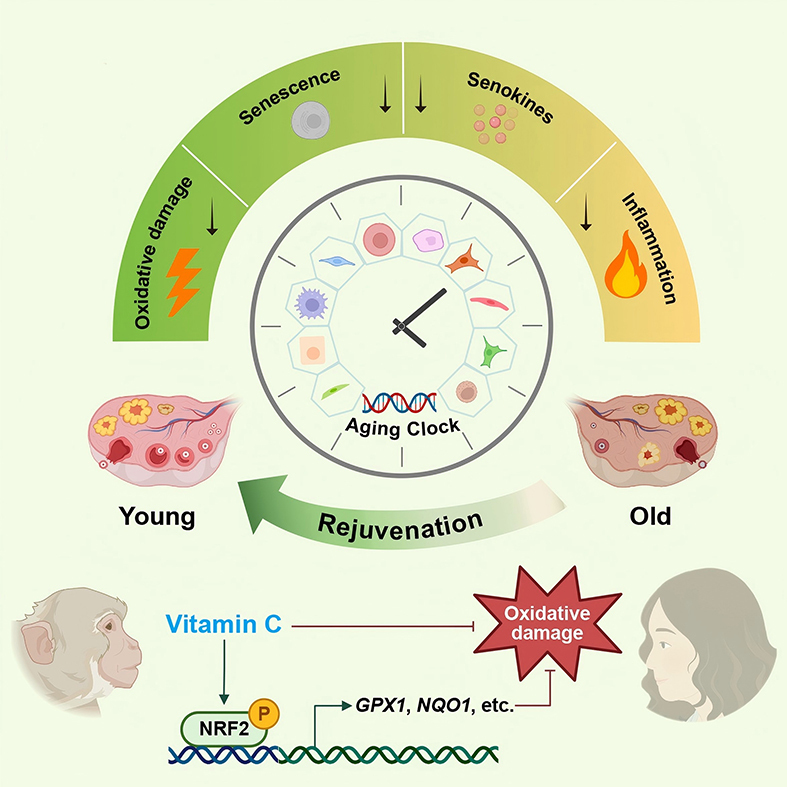
New study reveals that oral vitamin C supplementation delays ovarian aging in non-human primates, attenuating key aging hallmarks and rejuvenating the ovarian cellular and molecular profiles. (Graphic: Jing et al., 2025)