

Plants continuously generate new organs throughout their lives—a feat orchestrated by stem cells tucked within growing tips. But how do these cells know precisely when and where to divide? The answer lies in the walls surrounding them. Researchers led by Dr. YANG Weibing from the Center for Excellence in Molecular Plant Sciences of the Chinese Academy of Sciences have discovered that cell wall stiffness acts as a molecular guide, directing stem cell division with remarkable precision. The study was published in Science (doi: 10.1126/science.ady4102) on December 4, 2025.
The team found a striking pattern in the shoot apical meristem—the plant’s stem cell hub. Old, mature cell walls remain stiff like structural beams, while newly formed walls between dividing cells start soft and flexible. This stiffness difference comes from a simple chemical modification to pectin, a gel-like wall component. Stiff walls have highly methylesterified pectin, while soft new walls have de-methylesterified pectin. The softening is controlled by an enzyme called PME5, but the plant employs a clever safeguard: It locks the instruction manual for this enzyme—the PME5 messenger RNA—inside the nucleus. As the cell divides and the nucleus briefly disassembles, the mRNA escapes to produce PME5 exactly where the new wall forms. This ensures that PME5 softens only the new division plane, allowing it to orient correctly within the stiff mother cell. When PME5 is not working, the division plane lacks the necessary “softness/flexibility”. This leads to misoriented divisions (slanted or crooked walls) because the new wall cannot adjust its position correctly within the stiff mother cell.
When the researchers disrupted this mechanism by letting PME5 mRNA escape prematurely, the results were dramatic—disorganized cell divisions, reduced stem cell activity, and stunted plants with malformed fruits. This nuclear sequestration strategy is not unique to PME5 but is used by several related enzymes. The team found this bimodal wall pattern in corn, soybean, and tomato, suggesting it is a fundamental principle of plant growth. Since key crop traits like tiller number and seed count depend on stem cell activity, understanding this cell wall code could enable scientists to engineer crops with improved architecture and higher yields.
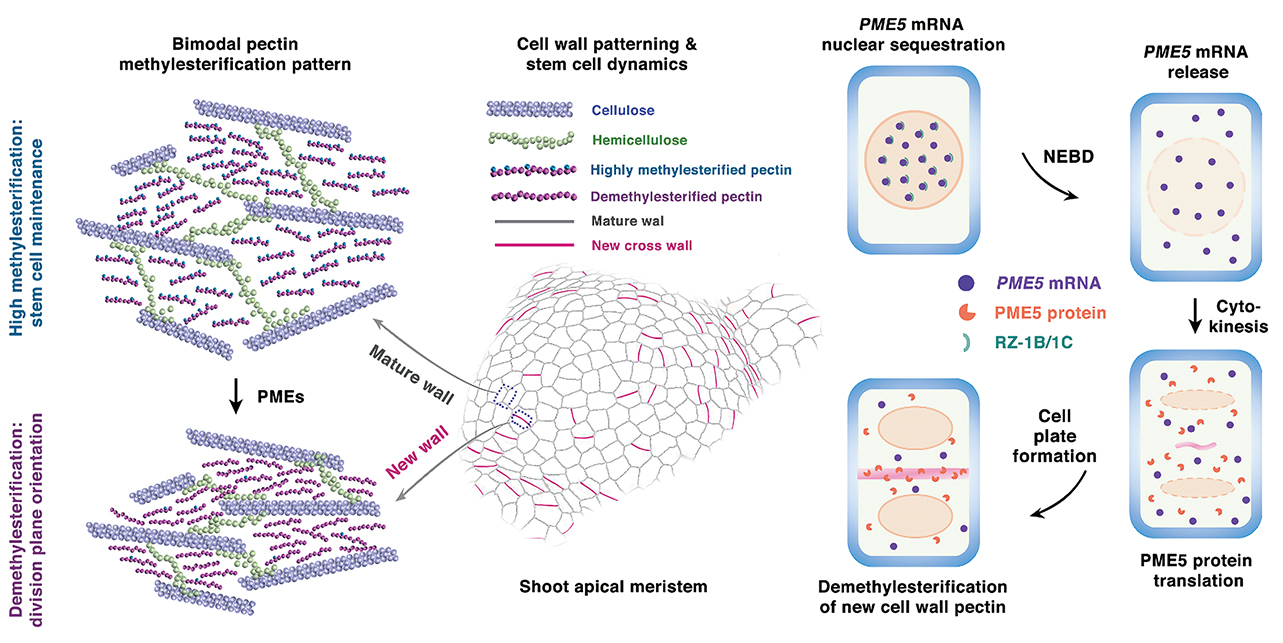
Proposed model for the regulation of plant stem cell dynamics by precise pectin modification. Mature cell walls retain highly methylesterified pectin for structural support, while newly forming division walls are enriched in de-methylesterified pectin that guides division plane orientation. This spatial pattern is achieved by locking PME5 mRNA inside the nucleus until cell division releases it to soften pectin precisely where new walls form. (Graphic: Dr. YANG Weibing’s group)