

InBrief · 31 Dec 2025
Mangrove Trees also Release Climate-Warming Methane
Mangrove Trees also Release Climate-Warming Methane
Mangrove ecosystems are celebrated as powerful carbon sinks, absorbing and storing atmospheric CO2 more efficiently than most terrestrial forests. However, they also release methane—a greenhouse gas far more potent than carbon dioxide. A study published in Nature Geoscience (doi: 10.1038/s41561-025-01848-4) on November 14 reveals that mangrove tree stems represent a previously overlooked pathway of methane emissions, partially reducing the climate benefits of these coastal ecosystems.
Researchers from the South China Botanical Garden of the Chinese Academy of Sciences conducted a global-scale assessment combining long-term field monitoring across multiple Chinese mangrove sites, worldwide literature data, and machine learning models. Their analysis showed that methane produced by anaerobic microbes in waterlogged mangrove soils travels upward through specialized aerenchyma tissues in tree stems and escapes into the atmosphere. Field measurements confirmed that emissions are highest near the stem base and decrease with height.
The team estimates that mangrove tree stems globally release approximately 730.6 gigagrams of methane annually—offsetting roughly 16.9% of the carbon buried in mangrove sediments each year. When soil methane emissions are included, total methane losses could offset up to 27.5% of mangroves’ blue carbon sequestration. These findings suggest that current climate mitigation assessments based solely on sediment carbon burial without consideration of methane emission may overestimate the benefits of mangrove restoration projects. However, even when considering the methane emissions, the mangroves are still a more powerful carbon sink than most terrestrial ecosystems.
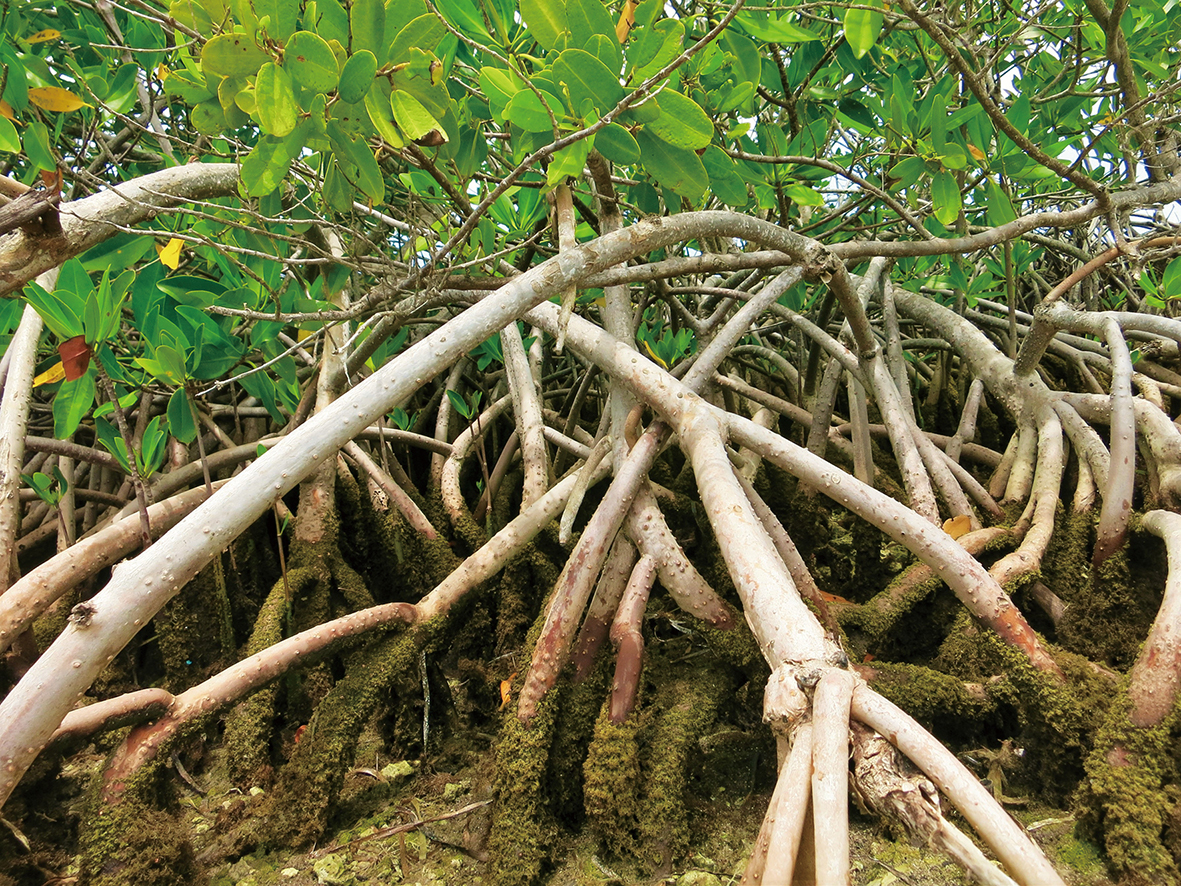
Mangrove roots in waterlogged soil—where anaerobic microbes produce methane that travels up through tree stems into the atmosphere. (Graphic: Pixabay)