

Yeast cells engineered for efficient chemical production face a critical challenge—they age and accumulate toxic metabolites during prolonged industrial fermentation, ultimately reducing productivity. A team at the Dalian Institute of Chemical Physics (DICP) of the Chinese Academy of Sciences has now shown that extending the cellular lifespan of yeasts dramatically enhances their biosynthetic capacity.
In a study published in PNAS (doi: 10.1073/pnas.2515324122) on November 10, researchers led by Dr. ZHOU Yongjin systematically engineered yeast longevity through four dimensions: nutrient sensing, mitophagy, protein stability, and genomic stability. By weakening nutrient-sensing pathways and enhancing mitophagy—the cellular process that removes damaged mitochondria, together with metabolic pathway optimization, the team achieved sclareol production of 25.9 grams per liter, the highest microbial production recorded for this valuable precursor for the synthesis of perfume Ambrox. Omics analysis revealed that lifespan extension automatically remodeled cellular metabolism, improving robustness during late-stage fermentation when cells typically decline. The longevity engineering strategy also boosted production of sesquiterpenes and phenolic acids, demonstrating broad applicability. This work establishes a connection between chronological lifespan and biosynthetic capacity—offering a generalizable strategy for sustainable biomanufacturing beyond conventional metabolic engineering.
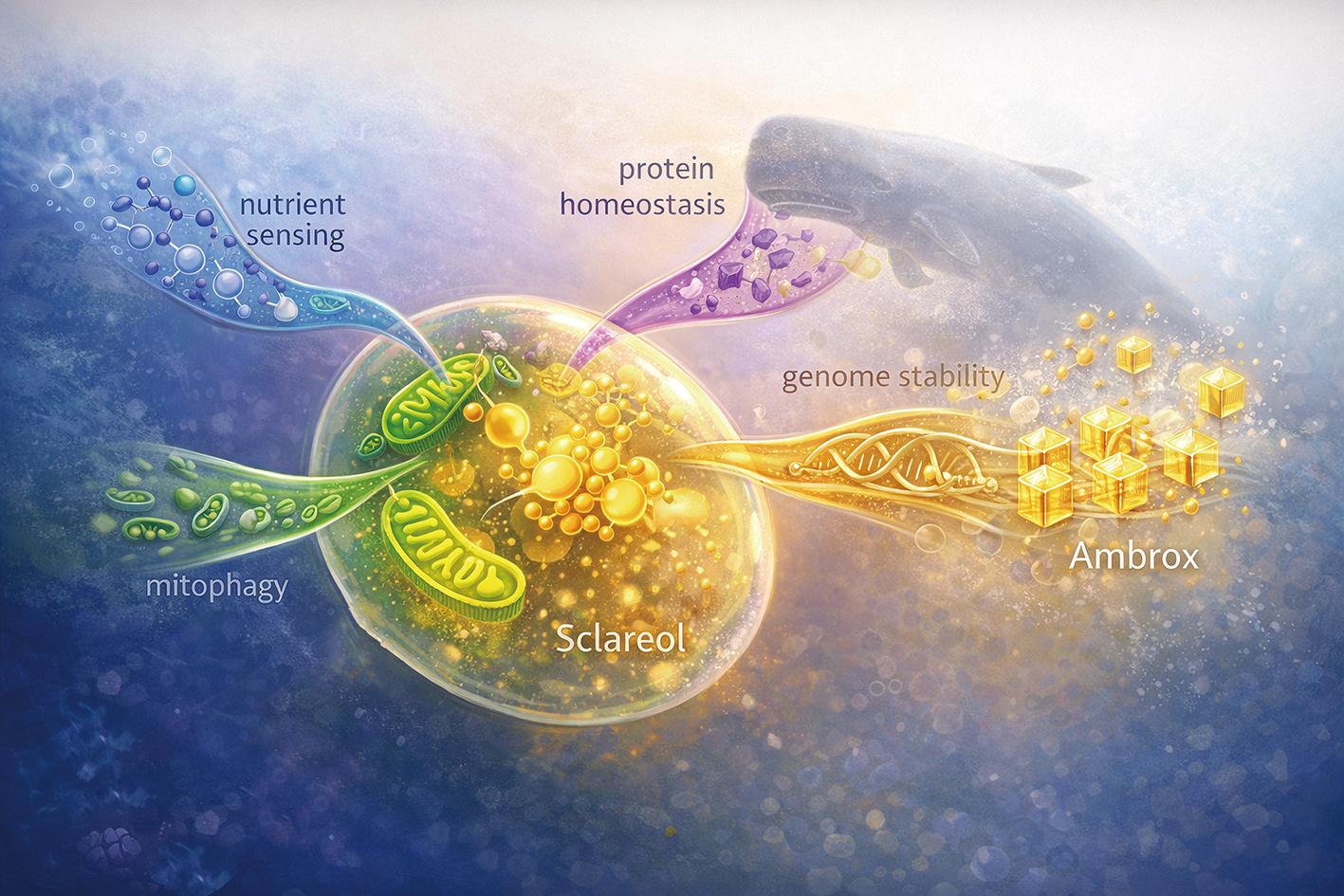
Engineering yeast longevity boosts sustainable sclareol production, a valuable precursor for the synthesis of perfume Ambrox. Extending cell lifespan through four longevity pathways dramatically increased sclareol yields—without the cellular stress of traditional methods or harvesting from endangered whales. (Image generated by AI)