

InBrief · 31 Dec 2025
An Earthworm-inspired Brain Probe
An Earthworm-inspired Brain Probe
Brain-computer interfaces rely on electrodes to record neural activity, but most existing electrodes remain fixed once implanted, limiting their sampling range and often triggering immune responses that degrade signal quality over time. As reported in a Nature paper (doi: 10.1038/s41586-025-09344-w) on September 17, researchers from the Shenzhen Institutes of Advanced Technology (SIAT), Chinese Academy of Sciences, and Donghua University have now developed NeuroWorm—a soft, movable fiber electrode that can navigate through tissues while continuously recording high-quality signals. The device marks a shift from static to dynamic neural interfaces.
Inspired by earthworm locomotion, the 200-micrometer-diameter fiber integrates up to 60 independent signal channels and features a magnetic tip that enables wireless steering via external magnetic fields. In rat experiments, researchers guided NeuroWorm through muscle fasciae via a minimally invasive incision, demonstrating smooth movement between tissue layers while capturing stable electromyographic signals from multiple positions over seven days. Long-term implantation in rat leg muscles for over 43 weeks showed continuous signal recording with minimal fibrotic encapsulation—less than 23 micrometers compared to 451 micrometers for conventional rigid electrodes. The team also navigated NeuroWorm through a rabbit’s brain from the cortex to subcortical regions while maintaining stable signal quality throughout. By enabling noninvasive repositioning through magnetic guidance, NeuroWorm eliminates the need for repeated surgeries due to electrode drift or misplacement. Hence, NeuroWorm provides a platform for long-term, multisite neural monitoring with applications in brain-computer interfaces, smart prosthetics, epilepsy mapping, and chronic neurological disorder management.
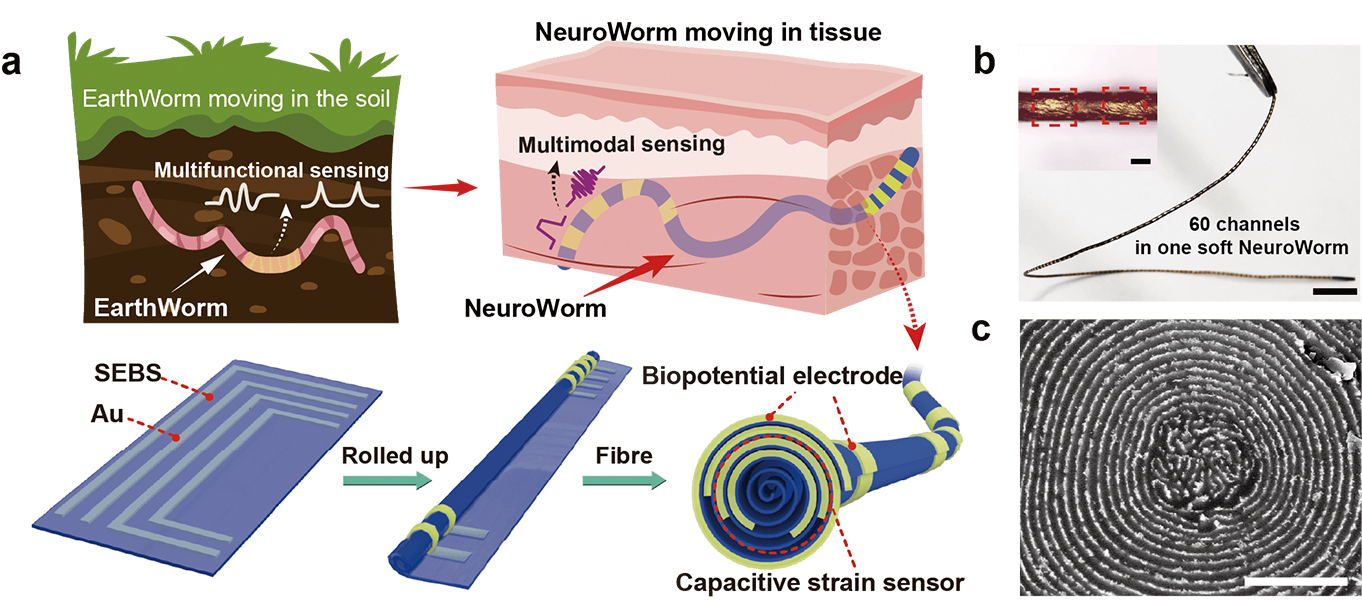
Design and fabrication strategy of NeuroWorm. (Image by SIAT)