

By SONG Jianlan
About 18 months after its launch, Einstein Probe (EP, also named “Tianguan” in Chinese)1, an astronomical satellite developed by the Chinese Academy of Sciences (CAS) in cooperation with its European partners, detected on July 2, 2025 an extremely bright X-ray source from a galaxy about 7.2 billion light years away. It appeared to be the radiation from a tidal disruption event (TDE) where a black hole preyed on a nearby star; however, it was distinctive to any previously detected X-ray source.
Designated as EP 250702a, this source caught worldwide attention and triggered a synchronized observation campaign. Ground- and space-based instruments of different wavebands—including the Chandra Advanced CCD Imaging Spectrometer (ACIS), the Very Large Telescope (VLT) and others— were targeted at the coordinates shared by EP. Confluence of data and subsequent careful analysis prompted the EP team to propose that the radiation was most likely from a black hole of intermediate mass (IMBH) devouring a white dwarf (WD). They reported their analysis and discovery as a cover article in Science Bulletin (https://doi.org/10.1016/j.scib.2025.12.050) in February 2026, explaining why it was very likely an IMBH-WD TDE.
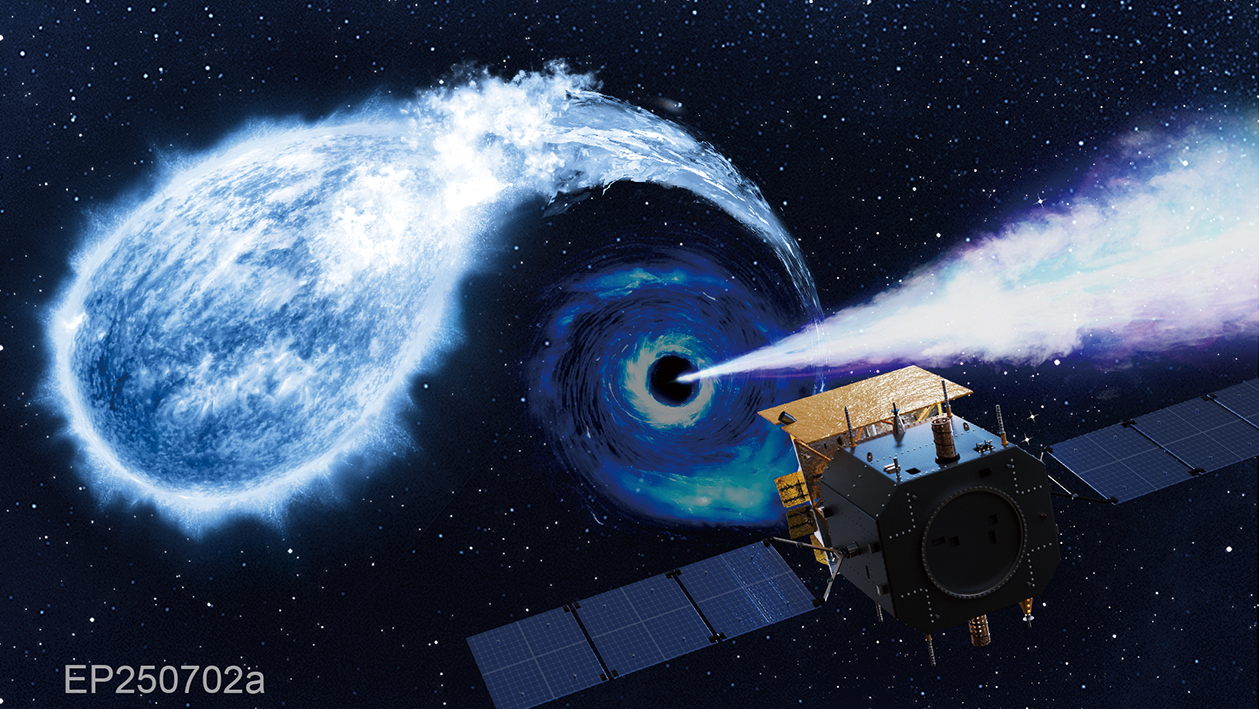
The Einstein Probe (on the right) is illustrated observing the scenario where an intermediate-mass black hole is preying on a white dwarf, developing a huge accretion disk and beaming out relativistic jets. (Credit: EP Science Center, National Astronomical Observatories, CAS/Sci Visual)
This detection likely represents the most compelling and clear-cut observation of its kind to date, and further studies into this high-redshift object might inspire later explorations into the stellar evolution of our cosmos.
How has the team found out it was likely a TDE with an IMBH preying on a WD? Let’s begin with TDE.
Tidal Disruption Events
Black holes are many celestial bodies’ graveyard. Getting too close to a black hole is fatal: The black hole will give the approaching star an asymmetrical gravitational pull—stronger on the near side and weaker on the far side. Given the black hole’s mighty gravity, even a tiny variation in distance could make a huge difference, producing a furious “tidal force.” Once the tidal force builds up to a critical point, the star will be torn apart and further stretched into a long, thin stream of stellar gas. In chaos, the gas falls onto the black hole, with the particles colliding with each other in a swirling disk surrounding the black hole. In the process, the stellar gas gets ionized, producing a powerful electromagnetic flare, generally in X-rays, visible light and ultraviolet wavelengths.
Such a scenario called accretion could last for years. The accretion disk can literally “shed light on” the black hole that would otherwise stay invisible, offering human beings a once-in-a-lifetime opportunity to stare at and understand this mighty monster in the cosmos.
Therefore, TDEs are important targets of astronomical observations. Unfortunately, their dim, remote signals are not easy to detect; and the X-ray composition can be seriously absorbed by our atmosphere. Only highly sensitive space-based instruments can catch them. Thanks to the fast development of X-ray focusing imagery and accordingly that of astronomical observational instruments, recent years saw obvious progress. Now more than 100 TDEs have been observed.
In all such detected TDEs, however, the preys were invariably gaseous stars. They typically give off mildly strong and long-lasting X-ray flares that could sustain for years.
The Unusual Profile of EP 250702a
The excellent sensitivity in combination with unprecedently wide field of view has made it possible for EP to catch the early outburst of EP250702a and share its position with the whole astronomical circle.
Formally came into operation in July 2024, EP is equipped with the state-of-the-art X-ray focusing imagery called “Lobster-eye micropore optics.” Its wide-field X-ray telescope (WXT) can scan the X-ray sky efficiently to detect interesting objects, and promptly share their coordinates with worldwide instruments for follow-up observations. EP’s own follow-up X-ray telescope (FXT) can also perform close-up high-quality observations in response to the alerts given by the WXT. In the case of EP250702a, it conducted a follow-up observation lasting for over a month. The observations by EP and other instruments, covering a wide range of wavelengths extending from the radio to the gamma-ray band, yielded a comprehensive view of the target with great detail.
EP250702a looked much different from all previously detected TDEs. It gave off a series of short but powerful X-ray flares. Data from EP-WXT as well as other instruments, including Fermi/GBM and Konus-Wind, revealed that these rapid, extremely luminous X-ray outbursts spanned approximately one day. The radiation peaked at energies so high that it extended to the gamma-ray band, reaching tens of MeV. During this peak phase, the gamma-ray emissions were detected in multiple episodes, covering a timespan of more than three hours. Its X-ray radiation dropped sharply within 20 days, forming a contrast with typical TDEs that last for years. In fact, the combination of intense, rapid flaring at outburst and an extremely rapid decay was never seen in any previously known transient phenomena.
Nor was it a typical gamma-ray burst (GRB). The WXT of EP recorded a soft X-ray emission about one day before the triggering of the gamma-ray flares, which is unusual for a GRB. Moreover, its gamma-ray flares could have sustained beyond 14 hours—this exceptionally long peak even exceeded those of ultra-long GRBs.
“Should it be a GRB typically resulting from the collapse of a star, a large amount of energy could also be released, but it would generally last for just seconds to minutes,” explained Dr. ZHANG Wenda from the National Astronomical Observatories, CAS (NAOC). ZHANG is a co-corresponding author of the paper. “Such an extremely long-lasting radiation accompanying short timescale flaring, is much more likely from a rare kind of jetted TDEs,” he asserted.
Such rare jetted TDEs generally develop relativistic jets, and produce luminous and energetic non-thermal outbursts in both X-ray and gamma-ray bands.
The spectrum of EP250702a varied in composition with time. Shortly after the onset, the flare broke out and steeply “hardened” to higher energies, with the peak dominated by high-energy non-thermal radiation in hard X-ray and gamma-ray bands. While its later phase was dominated by soft X-ray thermal radiation, displaying a hardening-to-softening transition.
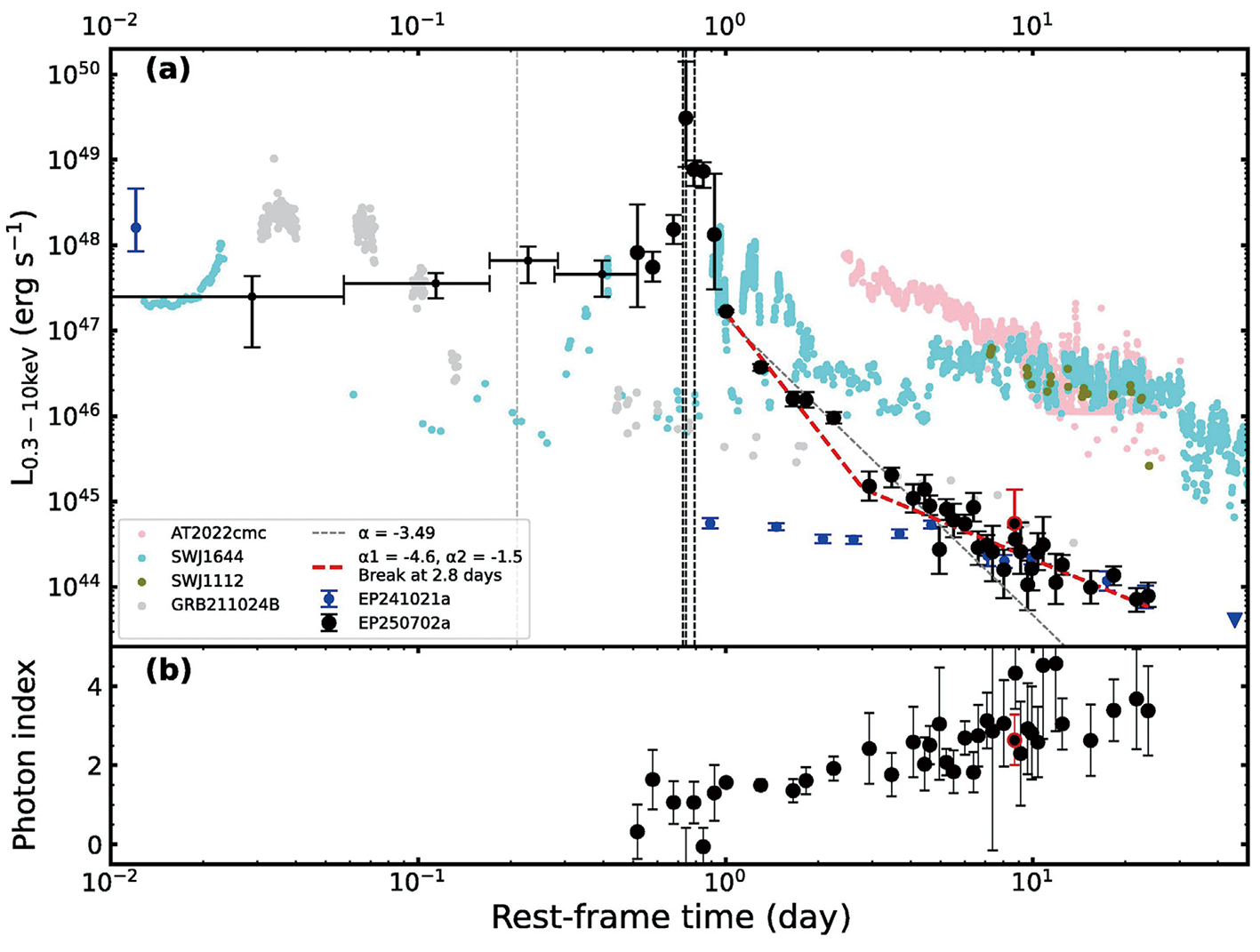
The unusual profile of EP250702a. (a) Light curve of EP250702a (in black dots) in comparison with those of other transients, including typical jetted tidal disruption events like SWJ1644 (in green blue), and an ultra-long gamma-ray burst GRB211024B (in gray). Compared with others, EP250702a demonstrates unprecedently fast evolution, with its luminosity steeply decaying by a 105 magnitude within just 20 days, at a rate by far exceeding other jetted TDEs. (b) The temporary evolution of the X-ray spectrum of EP250702a. At the onset its photon index hits an outstanding height of 1 (a very “hard” spectrum), and then significantly increases to beyond 3 (softening). Such a clear hardening-to-softening transition, never detected before, suggests an emergence of thermal radiation in the late phase. (Image: EP Science Center, National Astronomical Observatories, CAS)
What exactly could have given such an unusual profile?
Unveiling the Special Predator and Prey
The short variability timescale of the early outburst, explained the authors, indicates that an IMBH could be powering the accretion. Judging from the short minimum variability timescale of its light curve, the team gave a constraint that the radius of the emitting region could be less than 2.2×1010 cm, consistent to the size of an IMBH of about 750,000 solar masses. It was located off the nuclear region of its hosting galaxy, this further excluded the possibility of, and disturbance from a SMBH (or an active galaxy nuclear).
After comparing different alternatives, the team concluded that EP250702a could be the clearest evidence so far for a jetted TDE dominated by an IMBH.
The involvement of an IMBH cannot fully explain the weird profile of EP250702a, however. Its X-ray flux decayed much earlier than any previously documented jetted TDEs; particularly, this decay was much speeded compared to the previously detected candidates of IMBH-TDEs, demonstrating a significantly faster decay rate. Moreover, the X-ray luminosity at the peaks of the outburst was at least 10 to 100 times higher than those of all the known jetted TDEs.
“The short evolutionary timescale, together with the highest peak luminosity in X-ray, implies that it was not a main-sequence star but a WD being disrupted,” concluded Prof. YUAN Weimin, Principal Scientist of EP and co-corresponding author of the paper. “In the case of a gaseous star, both the accretion and the glowing processes would advance much more slowly, lasting for years or even longer,” he continued, exhilarated by EP’ capturing of such a unique transient.
The team’s theoretical modelling also confirmed that the profile of EP250702a is consistent with the tidal disruption of a low-mass WD by an IMBH.
Before EP 250702a, no clear evidence of such a TDE had been observed, with an IMBH devouring a WD.
IMBH-WD: An Exclusive Couple
WDs are a million times denser and thus much tougher than gaseous stars. Theoretically they can only be torn apart by IMBHs, because the latter are not only mighty enough, but also “small” enough—the fatal combination of size and mass makes it possible for them to drag the prey WD close enough and hence expose the latter to a tidal force beyond a mortal threshold. A TDE involving an IMBH and a WD can develop bright and rapid relativistic jets, bursting out extremely furious flares in a short timescale, just as EP250702a.
Moreover, in comparison with gaseous stars, WDs possess greater magnetic fields, which also make a difference. In the case of a TDE with an IMBH preying on a WD, the accretion disk could generate a stronger magnetic field to fuel more furious radiation outflows with the jets and, to generate a stronger afterglow called super-Eddington emission, as produced by the accretion disk in response to the bombarding flares.
The team’s simulation demonstrated that the soft X-ray afterglow of the observed profile is consistent with the extreme super-Eddington emission produced by the accretion disk of an IMBH-WD TDE.
“Its bright, long peak extending from the X-ray to the gamma-ray band, as well as its signature afterglow in soft X-ray make a continuous physics spectacle, which strongly supports the scenario of an IMBH-WE jetted TDE,” says Prof. JIN Chichuan from NAOC, co-corresponding author of the paper.
Even the hard-to-soft transition of its spectrum can be explained by the IMBH-WD predation. When the relativistic jet first launched, the spectrum was dominated by bright, high-energy radiation from the central streaming; while in the later phase, the super-Eddington glow emerged and gradually dominated the radiation, decaying more slowly than the non-thermal component dominating the peak. As a result, the overall spectrum manifested a transition from an extremely hard peak that progressively hardened (up to the gamma-ray band) during the flaring phase, to a softening afterglow gradually dominated by thermal radiation of lower energy (in the soft X-ray band).
The enigma of EP250702a is thus solved. The involvement of the exclusive couple of IMBH and WD naturally explains the unusual traits of the observed profile. “We examined different alternative models, but the scenario of a jetted TDE where an IMBH disrupting a WD gives the most self-consistent and natural explanation,” the team concluded.
New Window on Drastic Cosmos
Very likely EP250702a makes the first specimen available for an IMBH-WD TDE. Before it, only very few candidates of IMBHs had been detected, and even the existence of IMBHs had been dubious. Now filling a long-lasting gap, the observation on EP250702a could provide a great opportunity to understand the cosmic evolution of black holes, especially the seeding and growth of SMBHs. As possible “seeds” that later grow into SMBHs, IMBHs can offer valuable information to test existing models of black-hole growth.
The redshift (z ≈ 1.036) of EP250702a, while not exceptionally high, is still noteworthy in the context of TDE observations. The predation occurred when the cosmos was 6.1 billion years old, well into its mature. Its detection was enabled by the high sensitivity and wide field of view of EP-WXT. This demonstrates the instrument’s unique capability to identify such transients at cosmological distances, and suggests that similar or even higher-redshift events may be discovered in the future as EP’s survey continues. Observations of such distant TDEs can therefore provide valuable insights into the evolution of star clusters in young galactic environments.
More interestingly, aside from electromagnetic radiations, WD-TDEs like EP250702a can simultaneously emit gravitational waves—whose frequencies fall within the measuring range of planned space-based observatories for gravitational waves, such as LISA. This heralds great opportunities for future multi-messenger astronomy.
“EP is dedicated to capturing transients—signals from the drastic phenomena that keep changing with time in our cosmos,” introduced Prof. YUAN. “The discovery of EP250702a has fully verified the excellent monitoring capacity of WXT onboard EP. It not only proved that we can capture the drastic moments of cosmic evolution, but also demonstrated the important role played by China in astronomical explorations.”

In Chinese the Einstein Probe is named “Tianguan” after the “guest star” (the ancient Chinese term for supernovae) discovered by ancient Chinese astronomers in the year 1054. The legacy from this supernova (designated as SN1054) has become the nowadays Crab Nebula.
Reference
Li, Dongyue, et al. A fast powerful X-ray transient from possible tidal disruption of a white dwarf, Science Bulletin 71, 538–546 (2026). https://doi.org/10.1016/j.scib.2025.12.050
1 The Einstein Probe is a space mission led by the Chinese Academy of Sciences (CAS), in collaboration with the European Space Agency (ESA), the Max Planck Institute for Extraterrestrial Physics (MPE) in Germany, and the French Space Agency (CNES).