

Headline · 24 Dec 2025
Listening to Echoes of Immemorial Big Bang —
AliCPT Sets Out to Investigate Early-Time Universe
Listening to Echoes of Immemorial Big Bang —
AliCPT Sets Out to Investigate Early-Time Universe
By SONG Jianlan

The AliCPT located in the Ali region, Xizang. (Credit: AliCPT Collaboration)
In July, the Ali CMB Polarization Telescope (AliCPT) officially released high-quality maps of 150 GHz radiation from the Moon and Jupiter. The quality of these images not only validates the exceptional performance of the core instrument of AliCPT-1 but also signifies the successful completion of its first-stage construction.
Designed to detect primordial gravitational waves (PGWs — the faint echoes of the Big Bang) by measuring the B-mode polarization of cosmic microwave background (CMB) radiation, AliCPT is situated on a mountain ridge at an altitude of 5,250 meters in the Ali Region of Xizang, China. It is China’s first observatory dedicated to PGW detection, and its core telescope also stands as the first high-altitude, multi-band, and highly sensitive ground-based CMB polarization telescope in the Northern Hemisphere.
Investigating the Genesis of the Universe
According to the cosmic inflation theory, the dramatic impact of the violent expansion that occurred just a tiny fraction of a second—more precisely, approximately 10-36 seconds — after the Big Bang could have triggered the first wave of spacetime ripples, primordial gravitational waves (PGWs). This expansion stretched the universe from an extremely dense point to a cosmological scale. Cosmic inflation established the initial conditions that determined the subsequent evolution of our universe. For instance, it shaped quantum fluctuations, which in turn generated primordial density perturbations — these perturbations acted as “seeds” that eventually grew into the universe’s large-scale structures, such as galaxy clusters.
Following the Big Bang, the universe existed as a hot, opaque particle plasma that trapped light. Approximately 380,000 years later, the universe cooled down sufficiently to allow the formation of neutral atoms — enabling the first photons to travel freely. This “first light”, known as the cosmic microwave background (CMB), now permeates the universe as a faint microwave glow, corresponding to a blackbody temperature of 2.73 Kelvin (K). As a fossil relic from the universe’s infancy, the CMB carries invaluable information about the universe’s origin and early evolution. Detecting the CMB helps scientists understand dark matter distribution, nature of dark energy, shape of the universe, and origin and evolution of the universe.
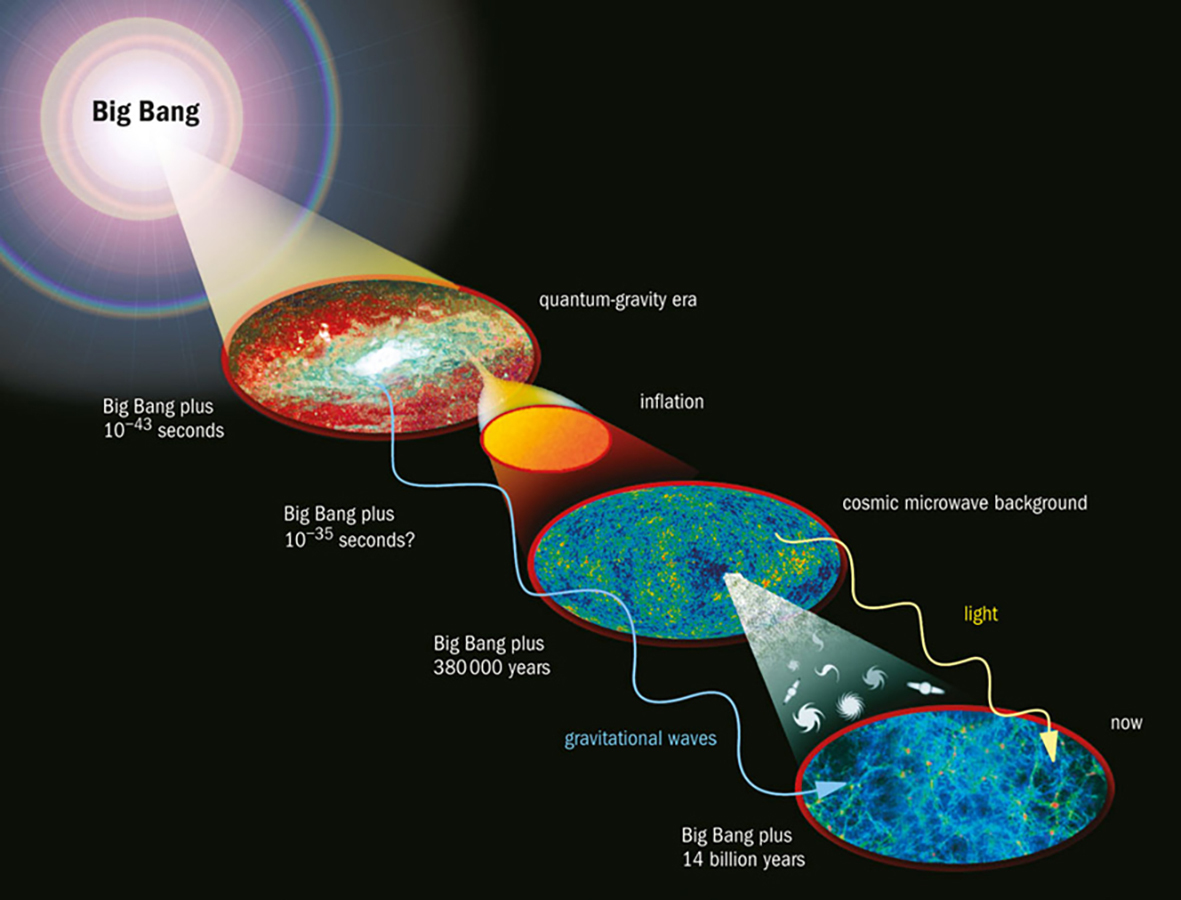
A schematic timeline of the origin and early evolution of the universe, spanning from the Big Bang to nowadays when CMB propagating through our universe as a relic from the Big Bang. (Credit: NASA)
Faint Voice from Immemorial Big Bang
As spacetime ripples from the universe’s infancy, PGWs have undergone extreme wavelength stretching during cosmic inflation and subsequent continuous expansion, resulting in an extremely low frequency of approximately 10-17 Hz today. This frequency lies far beyond the detection range of most current gravitational wave facilities, making effective detection via existing mainstream methods unachievable. Currently, the core method for detecting PGWs is measuring the B-mode polarization of the CMB radiation — a unique “trace” left by PGWs, which perturbed spacetime and influenced photon propagation in the early universe. Capturing this signal allows for the direct detection of PGWs. However, while previous space missions such as WMAP and the Planck satellite successfully mapped CMB temperature and polarization, they failed to detect the faint B-mode signal due to insufficient instrument sensitivity. For this reason, the global focus of PGWs detection has now shifted to ground-based telescope experiments. Examples include the BICEP/Keck Array at the South Pole and the Simons Observatory in Chile’s Atacama Desert.
The AliCPT experiment, proposed in 2014 by Prof. ZHANG Xinmin, a cosmologist from the Institute of High Energy Physics (IHEP), Chinese Academy of Sciences (CAS), is targeted at measuring both the B and E modes of CMB polarization. The main goals of AliCPT are detecting PGWs by measuring the B mode polarization, studying the Chern-Simons interaction and nature of dark energy by measuring the EB correlation. Besides, AliCPT aims to precisely measure the E mode polarization to test the ΛCDM standard cosmological model and to search for time-varying astronomical objects.
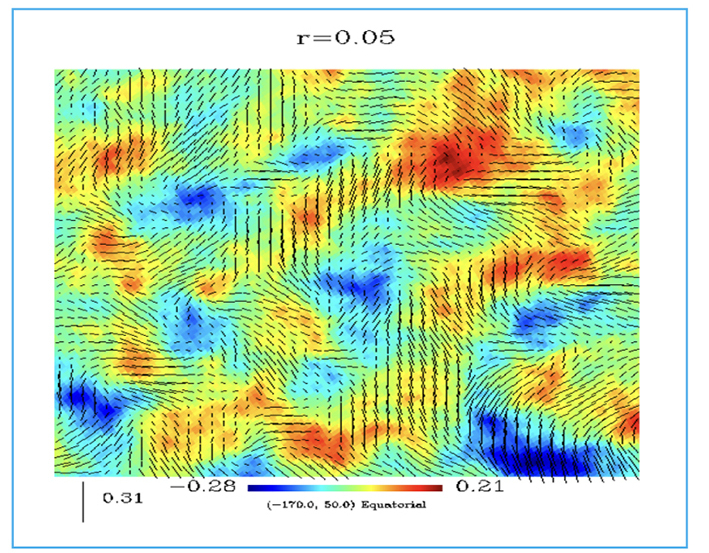
A simulation of CMB B mode polarization distribution. (Credit: AliCPT Collaboration)
A Mission Impossible Coming True
Detecting the CMB B-mode polarization is a monumental challenge due to its extremely faint signal. This quest is often likened to searching for a needle in a cosmic haystack — or discerning a single, subtle ripple across a vast ocean from an immense distance. It demands not only exquisitely sensitive instruments but also advanced algorithms to isolate the PGWs signal from overwhelming foreground noise.
Due to absorption by the Earth’s atmosphere, ground-based CMB instruments can only detect signals within specific frequency bands: The medium frequency band (90/150 GHz), the low frequency band (40 GHz), and the high frequency band (220/270 GHz). Among these bands, signals in the mid-range exhibit a better signal-to-noise ratio (SNR), enabling observations of acceptable quality for research purposes.
Led by the IHEP, the AliCPT project has evolved into an international collaboration, uniting approximately 100 scientists from 17 institutions across the globe. Following eight years of intensive collaboration among IHEP, the National Astronomical Observatories of China (NAOC), Stanford University, and other partners, the project successfully developed its flagship instrument, the AliCPT-1 telescope. After recent installation and calibration, the telescope has demonstrated performance that meets its design specifications. This collective effort culminated in the successful capture of “first light” — with initial images confirming the system’s outstanding performance and marking the start of its formal scientific observations this year.
Sponsored by CAS, the Chinese Ministry of Science and Technology and the National Natural Science Foundation of China, the project is anticipated to break through on the frontiers of fundamental physics, astrophysics and cosmology.
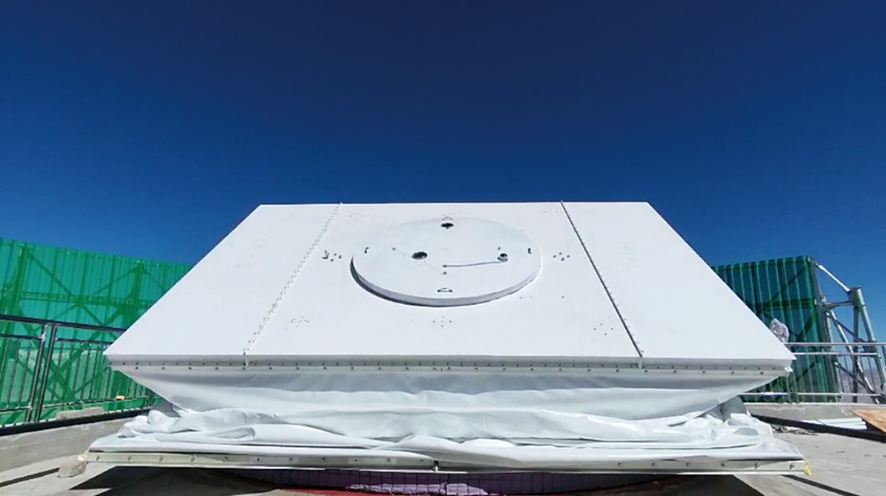
A view of AliCPT-1 from outside. (Credit: AliCPT Collaboration)
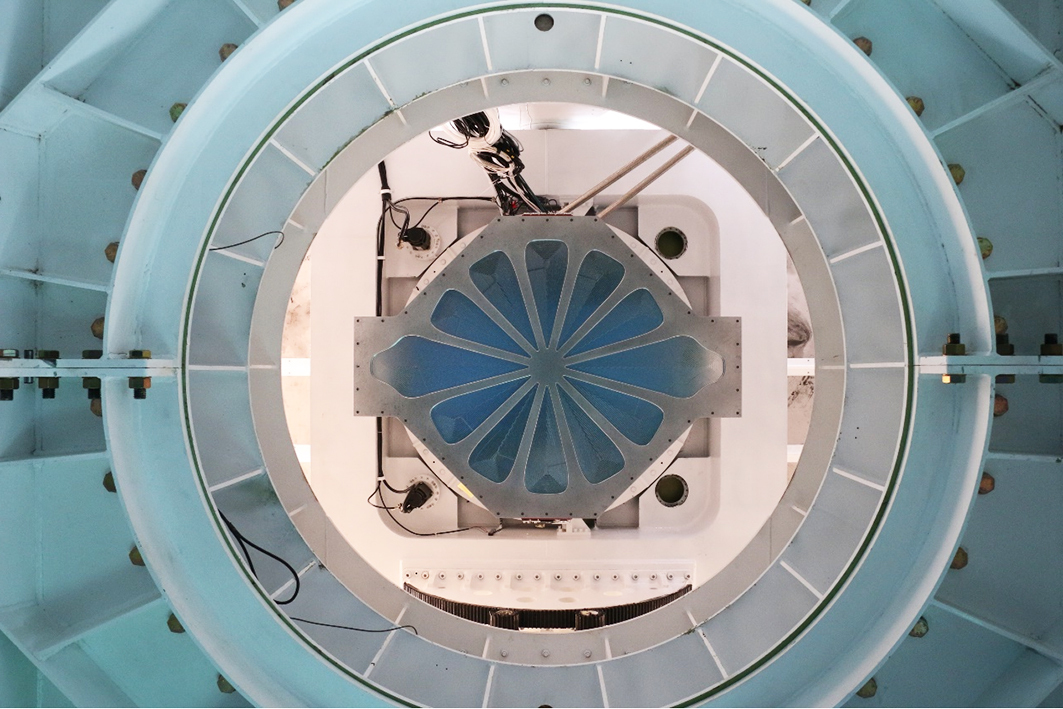
A view of AliCPT-1 receiver from below. (Credit: AliCPT Collaboration)
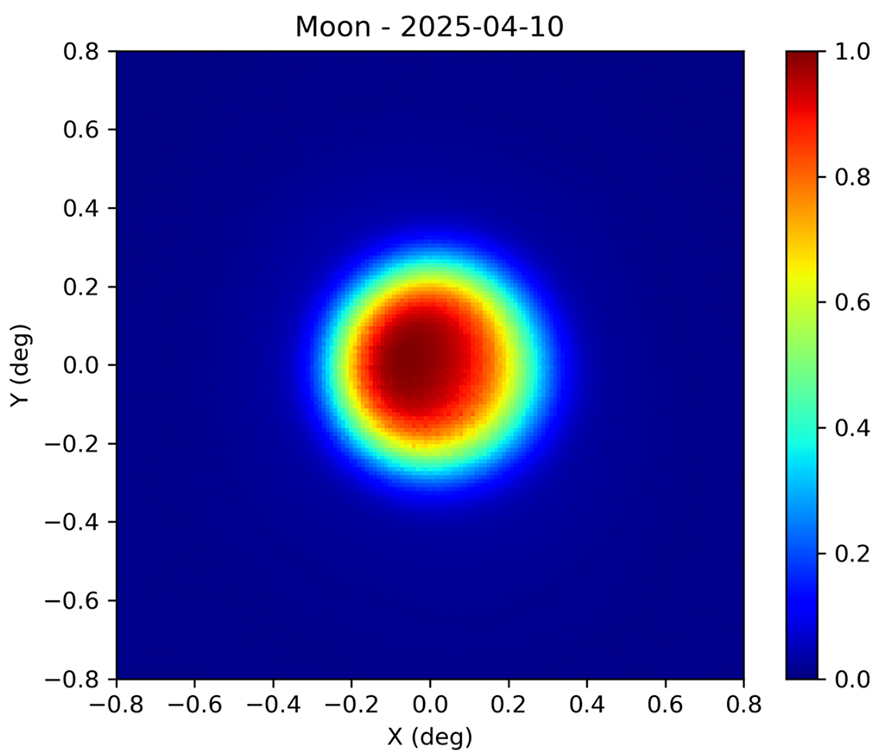
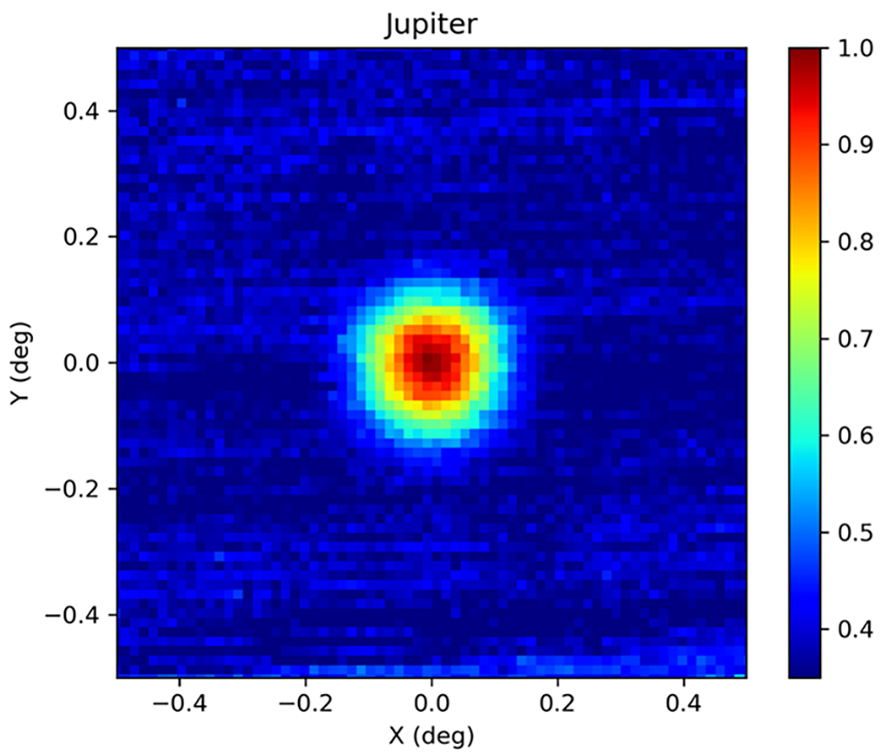
Maps of the Moon and the Jupiter at 150GHz band observed by AliCPT-1. (Credit: AliCPT Collaboration)