

By SONG Jianlan
With a mixed look of both Homo erectus and Homo sapiens, Yunxian Man, who could have connected different ancestors of ours, helps unveil a stage of fast diversification in human evolution.
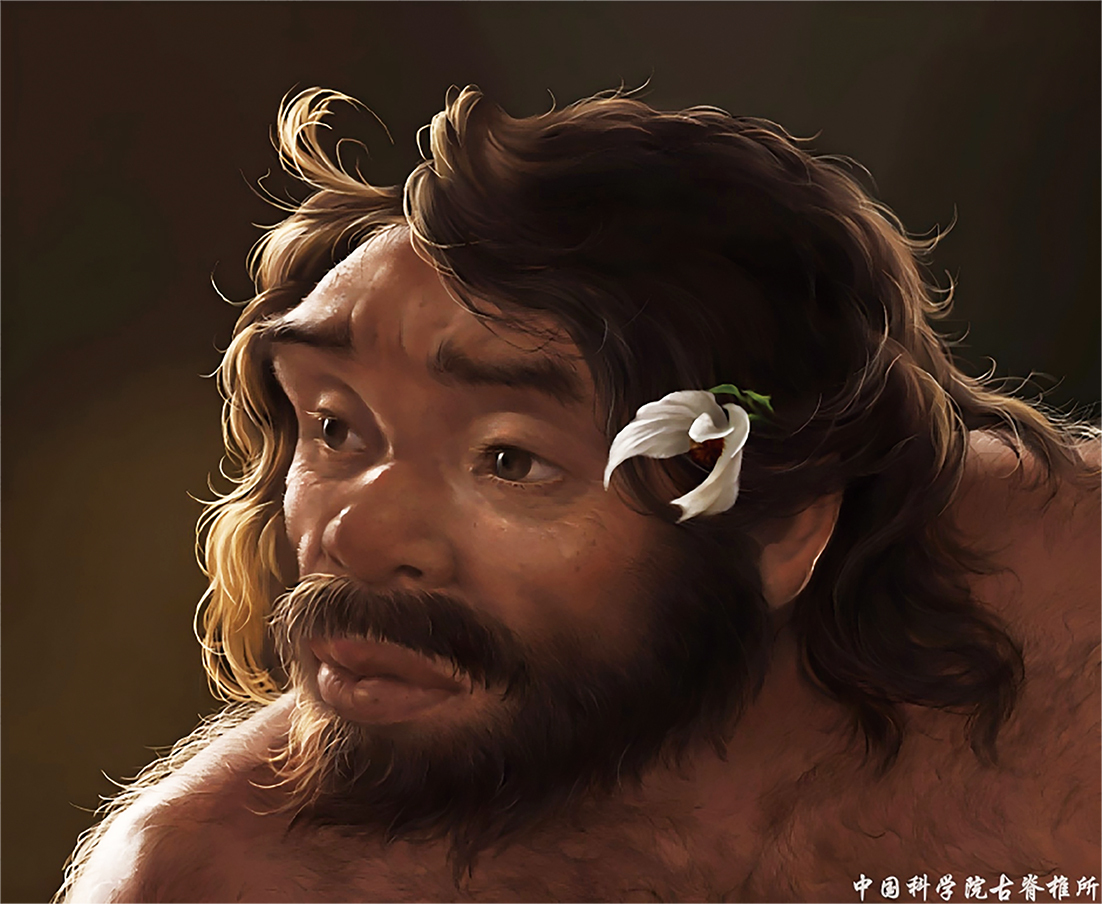
Life reconstruction of Yunxian Man. (Credit: IVPP)
Dating back to about one million years ago, two fossil human crania from Shiyan city of central China have long puzzled paleoanthropologists. Named Yunxian 1 and 2 after the county of their origination, they are seriously deformed and even crushed, making it very difficult to determine their phylogenetic position via anatomical analysis.
New technologies, like 3D virtual imaging powered by computed tomography (CT) and digital modeling, have enabled further studies into the inner structures of these invaluable specimens. Based on the antique age of the materials, and some of their traits hinting to earlier hominins, a study published in 2010 classified them into Homo erectus. However, whether or not they belong to other clades remained fiercely debated, partially due to the scarcity of fossil evidence from their time, the Middle Pleistocene, as well as the lack of more reliable and accurate restoration and reconstruction of the invaluable specimens.
Now a new research restored the anatomic morphology of Yunxian specimens with better accuracy and reliability, and reconstructed a virtual cranium for Yunxian Man. The subsequent analyses surprisingly found that this species should not be assigned to H. erectus, but to a new human clade.
This even revised the once-believed origin of H. sapiens, or modern humanity.
The Restored Cranium
Led by Prof. NI Xijun from the Institute of Vertebrate Paleontology and Paleoanthropology (IVPP), Chinese Academy of Sciences (CAS), a team of paleoanthropologists successfully restored and reconstructed the crania, and re-examined the phylogenetic position and evolutionary context of Yunxian Man. Finally, they reported their discoveries in Science on September 26.
Using high-resolution CT scans, the team evaluated the distortion and damages of the crania Yunxian 1 and Yunxian 2. The latter is much better preserved, with little plastic deformation, though fragmentary. Therefore, the researchers reconstructed the representative cranium – a virtual one – for Yunxian Man, mainly based on measurements of the Yunxian 2 specimen, together with some data from the other. With aid from CT image segmentation, they digitally split the fossil bones, separated them from the cranium, and repositioned the fragments to reconstruct the representative cranium.
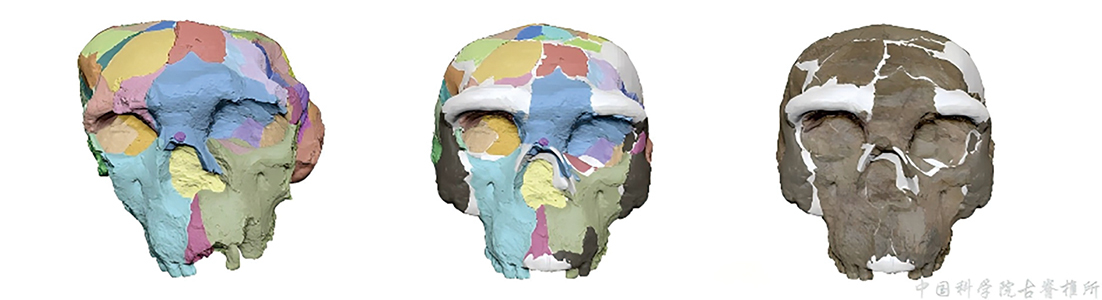
Restoration and reconstruction of Yunxian 2 Cranium. (Credit: IVPP)
The reconstructed cranium is basically complete, with only some small components missing, like part of the zygomatic arches, and the central incisors. It displays a mosaic appearance: A mixture of primitive traits similar to those of H. erectus, as well as derived characters from H. sapiens. It has a large and long braincase, and a moderate endocranial capacity of about 1,143 mL, outpacing many peers of its age. Its frontal lobe is low and narrow, however, barely more expanded than those of H. erectus, and considerably less expanded than those of Neanderthals or H. sapiens.
The newly restored cranium can better represent the original morphology of Yunxian Man. However, to what human clade should this “bizarre” cranium be assigned?
The Surprising Position of Yunxian Man
To determine the phylogenetic position of the species, the team made very careful geometric morphometrics and phylogenetic analyses adopting a rigorous statistical approach. They first established a comprehensive dataset of geometric morphometrics including 533 landmarks and semi-landmarks from 179 specimens of both fossil hominins and modern humans, and made a high-resolution anatomic analysis. Then they combined their cladistic analysis of the discrete traits with Bayesian tip-dating to estimate the time at which different clades diverged.
The complex analyses finally placed Yunxian Man in a phylogenetic clade close to the clade of H. sapiens – much more advanced than H. erectus, revising the family tree of diverse fossil and extant human beings, including H. sapiens, or the nowadays humanity.
To address potential errors or biases in their own research, the team explicitly conducted a series of robustness tests, using a bootstrap method to resample the character scores for the specimen Yunxian 2. The result remained consistent after almost 10,000 simulations, in face of artificially introduced random errors in the reconstruction of the cranium. Moreover, the morphometric analysis and the phylogenetic analysis converged to the same positioning of the cranium – between Neanderthals and H. sapiens.
Anchoring on the new phylogenetic position of Yunxian Man, the team further calibrated the phylogenetic positions of many fossil humans previously lumped in the “archaic H. sapiens” waste bin and then inferred the divergence time between different clades based on parsimony criteria and Bayesian tip-dating.
The H. longi clade: From a Single Specimen to a Lineage
The morphometric and phylogenetic analyses suggested that Yunxian Man might be a cousin of Denisovans – an extinct Asian human genetically identified. Based on the analysis of ancient DNAs extracted from the fragmental fossil specimens, researchers determined that these materials represent a human clade distinctive from Neanderthals that shares the same ancestor with H. sapiens.
NI’s team further revealed that Yunxian Man could be a sister of another Asian human species, Harbin Man, represented by an excellently preserved fossil cranium from Harbin, the capital city of Heilongjiang province in northeastern China. Dated back to at least 146 thousand years ago, it has a large cranial capacity of about 1,420 mL – falling in the range of modern humans – and again, a mosaic of primitive and derived characters.
Back in 2021, also based on parsimony criteria and Bayesian tip-dating, NI’s team made phylogenetic analyses on the Harbin cranium. They further found that several less-complete crania from late Middle Pleistocene, including those from Dali and Xiahe, could have formed an East Asian lineage independent from either H. erectus or H. sapiens. The team hence proposed in the journal The Innovation to establish a new human clade positioned between Neanderthals and H. sapiens – the H. longi clade.
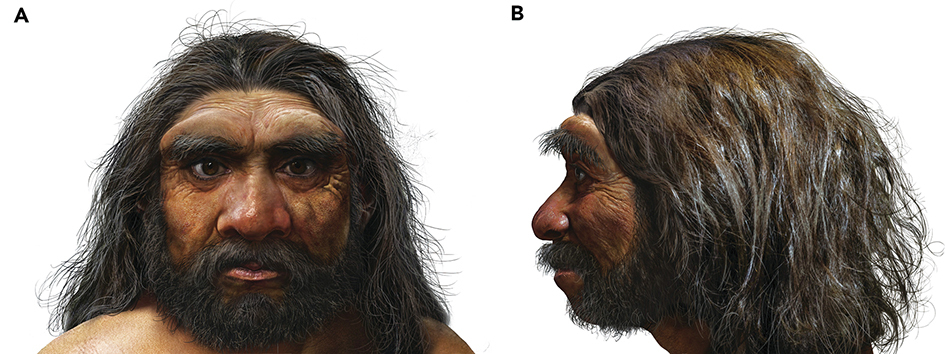
The life reconstruction of Harbin Man, which inspired the establishment of Homo longi. (Credit: IVPP)
The research published in Science also cleared some clouds hanging over the relationship of Denisovans with other clades. Previous genetic analyses of this clade were at odds with each other: Mitochondrial DNA indicated that it should be placed outside the divergence between H. sapiens and Neanderthals; whereas nuclear genome sequencing suggested that it could be a sister group to Neanderthals. Now the authors’ parsimony analysis suggested that Denisovans most likely belong to the H. longi clade.
With the new results, NI and co-authors proposed that all the three, namely Denisovans, Harbin and Yunxian people, could be assigned to the clade H. longi. The three clades diverged at a time earlier than previously estimated – earlier than what the existing fossil record indicated, but highly consistent with the prediction based on human genome data. Among the three, Yunxian Man represents an early member of the H. longi clade, probably close to the divergence time of the longi and sapiens clades. Its mosaic morphology might preserve some transitional features between the two.
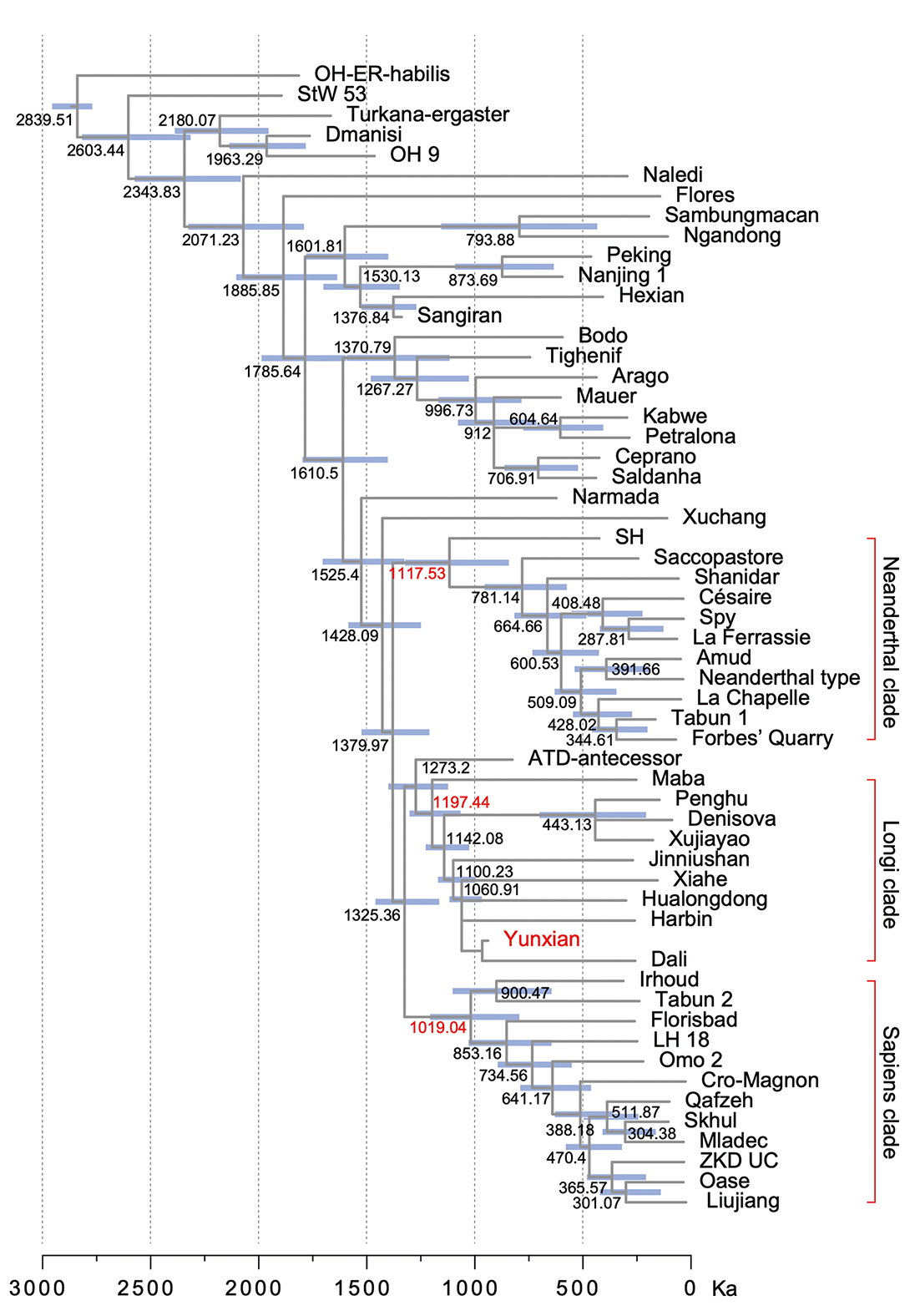
The team gives the renewed phylogeny and divergence time of 57 selected fossil human species. According to the new calculation, Yunxian Man, together with Harbin Man and Denisovans, can be grouped under the clade H. longi; and Yunxian Man represents an early member of the clade. (Credit: IVPP)
The revelation that Yunxian Man fell in H. longi clade rather than H. erectus implies that about 1.32 million years ago, the early ancestors of modern humanity might have diverged into many groups that each kept independently evolving, suggesting an evolutionary context much more complicated than thought. “Both the H. sapiens and H. longi clades might have deeply taken their roots beyond the Middle Pleistocene and probably experienced rapid early diversification,” say the authors.
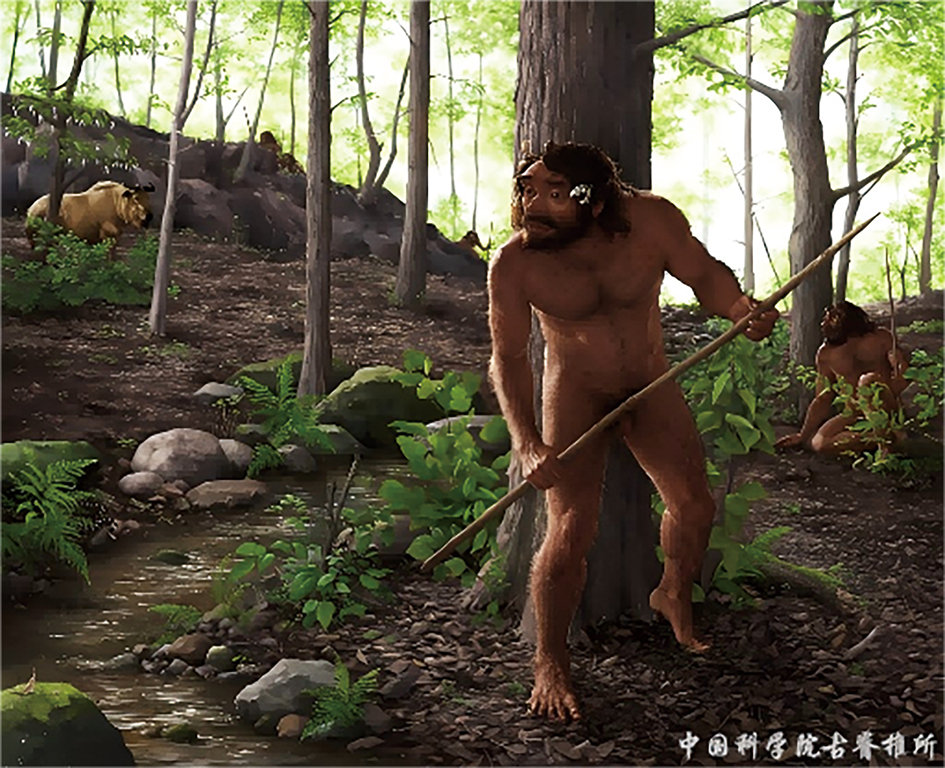
The ecological reconstruction of Yunxian Man. (Credit: IVPP)
Reference
Feng X., Yin Q., Gao F., et al. (2025). The phylogenetic position of the Yunxian cranium elucidates the origin of Homo longi and the Denisovans. Science 389, 1320–1324. https://doi.org/10.1126/science.ado9202
Ni X., Ji Q., Wu W., et al. (2021). Massive cranium from Harbin in northeastern China establishes a new Middle Pleistocene human lineage. The Innovation 2(3), 100130. https://doi.org/10.1016/j.xinn.2021.100130
A. Vialet, G. Guipert, He J., et al. (2010). Homo erectus from the Yunxian and Nankin Chinese sites: Anthropological insights using 3D virtual imaging techniques. Comptes Rendus Palevol 9, 331–339 (2010). https://doi.org/10.1016/j.crpv.2010.07.017